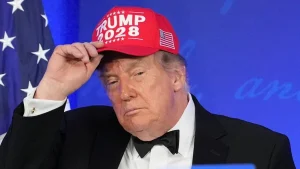
At the outset of his political career, US President Donald Trump portrayed China as a major threat to the American economy. He alleged that China was responsible for damaging US factories and weakening the middle class. That hardline stance against China was once a defining feature of his political rhetoric.
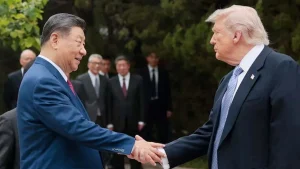
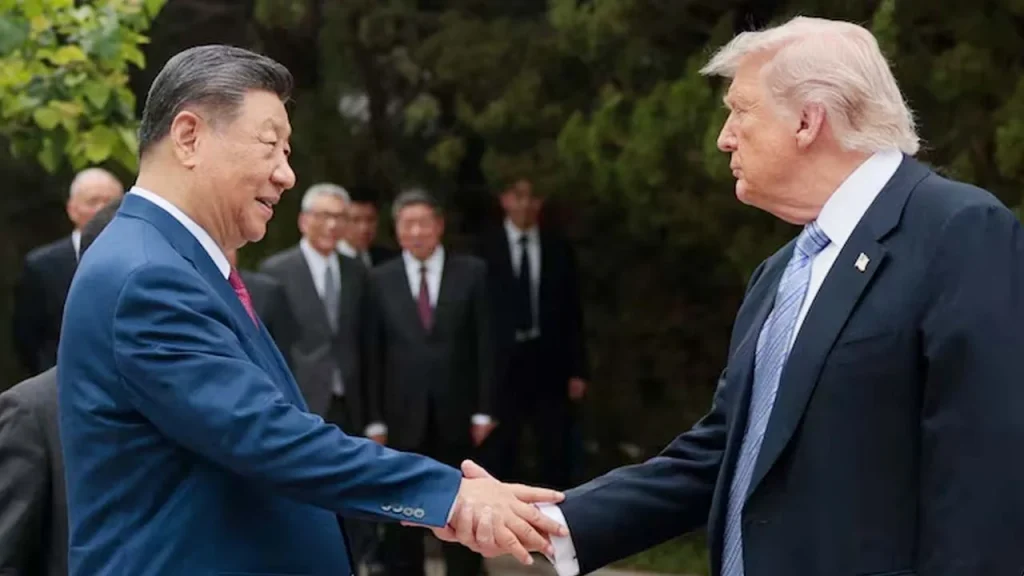
However, over time, a significant shift has occurred in Trump’s attitude toward China and its President, Xi Jinping. The leader whom he once harshly attacked as an economic rival is now someone with whom Trump speaks of having a close relationship. He has even prepared to host a state dinner for Xi Jinping this Thursday.
Earlier this month, Trump described Xi as a “terable gentleman” and noted that they share a “very good relationship.” He remarked that despite being rivals, the two nations maintain strong commercial ties.
Trump has also recently adopted a comparatively softer stance regarding various Chinese actions. Responding to reports that China provided satellite imagery to Iran, Trump expressed his belief that Xi had acted “reasonably.” Furthermore, although he previously accused China of stealing data on US voters in 2020, he has now shown reluctance to take retaliatory measures.
From Trade War to Mending Ties
This shift in Trump’s policy comes at a time when the competition for global leadership between China and the United States is intensifying. Beyond the manufacturing sector, China is advancing rapidly in fields such as artificial intelligence (AI), electric vehicles, and other modern technologies. This progress is impacting not only the US economy but also the economies of industrialized nations like Germany, Italy, France, South Korea, and Japan.
Some analysts believe that after failing to exert sufficient pressure to alter China’s behavior, Trump has now opted for a path of diplomatic hospitality.
Trump visited Beijing last May. The two leaders are likely to meet twice more this year on the sidelines of international summits. A helipad has been prepared on the White House South Lawn in anticipation of Xi’s visit. Trump even expressed frustration that the White House ballroom was not ready to welcome the Chinese President.
Yet, last year, Trump had exerted pressure on China by imposing a series of high tariffs and export controls. Ultimately, that strategy did not yield the expected results. China holds significant control over rare earth minerals crucial for electronics manufacturing. Leveraging this position during trade negotiations, Beijing pressured the Trump administration to enter into an interim trade agreement with the US.
According to Michael Kovrig, a senior advisor at the International Crisis Group, Trump shifted his strategy after the initial attempt to pressure China through high tariffs and export bans failed. In his view, the two leaders were engaged in a contest for influence, a dynamic that strengthened Xi Jinping’s position.
Strain with Allies, Opportunity for China
Analysts note that another aspect of Trump’s policies is the strain placed on traditional US economic and security alliances. Trump has taken jabs at French President Emmanuel Macron in various statements. His relationship with NATO member nations has fluctuated between closeness and tension. Trade disputes with long-standing ally Canada have also intensified.
Kovrig believes this creates an opportunity for China to implement a “divide-and-conquer” strategy. He argues that many Western leaders are now keen to stabilize relations with Beijing so they can focus on other issues arising from the Trump administration’s policies.
However, Trump can point to some symbolic successes stemming from his close relationship with Xi. During Joe Biden’s vice-presidency, he met with Xi three times on the sidelines of international summits. Under Trump, a precedent of mutual state visits between the two leaders was established, signaling a continuity of communication between the heads of the world’s two largest economies.
Chinese Production Unabated by Tariffs
According to US Census Bureau data, the US goods trade deficit with China has narrowed compared to the same period in 2025. However, Trump administration officials state that China is routing some goods through third countries, such as Vietnam, to circumvent tariffs. On the other hand, China’s manufacturing sector did not suffer a major blow from the tariffs imposed by Trump. Instead, by creating new markets, China increased its exports to other parts of the world. Last year, the country recorded a global trade surplus of approximately $1.2 trillion. Chinese companies have also exerted pressure on the automotive industries of Germany, Japan, and South Korea by offering low-priced electric vehicles.
Amidst the trade hiatus, both the United States and China are focusing on enhancing their respective capabilities. Despite having limited access to advanced computer chips, China is expanding its military and AI capabilities. Meanwhile, the Trump administration is forging partnerships with various countries to secure supplies of rare earth minerals.
The United States also aims to advance rapidly in the AI sector. Trump recently stated on social media that slowing down the pace of AI development would effectively hand an advantage to China. In his view, AI will serve as the driving force behind the greatest economic expansion in history.
However, there are allegations that Chinese AI companies are using US AI models for training purposes. If AI emerges as a key arena for projecting global influence in the future, this issue could become critical for the United States.
Nevertheless, US Attorney General Todd Blanche has stated that it would be unfair to label all of China as the “bad actor” in the realm of AI. When asked whether Trump would raise this issue during his meeting with Xi Jinping, he emphasized the personal relationship between the two leaders.
What will Xi’s visit yield?
State visits are typically associated with specific achievements or agreements regarding trade, security, or diplomacy. However, the exact outcome of Xi Jinping’s visit this Thursday remains unclear.
According to Georgetown University professor Evan Medeiros, the most significant result of this visit might well be the personal rapport between the two leaders. He believes this emphasis on personal relationships comes at a time when the US needs to adopt a more assertive stance in various areas of competition with China.
Consequently, Trump’s China policy has reached a different phase. The US President, who once prioritized harsh rhetoric and the imposition of tariffs against China, is now placing importance on a good personal relationship with Xi Jinping, dialogue, and state hospitality. However, the extent to which this altered strategy will impact the long-term economic and strategic rivalry between the two nations will depend on subsequent developments regarding trade, technology, military capabilities, and diplomatic relations.