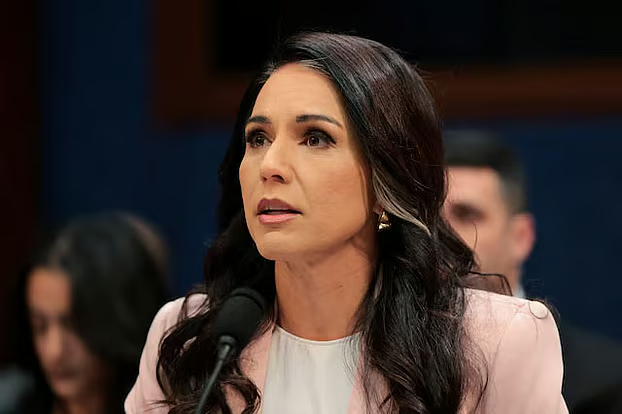
Tulsi Gabbard is stepping down from her position as the U.S. Director of National Intelligence. She remained loyal to Donald Trump to the very end, fighting to validate his grievances against his political adversaries. Last year, she leveled serious accusations against former President Barack Obama and several top security officials, claiming that the Obama administration had exaggerated the extent of Russian interference in the 2016 election. She alleged that, in doing so, they had orchestrated a “treasonous conspiracy.” In January, Tulsi Gabbard appeared on the scene during an FBI operation in Georgia, where intelligence agents were searching for ballots related to the 2020 election—despite her primary mandate being strictly limited to overseeing foreign intelligence matters.
Last Friday, Tulsi Gabbard submitted her letter of resignation to President Trump. She announced that she would officially step down on June 30. Her decision was prompted by her husband’s recent cancer diagnosis; she chose to resign in order to be by his side. However, numerous media outlets have reported that she was, in fact, forced to resign by the White House. Last month, the British newspaper The Guardian reported that Trump had privately consulted with cabinet members regarding the removal of Tulsi Gabbard from her role as the overseer of the 18 U.S. intelligence agencies.
Tulsi Gabbard was a staunch Trump loyalist; she even lent her support to various conspiracy theories espoused by Trump regarding past elections. However, she remained steadfastly opposed to U.S. military intervention abroad and to wars aimed at regime change in other nations. Ultimately, this stance proved to be her undoing. In particular, her assessments regarding Iran’s nuclear program and capabilities repeatedly drew the ire of President Trump. Last June, Israel launched a surprise attack on Iran, a conflict in which Washington subsequently intervened for a period of twelve days. During that time, several Iranian nuclear facilities were subjected to airstrikes—an episode during which Trump reportedly exerted significant pressure on Tulsi Gabbard. He wanted Tulsi Gabbard to state in her assessment that Iran was on the verge of developing a nuclear bomb.
Last January, Trump’s national security team finalized a plan to oust Venezuelan President Nicolás Maduro and abduct him to face trial in New York. However, Tulsi Gabbard was kept entirely in the dark regarding this entire scheme. It is reported that she was excluded from the planning process because of her past opposition to U.S.-backed regime-change operations abroad. At the time, Tulsi Gabbard posted photos of herself practicing yoga on Instagram. She was performing yoga on a beach in Hawaii—the place she called home before moving to Washington. In the caption accompanying the photos, she wrote: “My heart is filled with gratitude, goodwill, and peace.”
In late February, Trump launched a new war against Iran, involving both the United States and Israel. During this period, Tulsi Gabbard was largely sidelined from the highest echelons of policymaking. Given her rank and position, she should have been involved in key decision-making processes; yet, she was excluded from White House planning meetings. She was even absent from the war briefings delivered to Congress. In March, one of Tulsi Gabbard’s top aides, Joe Kent, resigned. He had served as the Director of the National Counterterrorism Center. A longtime supporter of Trump, Kent decided to step down in protest against the war with Iran.
In his resignation letter, Joe Kent wrote: “In good conscience, I cannot support the ongoing war with Iran.” This resignation letter circulated widely across social media platforms. He further stated: “Iran posed no imminent threat to our country. It is clear that we initiated this war solely due to pressure from Israel and its influential lobby within the United States.”
Kent’s resignation stunned the Trump administration. Due to her opposition to foreign intervention, Tulsi Gabbard became increasingly isolated within Trump’s inner circle. During the 2024 election campaign, Trump and his campaign team had presented her to a war-weary American public as an “envoy of peace,” promising that she would put an end to all wars. In this context, he referred to the war in Ukraine—which began during the Biden administration—and Israel’s war in Gaza. In his victory speech in November 2024, Trump stated, “I am not going to start any wars. I will stop wars.”
However, shortly after assuming office for his second term, Trump reneged on that pledge. Last year, he ordered the U.S. military to conduct bombing raids in seven countries. These nations were Yemen, Syria, Iran, Iraq, Nigeria, Somalia, and Venezuela. On February 28, he launched a joint attack with Israel against Iran. This escalated into a regional conflict. Tehran carried out retaliatory strikes against U.S. bases and other targets across the Middle East. Iran subsequently blocked the Strait of Hormuz—a vital waterway through which more than one-fifth of the world’s oil and gas is transported. Consequently, oil prices in the United States surged, and the global economy suffered a shock. On April 8, the United States and Iran agreed to a temporary ceasefire; however, negotiations regarding a permanent settlement have reached an impasse. Trump has repeatedly threatened to resume hostilities.
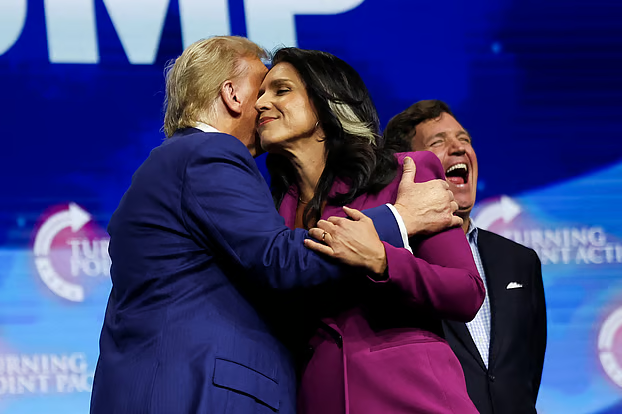
Trump styles himself as an “America First” president. He cultivated an image as an opponent of military intervention on foreign soil; yet, during his tenure, Tulsi Gabbard—one of his key advisors—became an uncomfortable reminder for Trump. This is because Trump has initiated a war that, thus far, has proven to be a failure. The Iranian government, which rose to power following the 1979 revolution, remains unseated. The cunning tactics Trump employed to launch a war against Iran are reminiscent of past U.S. conflicts—particularly the 2003 invasion of Iraq, when George W. Bush manipulated intelligence to justify the war.
Since last June, Donald Trump and other U.S. officials have repeatedly asserted that Iran is merely weeks or months away from developing a nuclear bomb. In a meeting with congressional leaders last March, Trump stated, “If we hadn’t struck within two weeks, they would have acquired nuclear weapons.”