





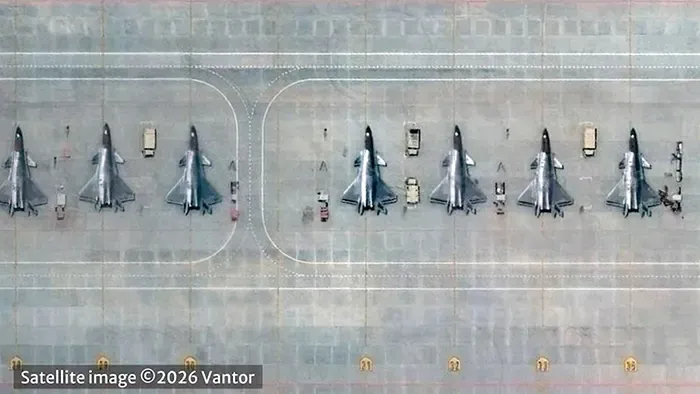
China has ramped up the deployment of its state-of-the-art J-20 ‘Mighty Dragon’ stealth fighter jets at airbases near the Indian border. Recently released commercial satellite imagery reveals that China has deployed at least 11 J-20 jets across two airbases facing India.
Reports citing satellite images provided by Planet Labs indicate that these fighter jets were deployed between late June and early July of this year.
Seven J-20s at Hotan Airbase
According to the report, seven J-20 fighter jets were spotted near the runway at the Hotan airbase in China’s Xinjiang region on July 9. This facility serves as a dual-use airbase for both civil and military operations.
The Hotan airbase is located approximately 389 kilometers from Leh, India, and just 245 kilometers from the Daulat Beg Oldi airbase in northern Ladakh.
The report claims this is the first instance where such a large number of J-20 fighter jets have been observed simultaneously at a Chinese airbase in commercial satellite imagery.
Four J-20s at a Tibet Airbase
Another satellite image shows four additional J-20 fighter jets at the Damshung airbase in Tibet. This base is situated roughly 344 kilometers northwest of Tawang in Arunachal Pradesh.
Sameer Joshi, a former fighter pilot and co-founder of the Indian defense research firm NewSpace, stated that the deployment of seven J-20s at Hotan and four at Damshung signifies that operating fifth-generation fighter jets from high-altitude bases near the Indian border has become a routine activity for China, rather than merely a show of force.
In his view, the Indian Air Force must now accept the threat of stealth fighter jets along the northern border as a standard reality. Consequently, it is crucial to rapidly enhance India’s stealth-detection sensors, integrated air defense systems, and long-range strike capabilities.
Why is the J-20 significant? A key feature of the J-20 fighter jet is its stealth technology, which minimizes its radar signature and enables it to conduct effective operations within hostile airspace.
According to reports, this technological advantage gives the J-20 a significant strategic edge over non-stealth fighters—such as the French-made Rafale currently used by the Indian Air Force.
India currently possesses no indigenous stealth fighter jets. It is estimated that the country’s first home-grown stealth fighter, the Advanced Medium Combat Aircraft (AMCA), may not join squadron service for at least another decade.
Rapidly Expanding J-20 Fleet
Citing an analysis by The War Zone, the report notes that China’s J-20 fleet has expanded rapidly in recent years. The figures are as follows: approximately 50 J-20s in 2019; around 200 by the end of 2022; a production capacity of about 120 J-20s annually by late 2025; and a total fleet estimated between 300 and 500 aircraft by mid-2026, deployed across more than a dozen PLAAF units.
The UK-based Royal United Services Institute (RUSI) projects that the number of Chinese J-20 fighter jets could reach approximately 1,000 by 2030.
‘China’s Production Capability is Remarkable’
Former Indian Air Force Air Marshal Normadeshwar Tiwari stated that the capacity to produce 125 fighter jets annually is a testament to China’s advanced manufacturing systems.
In his view, China is manufacturing fighter jets at a pace comparable to that of commercial aircraft production. This has been made possible by integrated supply chains, highly precise manufacturing processes, and a skilled workforce.
He noted that ever since the First Gulf War, China has recognized the importance of air power and has consistently invested in this sector as a national priority.
India’s Current Capabilities
The Indian Air Force currently operates 36 Rafale fighter jets, which are deployed across two squadrons. Additionally, a contract has been signed to purchase 26 Rafale jets for the Indian Navy, and discussions are underway with the French manufacturer Dassault Aviation regarding the procurement of another 114 Rafales for the Indian Air Force.
The value of this potential deal could range from $36 billion to $40 billion. The Indian Air Force’s fleet also includes over 260 Russian-made Sukhoi-30 MKI aircraft, alongside Mirage-2000 and MiG-29 fighter jets.
According to reports, the Indian Air Force did not provide a response when asked for comments on the matter.