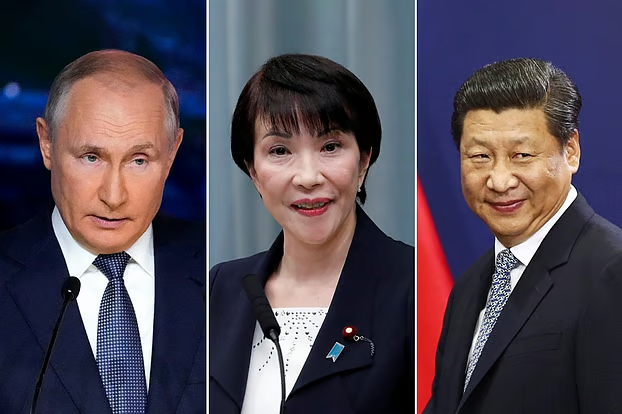
Relations between Japan and its two neighboring superpowers have been marked by bitterness for some time now. Last November, Japan’s relationship with China deteriorated following a controversial remark by Prime Minister Sanae Takaichi regarding the situation in Taiwan. Her comments were interpreted to suggest that, should Taiwan come under Chinese attack, Japan might deploy its own defense forces to support the United States.
Beijing views these remarks as a challenge to the post-World War II international order. Meanwhile, since the commencement of Moscow’s invasion of Ukraine in 2022, Japan and Russia have been observed consistently imposing reciprocal sanctions on one another. Against this backdrop, Russia also suspended negotiations for a peace treaty with Japan. However, although Japan recently began importing oil from Russia to mitigate the oil crisis triggered by the conflict in Iran, a recent joint statement from China and Russia offered a clear indication that the diplomatic thaw is far from complete.
In a joint statement issued last Wednesday following a summit in Beijing between Chinese President Xi Jinping and Russian President Vladimir Putin, the two leaders criticized Japan for “moving rapidly toward remilitarization,” characterizing this trajectory as a “serious threat” to regional peace and stability. Tokyo, however, dismissed these allegations as baseless just one day later.
Several recent initiatives by Japan’s ruling Liberal Democratic Party (LDP) have played a role in creating this climate of acrimony. For several years, the party has advocated for amending the country’s anti-war—or pacifist—constitution. The primary objective is to revise Article 9 of the Japanese Constitution, which was drafted in 1946 under the auspices of U.S. occupation forces following World War II.
This article prohibits Japan from threatening to use, or actually using, military force as a means of settling international disputes. However, approximately a decade ago, a controversial piece of legislation was enacted based on a reinterpretation of this very article. Passed during the tenure of the late Prime Minister Shinzo Abe, this law authorizes Japan to exercise the right of collective self-defense—meaning that if an ally comes under attack, Japan is permitted to provide them with military assistance.
Viewed from this perspective, current Prime Minister Sanae Takaichi appears to be largely following the path charted by Abe. He advocates for further amendments to the pacifist articles of the Constitution. The conservative faction of the LDP supports him in this endeavor. The rationale cited for this stance is the escalating security threats surrounding Japan—specifically, pointing to the military activities of North Korea and China. Furthermore, recent joint military exercises conducted by China and Russia in Japan’s vicinity have become a source of concern for Tokyo.
However, enacting any such amendment requires securing a two-thirds majority in both houses of the Japanese Parliament, as well as a simple majority in a national referendum. Consequently, Prime Minister Sanae Takaichi has called for broader public discourse on the matter to facilitate the swift adoption of these amendments. Although she asserts that public opinion favors the government’s position, ordinary citizens are becoming increasingly vocal in their opposition to these legislative changes. Earlier this month, on Constitution Day, approximately 50,000 people gathered in Tokyo to protest against the proposed constitutional amendments. Despite this, the government shows no signs of backing down.
Meanwhile, Japan is also shifting its focus toward the export of military hardware. To this end, it is forging closer military cooperation with various allied nations. The establishment of Official Security Assistance (OSA) programs with Southeast Asian nations—including Bangladesh—serves as a clear indication of Japan’s expanding military engagement.
Japan’s Ministry of Defense recently announced that, in response to a request from the Philippines, it is currently reviewing the potential export of Type 88 surface-to-ship missiles to that country. Philippine President Ferdinand Marcos Jr. told Japanese media that bilateral relations have entered a new phase, and he welcomed Japan’s decision to grant policy approval for the export of lethal weaponry.
Furthermore, Australia has signed an agreement with Japan to jointly construct the latter’s Mogami-class frigates. Additionally, New Zealand is reportedly considering purchasing the latest variant of these frigates from Japan.
Concurrently, Japan aims to raise its national defense spending to 2 percent of its Gross Domestic Product (GDP) by the 2027 fiscal year. Until now, this figure had hovered at approximately 1 percent.
It is against this backdrop that Russian President Vladimir Putin visited China last week. In a joint statement, the two leaders of China and Russia further stated that they remain vigilant regarding the “extreme provocations” of right-wing forces in Japan. With Putin by his side, Xi Jinping asserted that China and Russia must continue to oppose “all provocative acts that deny the fruits of the victory in World War II, and that seek to justify and revive fascism and militarism.”
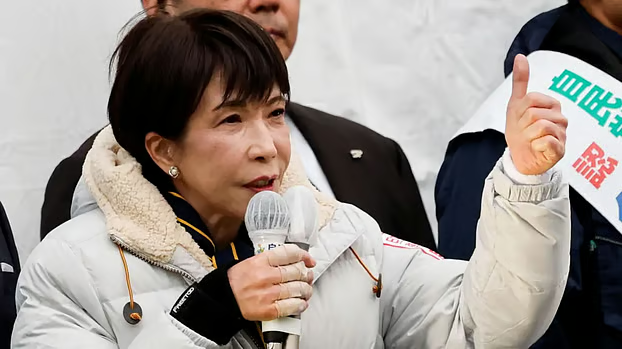
Ozaki also asserted that Japan’s “exclusively self-defense-oriented” policy remains unchanged. He stated that, since the end of the Second World War, Japan has consistently upheld the values of freedom, democracy, and the rule of law, contributing not only to Asian prosperity but also to global prosperity.
Amidst growing domestic discontent regarding militarization, it now remains to be seen in which direction this recent exchange of rhetoric with China and Russia—centering on this very issue—steers Japan’s relations with its two major neighbors.