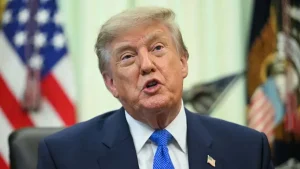
On Monday, President Donald Trump announced that he would initiate measures to suspend the federal gasoline tax in an effort to alleviate the financial burden placed on Americans due to the abnormal surge in fuel prices caused by the war with Iran.
However, the President cannot suspend this federal tax unilaterally or solely through his own executive authority; implementing this measure requires congressional approval.
Lawmakers from both parties have taken a strong stance in favor of suspending the gas tax. According to them, this measure would provide much-needed relief to families and businesses that rely on cars and trucks for commuting to work, school, or for other daily necessities.
According to data from the AAA motor club, the national average price for gasoline stood at $4.52 per gallon as of Monday. Before Trump initiated the conflict with Iran, the average price of gas was just under $3 per gallon; the current price represents a 50 percent increase compared to that figure.
Where is the Gas Tax Revenue Spent?
Currently, a federal excise tax of 18.4 cents is levied on every gallon of gasoline, and 24.4 cents on every gallon of diesel. This figure, however, does not include individual state taxes—amounts which, in many cases, exceed the federal tax rate. The revenue generated from these taxes amounts to over $23 billion annually, which is allocated toward the improvement of federal highways and public transportation systems.
Responding to questions from reporters at the White House, Trump was asked how long the tax suspension should remain in effect. He replied, “It will remain suspended until the situation returns to normal or becomes appropriate.” Trump further noted that while the tax constitutes a very negligible or minor fraction of the total price of gas, “it is still money, after all.”
As gas prices have skyrocketed, the Trump administration has released millions of barrels of oil into the market from the United States’ “Strategic Petroleum Reserve.” Additionally, they have temporarily lifted sanctions on certain shipments of Russian and Iranian oil currently floating at sea. The United States is currently engaged in discussions with various nations dependent on Middle Eastern crude oil, seeking to have them join a coalition tasked with patrolling the Strait of Hormuz. Notably, approximately one-fifth of the world’s total oil trade typically flows through this very strait.
Trump Needs Congressional Support—and Congress Is Now Stirring into Action
In a social media post on Monday, Republican Senator Josh Hawley of Missouri announced that he intends to introduce a bill proposing the suspension of the federal gas tax. Prior to this, members of the Democratic Party had also put forward similar legislative proposals.
Florida Republican Representative Anna Paulina Luna likewise stated in a post on the ‘X’ platform that, “in light of Trump’s recent comments,” she would introduce a bill aimed at suspending the federal gas tax. The ongoing surge in gas prices has sparked concern among some Republican leaders; they fear that this trend could jeopardize the party’s prospects for victory in the upcoming midterm elections. Trump had previously argued that bearing the burden of higher fuel prices was a justifiable cost to ensure that Iran does not acquire nuclear weapons.
However, on Sunday, that hardline stance of the Trump administration appeared to soften somewhat. In an interview on NBC’s Meet the Press, Energy Secretary Chris Wright indicated that the Trump administration is “open to all proposals”—a stance that includes the temporary suspension of the gas tax.
Democratic Senator Richard Blumenthal of Connecticut and Senator Mark Kelly of Arizona have introduced a bill that would suspend the federal gas tax until October 1st. In the House of Representatives, Democratic Representative Chris Pappas of New Hampshire has submitted a similar proposal. While introducing the bill, Blumenthal stated, “This war that Trump has imposed on Iran is driving up gas prices across the country—and American citizens should not have to bear the additional economic burden resulting from this rash decision by Trump.”
To provide the public with some relief from high fuel prices amidst wartime conditions, several states—including Indiana and Georgia—have recently suspended their respective gas taxes. Additionally, the states of Kentucky and Utah have reduced their gas tax rates. Other states are also currently considering similar suspensions or reductions of their taxes.
According to industry experts, however, there are some downsides to this approach.
Gasoline or fuel taxes constitute the single largest source of revenue for funding various federal highway and public transportation projects.
According to the American Road & Transportation Builders Association—an organization representing the transportation construction industry—while the proposed bills include provisions to replenish any revenue shortfalls in the Highway Trust Fund using the general fund, suspending the gas tax carries the risk of exacerbating the federal budget deficit and jeopardizing the sustainability of long-term investments in the highway and public transportation sectors.
Citing various studies, the organization noted that many retailers do not pass on the full amount of the savings resulting from gas tax reductions to consumers. The studies further indicated…