



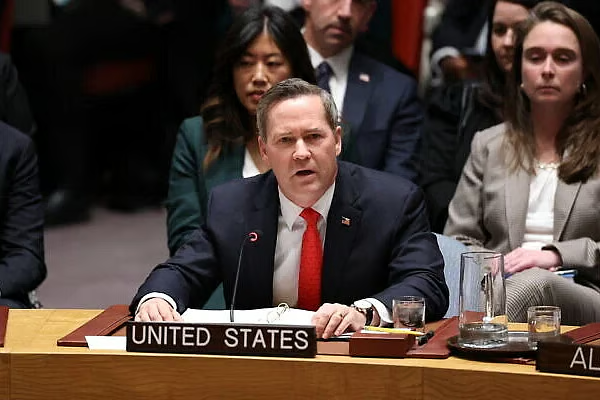
US President Donald Trump has refrained from attacking Iran for two consecutive nights. US Ambassador to the UN Mike Waltz stated that Trump wishes to allow more time for diplomatic discussions; this is why he has temporarily paused strikes on Iran.
Speaking to Fox News on Sunday, Mike Waltz said that President Trump is providing some time and opportunity for negotiations.
Iran has responded to the US decision to halt attacks. A military spokesperson for the country stated yesterday that Tehran has paused “retaliatory” strikes in the region.
Iran and the US had agreed to a ceasefire last June. However, the US subsequently launched daily attacks on Iran for nearly two weeks, and Iran retaliated in kind, effectively causing the ceasefire to collapse. Yet, the two-night pause in attacks has resulted in a temporary lull in the conflict.
So, has Trump decided not to escalate the conflict further for the time being? Responding to this question on NBC, Mike Waltz said he would not say that; President Trump is keeping all options open.
A report by *The New York Times* indicated that Trump administration officials have warned that if the conflict expands, the US could rapidly deplete its limited stockpiles of air-defense missiles and other munitions.
Mike Waltz dismissed this report, stating that the US military possesses everything necessary to conduct this operation effectively.
As of Sunday evening, Trump had made no public comments regarding the latest situation in the conflict. However, he had previously posted computer-generated images on his Truth Social account showing US military aircraft dropping bombs on Iranian ships and Kharg Island.
Meanwhile, Iranian Foreign Ministry spokesperson Esmaeil Baghaei announced that Oman and Iran held several rounds of technical meetings in Tehran last Friday and Saturday regarding the management of the Strait of Hormuz.
Disputes over control of the Strait of Hormuz had reignited tensions between the US and Iran earlier this month. This dispute remains a major obstacle to permanently ending the conflict.
Iran and the US signed a memorandum of understanding last June. It called for halting military operations, reopening the Strait of Hormuz, and reaching a final agreement to end the war within the next 60 days.
However, on July 13, Iranian forces attacked oil tankers in the Strait of Hormuz. Subsequently, the United States resumed attacks on Iran and reimposed a naval blockade on Iranian ports.
In retaliation, Iran launched attacks on various US military installations and bases across the Middle East. Four US soldiers were killed in these attacks. According to Iran’s Ministry of Health, a number of people in the country were killed in US attacks.