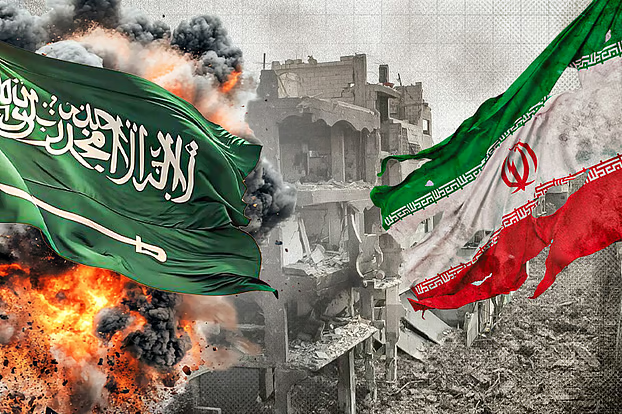
Saudi Arabia has proposed a non-aggression pact involving Middle Eastern nations and Iran. This initiative is modeled after a 1970s-era agreement designed to de-escalate tensions in Europe during the Cold War. This information was revealed in a report published yesterday, Thursday, by the British newspaper The Financial Times.
This Saudi initiative has garnered support from various European nations and institutions within the European Union (EU). However, it remains unclear whether the United States and Israel will endorse this proposal.
Saudi Arabia is primarily drafting this new agreement using the historic Helsinki Accords of 1975 as a model. That agreement—signed by the then-Soviet Union, the United States, and European nations—recognized the post-World War II borders of Europe. Simultaneously, all parties agreed to uphold human rights and foster mutual cooperation in economic, scientific, and humanitarian spheres.
An Arab diplomat told The Financial Times that such an agreement for the Middle East would be welcomed by “most Arab and Muslim countries, as well as Iran.” However, Iran has previously called upon Gulf nations to dismantle the U.S. military bases located within their territories.
Experts believe that Israel would strongly oppose any formal agreement capable of reducing tensions between Arab nations and Iran. Furthermore, it remains unclear how sensitive issues—such as the strategically vital Strait of Hormuz—would be addressed within the framework of this agreement.
Tehran seeks to maintain its authority over this waterway and has even implemented its own toll system for maritime traffic passing through it.
A Divided Gulf Region, Stalled Peace Talks
Prior to the outbreak of hostilities, Saudi Arabia and other Gulf nations had urged the United States not to launch an attack on Iran. They feared that even if Iran were to suffer damage as a result of war, the country’s Islamic regime would ultimately emerge even stronger.
A recent report by the U.S. intelligence agency, the CIA, also reflected this apprehension. The report stated that, even following the conflict, Iran’s stockpile of long-range missiles remains largely intact, and there are no signs indicating the imminent collapse of the country’s government. The Gulf nations have become divided in their approach to handling the prevailing war situation. Despite their efforts to avert conflict, these countries have been subjected to attacks involving thousands of drones and missiles launched from Iran. Conversely, the Trump administration has been pressuring these nations to join a war against Iran.
According to a Reuters report, Saudi Arabia carried out airstrikes against Iran last March.
The United Arab Emirates has also launched attacks against Iran; however, Abu Dhabi’s stance is significantly more aggressive than that of Saudi Arabia. For instance, while Saudi Arabia is attempting to mediate through its close ally, Pakistan, the UAE is opposing this initiative.
The talks between the United States and Iran—facilitated by Pakistan—have currently reached a stalemate.
Saudi Arabia and the United Arab Emirates have also adopted divergent positions regarding the issue of Israel. While figures close to the Saudi royal family have been sharply critical of Israel, the United Arab Emirates has moved closer to the Jewish state.
Mike Huckabee, the U.S. Ambassador to Israel, stated that Israel deployed its “Iron Dome” missile defense system to the United Arab Emirates during the conflict. Furthermore, the office of Israeli Prime Minister Benjamin Netanyahu announced that he had secretly visited the United Arab Emirates—though Abu Dhabi has denied reports of this visit.