Iran’s Islamic Revolutionary Guard Corps (IRGC) has issued a warning, stating that if Iranian oil tankers are attacked, retaliatory strikes will be launched targeting US installations across the Middle East.
This information was reported yesterday, Saturday, citing Iranian media sources. The warning comes just one day after the United States carried out attacks on two Iranian tankers in the Gulf of Oman.
In a statement, the IRGC declared: “In response to any attack on Iran’s tankers and commercial vessels, forceful strikes will be launched against US bases located in this region, as well as against enemy vessels.”
Meanwhile, US President Donald Trump stated last Friday that he expects to receive a response from Iran regarding Washington’s latest peace proposal “possibly by tonight.”
However, even if Tehran has indeed conveyed a response through Pakistani intermediaries, no public indication of it had emerged as of yesterday. On the contrary, the Iranian news agency ISNA reported that Iran’s Deputy Foreign Minister, Abbas Araqchi, has raised questions regarding the reliability of the US leadership.
In a telephone conversation with Turkey’s Foreign Minister, Araqchi remarked: “The recent escalation of tensions by US forces in the Persian Gulf, coupled with ceasefire violations, has heightened doubts regarding the US’s intentions and sincerity toward finding a diplomatic solution.”
On Friday, a US warplane attacked two Iranian-flagged tankers in the Gulf of Oman, disabling them. Washington alleged that the two vessels had defied an Iranian “port blockade.”
An Iranian military official told local media that, in response to this incident, the Iranian Navy had also launched a retaliatory strike.
The previous night had witnessed another flare-up of tensions in the Strait of Hormuz. Tehran seeks to exert economic pressure by establishing control over this vital waterway, which is crucial for international trade.
The United States maintains that allowing control over one of the world’s most critical oil shipping routes to fall into Iranian hands is unacceptable.
Washington has conveyed a proposal to Iran—via Pakistani intermediaries—to extend the existing ceasefire. Through this initiative, the US aims to pave the way for negotiations toward a permanent resolution to the conflict that began 10 weeks ago with attacks on Iran by the United States and Israel. Margot Haddad, a journalist for the French television channel LCI, stated yesterday that in a brief interview, Trump told her he expects to receive Iran’s response very soon.
On Friday, a spokesperson for Iran’s Foreign Ministry said that the U.S. proposal is still under “review.”
Oil Spill Detected
Meanwhile, U.S. Secretary of State Marco Rubio met yesterday with Qatar’s Prime Minister, Sheikh Mohammed bin Abdulrahman Al Thani. The U.S. State Department reported that the meeting focused on security and stability in the Middle East.
The previous day, the Qatari leader met with U.S. Vice President J.D. Vance. During that meeting, the subject of a lasting peace initiative—mediated by Pakistan—was discussed. Amidst the ongoing conflict, Iran has also launched attacks targeting U.S. bases located in Qatar.
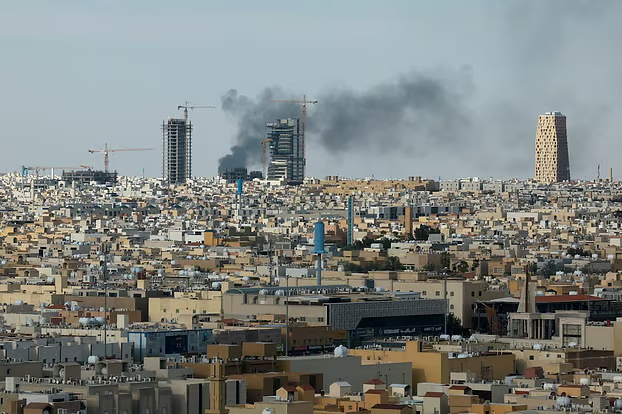
Separately, satellite imagery has revealed an oil spill off the coast of Kharg Island, a critical hub for Iran’s oil exports. Orbital EOS, a global monitoring firm, reported that a slick covering an area of approximately 52 square kilometers was observed spreading off the island’s western coast.
However, the exact cause of the incident remains unconfirmed. The UK-based organization, the Conflict and Environment Observatory, noted that by yesterday, the oil slick had significantly diminished and suggested that the spill likely resulted from a leak in oil infrastructure.
Kharg Island serves as the epicenter of Iran’s oil export operations and is of vital importance to the country’s beleaguered economy.
Following the outbreak of hostilities on February 28, Iran effectively closed off the Strait of Hormuz. This triggered instability in global markets and drove up oil prices.
In response, the United States subsequently imposed sanctions on Iranian ports. Furthermore, earlier this week, Trump halted “Project Freedom”—a short-term U.S. naval operation launched to reopen the Strait of Hormuz for commercial shipping traffic.
Tensions on the Lebanon Border
Meanwhile, the ceasefire along the Lebanon border is also under strain. Exchanges of fire between Israel and the Iran-backed Hezbollah are occurring on a daily basis.
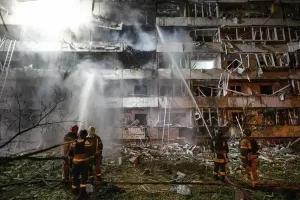
Authorities reported yesterday that at least nine people were killed in an Israeli attack in southern Lebanon. Lebanese state media reported that an airstrike was carried out on a highway south of Beirut—an area situated outside Hezbollah’s traditional strongholds.
This is being described as one of the most intense attacks since a ceasefire went into effect three weeks ago.
Hezbollah stated that, in response to the ongoing attacks, they launched drone strikes targeting soldiers in northern Israel on at least two separate occasions.
The Israeli military reported that several drones laden with explosives entered its territory, leaving one soldier seriously injured and two others moderately wounded.
Amidst these tensions, direct talks between Lebanon and Israel are scheduled to take place in Washington next week. The two nations have effectively been in a state of war since 1948; however, Hezbollah is strongly opposing these negotiations.