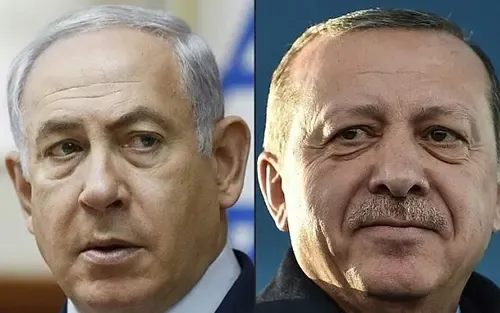
Israeli Prime Minister Benjamin Netanyahu intends to bring Turkish President Recep Tayyip Erdogan before a court of law. To this end, Netanyahu is preparing a case against him at the International Criminal Court (ICC). He aims to use this legal action as a tool to exert pressure amidst the escalating dispute between the two nations.
Online outlet RT reported this, citing i24NEWS. Previously, last month, Turkey announced that it had requested Interpol to issue a ‘Red Notice’ for Netanyahu’s arrest. This move followed a Turkish court issuing an arrest warrant for Netanyahu—citing charges including genocide—in connection with Israel’s interception of the Gaza-bound ‘Global Sumud’ flotilla earlier this year.
In response, Netanyahu launched a scathing verbal attack against the Turkish president. He labeled Erdogan an “antisemitic dictator” and accused him of committing genocide against the Kurds and harboring Hamas members. Netanyahu reiterated these allegations during his address to the UN General Assembly last week. He described Turkey as the “latest super-spreader of antisemitic lies.”
However, Turkey’s Communications Director, Fahrettin Altun, dismissed Netanyahu’s remarks as baseless allegations. Reports indicate that Netanyahu has instructed an Israeli inter-ministerial team and the head of the country’s international law division to prepare a dossier. This document will primarily focus on allegations of attacks against the Kurdish minority and claims that the Erdogan government provides funding to Hamas. The Hague-based International Criminal Court (ICC) was established under the Rome Statute. Since the statute came into force in 2002, the court has adjudicated cases involving genocide, war crimes, and crimes against humanity.
An i24NEWS report suggests that Israel is more likely to pursue this case through a third country, although filing it directly remains a possibility. Citing sources, the outlet reported that the aim is to use the existence of the case as leverage to exert pressure on Erdogan—essentially employing it as a preventive measure.
In November 2024, the ICC issued an arrest warrant for Netanyahu. He faces charges of using starvation as a weapon of war, intentionally targeting civilians in Gaza, and committing crimes against humanity. Neither Israel nor Turkey is a party to the Rome Statute. The United States—a close ally of Israel and an outspoken critic of the ICC’s arrest warrant for Netanyahu—is also not a party to the Rome Statute.
Washington has imposed sanctions on ICC President Tomoko Akane and senior trial lawyer Abdoulaye Seye. The US took this action alleging that the court was overstepping its jurisdiction. However, the ICC has strongly protested this decision, stating that the move constitutes a clear attack on the independence of an impartial judicial institution. No mechanism exists for the court to enforce the arrest warrants itself. The ICC lacks this power; to carry out an arrest, the court must rely on the cooperation of various countries.
An opinion poll conducted by The Economist/YouGov in July revealed that 49 percent of US citizens believe Netanyahu should be arrested if he enters the United States.