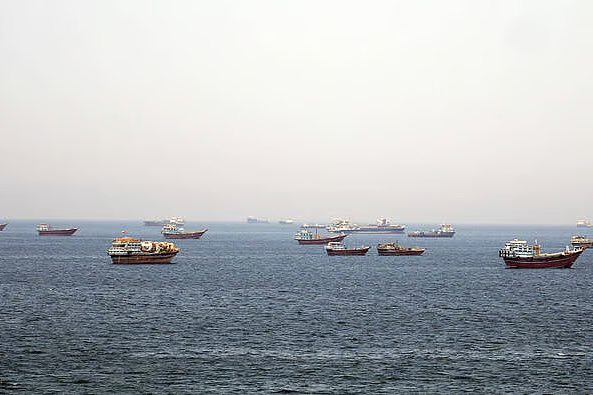
Ships stranded in the Strait of Hormuz, near Oman's Musandam, are visible. May 8, 2026. Photo: Reuters.
Both Iraq and Pakistan have signed agreements with Iran to ensure the supply of oil and liquefied natural gas (LNG) from the Gulf region through the Strait of Hormuz. Five sources familiar with the matter provided this information to Reuters. News of these agreements has emerged amidst Tehran’s exercise of control over the movement of fuel-carrying vessels through the Strait of Hormuz.
Claudio Stuer, a researcher at the Oxford Institute for Energy Studies, stated that due to the conflict involving the United States and Israel in Iran, fuel exports have plummeted from a region that typically supplies 20 percent of the world’s total crude oil and LNG. In recent weeks, the United States has maintained a blockade on Iranian ports. Although Iran initially sought to halt shipping traffic through the Strait of Hormuz, it is now shifting that stance.
Stuer further added, “Iran has stepped back from its position of closing the Strait of Hormuz and is now controlling access to it. Hormuz is no longer a neutral waterway; it is now a controlled corridor.”
Typically, the majority of Iraq’s crude oil exports pass through the Strait of Hormuz. Iraq is one of the countries most severely affected by the effective closure of the strait. Meanwhile, Pakistan—which has also been attempting to mediate a resolution to the conflict—remains heavily dependent on fuel imports from the Gulf region. Consequently, fuel prices within the country have surged due to the disruption in supply.
Under the terms of a previously undisclosed agreement between Baghdad and Tehran, two massive Iraqi oil tankers successfully transited the Strait of Hormuz last Sunday. Each vessel was carrying approximately two million barrels of crude oil.
An official from Iraq’s Ministry of Oil, who is privy to the preliminary agreement and ongoing negotiations, told Reuters that his country is currently seeking Iran’s consent to facilitate the passage of additional vessels. This is critical because 95 percent of Iraq’s national budget relies on revenue generated from oil exports.
The official further noted, “Iraq is a close ally of Iran.” “Therefore, if Iraq’s economy falters, Iran’s economic interests within the country will also suffer.”
Another official from Iraq’s Ministry of Oil and a source within the shipping sector also confirmed the existence of these discussions with Tehran. However, as they were not authorized to speak on the matter, all sources requested anonymity.
Reuters reached out to a spokesperson for the Iraqi government for comment on this issue; however, there was no immediate response.
Qatari LNG for Pakistan
Two industry sources told Reuters that, following a separate bilateral agreement between Islamabad and Tehran, two tankers carrying Qatari LNG are currently en route to Pakistan. However, as they were not authorized to speak to the media, these two sources also requested anonymity.
Prior to the outbreak of the conflict, Pakistan typically received approximately 10 LNG cargoes per month. Now, with the onset of the summer season, the country’s demand for fuel has surged in order to meet the increased need for electricity.
The sources stated that neither Iraq nor Pakistan paid any direct fees to Iran—or to Iran’s Revolutionary Guards (IRGC)—in exchange for permission for these vessels to navigate the route.
The sources further noted that Qatar was not directly involved in these bilateral agreements; however, they did inform the United States of the matter before dispatching the fuel to Pakistan.
Reuters contacted Pakistan’s Ministry of Petroleum and Ministry of Information for a statement regarding this issue; however, they did not provide an immediate response. Similarly, Qatar’s Ministry of Foreign Affairs also declined to comment on the matter.