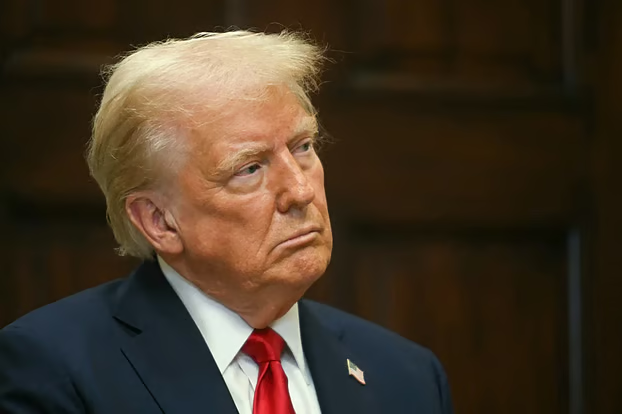
US President Donald Trump has reacted angrily to the crash of a US military helicopter in the Strait of Hormuz, a waterway of strategic importance. He alleged that Iran shot down the helicopter while it was on patrol and warned that the US would retaliate for this attack.
Trump issued this warning in a social media post on Tuesday night. Earlier, he had indicated that the US was in the final stages of reaching an agreement with Iran regarding its nuclear program. He made that remark after the exchange of retaliatory attacks between Iran and Israel had ceased; those hostilities took place between Sunday night and Monday morning. Both sides agreed to halt attacks following Trump’s intervention.
In a post on his own social media platform, Truth Social, Trump stated, “Our military has informed me that the Iranians shot down one of our highly advanced Apache helicopters while it was patrolling the Strait of Hormuz. There were two pilots on board, and they are safe and unharmed.” The US President added, “Regardless of the circumstances, it is now imperative for the US to take necessary action in response to this attack.”
Prior to Trump’s post, international media outlets—citing the US military—had reported that a US Army Apache helicopter crashed off the coast of Oman. US forces successfully rescued both pilots.
Meanwhile, Israeli military chief Eyal Zamir adopted a firm stance, stating that Israel is prepared to launch another powerful attack on Iran if ordered to do so.
Earlier on Tuesday, before reacting to the helicopter crash, Trump had said, “We are in the final stages of an excellent deal. This agreement will in no way allow Iran to develop nuclear weapons.” Noting that the Strait of Hormuz would be reopened within two or three days of the deal’s signing, he added that a “final victory” over Iran could be declared within the next two weeks.
The US and Israel launched attacks on Iran on February 28. Following this, Iran blocked the Strait of Hormuz, a vital route for global energy supplies; this waterway facilitates the transport of approximately 20 percent of the world’s total energy.
Iran’s Ambassador to the United Nations, Amir Saeid Iravani, stated that the United States and Iran are exchanging messages regarding the final draft of the agreement via Pakistan. Meanwhile, Iranian Foreign Ministry spokesman Esmaeil Baghaei directly blamed Washington for the escalating tensions. He noted that the United States is a key party to the ceasefire negotiations, and therefore, it bears responsibility for any violation of the ceasefire.