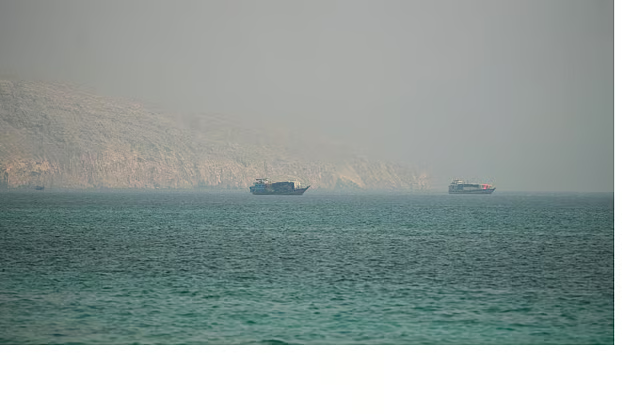
Iran announced the closure of the Strait of Hormuz today, Sunday. The country claims a vessel was navigating via an unauthorized route and was stopped following an attack. Tehran has warned of a “harsh response” should any retaliatory measures be taken in connection with this incident.
In a statement, the Navy of Iran’s Islamic Revolutionary Guard Corps (IRGC) said that a vessel had compromised maritime security by switching off its location-tracking system; it was subsequently stopped after being attacked. However, they did not provide detailed information about the vessel.
The statement further noted that several vessels attempted to traverse the Strait of Hormuz via “unauthorized routes” and ignored warnings to alter their course.
According to the IRGC, the Strait of Hormuz will remain closed “until further notice” and “until US interference in the region ceases.”
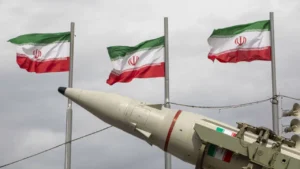
The IRGC Navy added that any aggression against Iran would be met with a “harsh response” and that new enemy bases in the region would also be targeted.
Meanwhile, senior US officials told reporters last Friday that the US wants Iran to publicly announce an end to attacks on ships in the Strait of Hormuz and to keep all shipping lanes in the strait open for navigation without tolls.
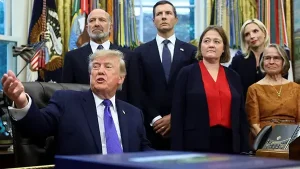
US President Donald Trump stated on Friday that, despite escalating tensions this week, the US and Iran had agreed to continue talks. At the same time, he announced an end to the ceasefire.
A senior Iranian source told the news agency Reuters that Iran, the US, Qatar, and Pakistan had agreed in principle to hold talks. Mediators were attempting to arrange a conference call regarding this matter yesterday, Saturday, while Iranian Foreign Minister Abbas Araghchi was in Oman.
However, it was not immediately known whether that effort ultimately succeeded.
In a statement, Iran’s Foreign Ministry announced that Araghchi had met with Omani Foreign Minister Sayyid Badr Albusaidi in Oman. There, they exchanged views on “appropriate measures” to ensure the safe passage of ships through the Strait of Hormuz.
Later, Oman’s state news agency announced that representatives from Oman and Iran would continue discussions—at both technical and political levels—regarding issues related to the Strait of Hormuz.
Conflict spread across the Gulf region after the United States and Israel launched joint airstrikes on Iran on February 28. This caused global energy prices to rise. Oman, along with several other nations, is playing a mediating role to bring the conflict to an end.
Before the conflict began, approximately one-fifth of the world’s total oil supply was transported through the Strait of Hormuz. However, Iran’s blockade of this waterway has driven up fuel prices, further intensifying inflationary pressures worldwide.
US media outlet CNN reported yesterday (July 11) that Oman has put forward a draft proposal regarding the Strait of Hormuz. The proposal advocates for free navigation through the southern corridor of Omani waters, while requiring ships passing through the northern corridor—within Iranian waters—to obtain prior approval from Iran; however, no toll would be charged for this passage.
The White House and the US State Department did not immediately comment on the CNN report.