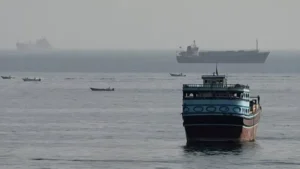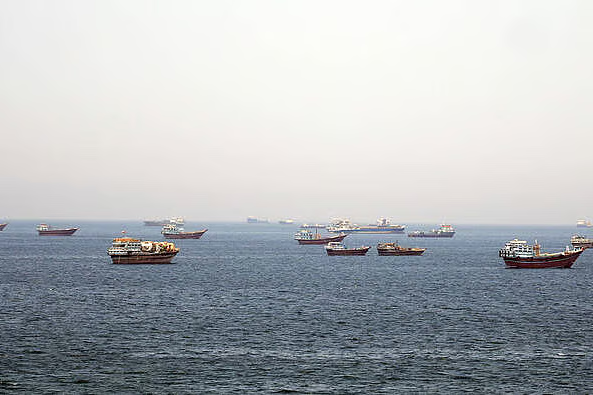
Ships stranded in the Strait of Hormuz, near Oman's Musandam, are visible. May 8, 2026. Photo: Reuters.
The United States has claimed that senior officials from the US and China have reached an agreement regarding the need to prevent any country from imposing tolls on shipping traffic through the Strait of Hormuz. The US State Department made this assertion to Reuters yesterday, Tuesday.
This suggests that the two nations are attempting to identify some common ground in their efforts to pressure Iran into relinquishing its control over this vital waterway.
The US State Department’s claim comes at a time when a meeting between US President Donald Trump and Chinese President Xi Jinping is imminent. This summit between the two leaders is scheduled to take place in Beijing later this week.
It has been reported that the issue of Iran’s tight control over the Strait of Hormuz will also feature on the meeting’s agenda.
On February 28, the United States and Israel jointly launched attacks against Iran. Iran responded in kind by firing missiles and drones targeting US bases located in the Gulf region, as well as targets within Israel.
Immediately following the outbreak of hostilities, Tehran effectively shut down the Strait of Hormuz—a critical maritime route for commercial shipping. Prior to the conflict, this waterway facilitated the transport of one-fifth of the world’s oil and gas supplies. The disruption of normal shipping traffic through the strait dealt a severe blow to the global energy market.
The US State Department stated that Chinese Foreign Minister Wang Yi and US Secretary of State Marco Rubio discussed this matter during a telephone conversation last month (April).
When asked by the news agency Reuters about the details of that phone call, State Department spokesperson Tommy Pigott remarked, “They agreed on the necessity of preventing any country or organization from imposing tolls on transit through international waterways such as the Strait of Hormuz.”
Typically, the US State Department issues formal statements to publicize such diplomatic phone calls. However, in this instance, they departed from standard protocol and did not release a formal statement regarding this particular conversation.
The Chinese Embassy did not dispute the US account of the phone call; instead, they expressed hope that all parties would work together to facilitate the resumption of normal shipping traffic through the strait. Prior to the war, this strait served as a transit route for approximately one-fifth of the world’s total oil and gas supplies.
Liu Pengyu, a spokesperson for the Chinese Embassy in the United States, told Reuters, “Maintaining the safety and stability of this region, and ensuring unimpeded passage, aligns with the shared interests of the international community.”
As a precondition for ending the war, Tehran has asserted the right to levy tolls on shipping traffic passing through the Strait of Hormuz. Conversely, the United States has imposed a naval blockade on Iran. Concurrently, Trump had raised the possibility of either imposing U.S. fees on vessels transiting the strait or collaborating with Iran to collect tolls.
Following both domestic and international pressure regarding this matter, the White House stated that Trump wishes for the Strait of Hormuz to remain open for normal transit, free from any obstructions.
To date, Chinese officials have refrained from commenting directly on the issue of Iranian tolls, although they have criticized the U.S. naval blockade.