




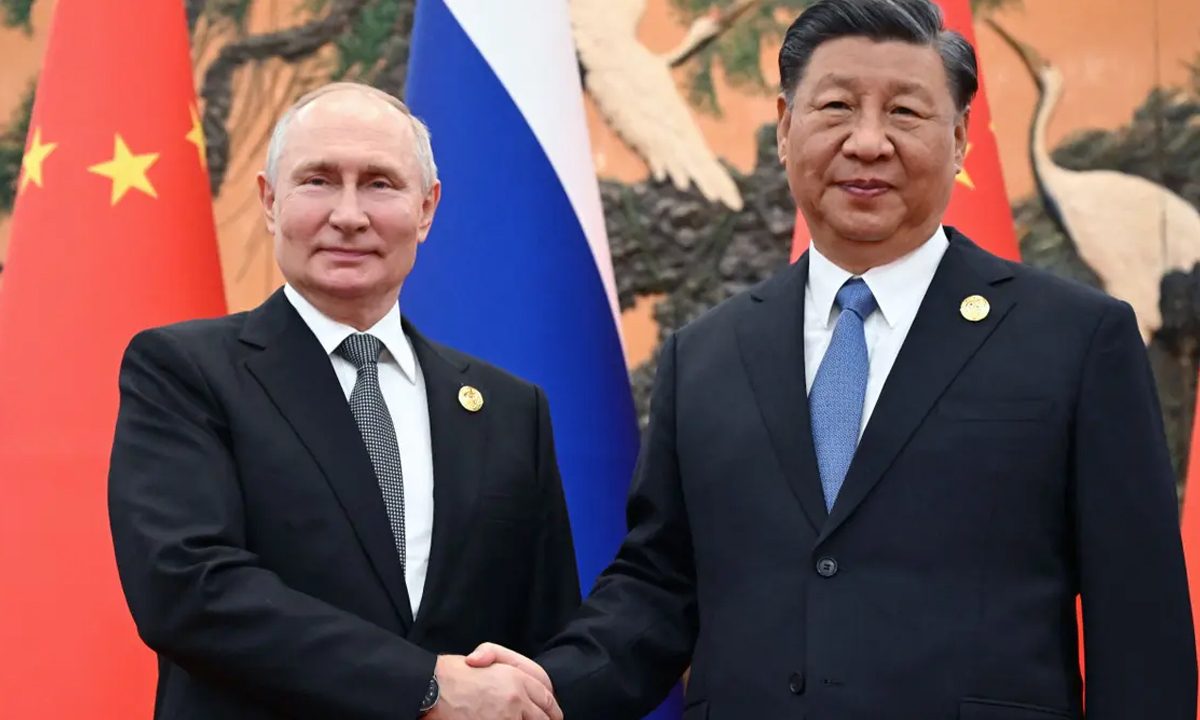
There is no formal military alliance between China and Russia; nor have the two nations entered into a mutual defense pact akin to NATO. However, through military training, joint naval and air exercises, the exchange of defense technology, intelligence cooperation, and economic coordination to counter Western sanctions, their relationship has reached a stage that analysts effectively describe as an “undeclared” or “shadow” military alliance.
Countries such as Iran and North Korea have also become involved in this cooperation. Consequently, the deepening ties between China and Russia are no longer viewed merely as a bilateral relationship, but rather as part of a broader alignment of authoritarian powers aimed at countering the influence of the United States and its allies.
A report by the U.S.-China Economic and Security Review Commission (USCC)—a body established by the U.S. Congress—highlights the military, economic, and technological dimensions of this China-Russia relationship. The report notes that following the war in Ukraine, China has become increasingly indispensable to Moscow, particularly as Western sanctions and restrictions on technology exports have intensified. Meanwhile, by leveraging Russia’s dependence on it, Beijing is securing military and technological advantages—all while avoiding the obligations that would come with a formal alliance.
China Leverages Secret Military Training and Experience from the War in Ukraine
One of the most significant aspects of China-Russia military cooperation is the training of each other’s troops. According to information from three European intelligence agencies and reviewed documentation, approximately 200 Russian soldiers were secretly trained in China toward the end of 2025. Intelligence sources indicate that some of these personnel subsequently participated in the war in Ukraine.
Under a bilateral agreement, senior military officials from both nations signed a memorandum regarding this training in Beijing on July 2, 2025. The agreement stipulated that Russian troops would undergo training at several Chinese military facilities, including those in Beijing and Nanjing. The same pact also outlined plans for hundreds of Chinese soldiers to receive training at Russian military installations. The training topics included drone operations, electronic warfare, the operation of military aircraft, and the activities of mechanized infantry. It has also been noted that Russian troops utilized advanced Chinese drone technology and flight simulators during their training.
A European intelligence agency has verified the identities of several Russian soldiers who underwent this training. The agency claims that some of these individuals were directly involved in combat—specifically by operating drones—in the Russian-occupied regions of Crimea and Zaporizhzhia in Ukraine.
At the time the report was released, China’s Ministry of Foreign Affairs reiterated its neutral stance on the war in Ukraine. The ministry stated that China supports peace negotiations and urged the parties involved to refrain from escalating tensions or attempting to shift blame onto others.
At least 119 joint military exercises to date
Military cooperation between China and Russia extends beyond mere training. According to data from the US-China Economic and Security Review Commission (USCC), the two nations have participated in at least 119 joint military exercises—covering land, naval, and air operations—between 2003 and April 2026.
Since 2012, the two countries have conducted annual joint naval exercises. Joint bomber patrols began in 2019, followed by joint naval patrols in 2020. In recent years, the geographical scope of these activities has also expanded.
In July 2026, China and Russia conducted a joint naval exercise dubbed “Joint Sea-2026.” The drills encompassed submarine operations, anti-submarine warfare, and the use of drones. Following the exercises, the navies of both nations engaged in joint maritime patrols in the Pacific Ocean.
On July 17, Chinese Ministry of National Defense spokesperson Zhang Bin stated that the militaries of both countries had successfully completed all scheduled activities. He emphasized that these exercises were not directed at any third party, but were instead intended to enhance the capabilities of both forces in addressing maritime security challenges.
However, an assessment by the USCC indicates that despite the increase in joint exercises, full-scale coordination—or interoperability—between the two militaries has yet to be achieved. Furthermore, their experience in conducting joint operations on an actual battlefield remains limited. Growing Interdependence in Arms and Technology
At one time, Russian arms and technology played a major role in China’s military modernization. According to a report by the US-China Economic and Security Review Commission (USCC), 77 percent of China’s total arms imports between the 1990s and the early 2020s came from Russia. During this period, Beijing purchased approximately $38.5 billion worth of weaponry from Russia.
However, as China’s own defense industry has advanced, its reliance on Russian arms has diminished. Conversely, following the war in Ukraine—and the subsequent pressure from Western sanctions—Russia has become increasingly dependent on Chinese technology and industrial components.
The USCC report states that in 2026, 90 percent of the sanctioned technology products entering Russia originated from China. Since 2022, China has exported $10.3 billion worth of critical technology and dual-use goods to Russia, including semiconductors, drone components, electronic circuits, and various machinery.
The report further notes that Ukrainian military intelligence documents have revealed the use of Chinese-made mini-computers, GPS modules, motors, batteries, and storage drives in the V-2U autonomous drones employed by Russian forces. It also highlights that the supply of drone engines and other materials from China has contributed to an increase in Russia’s domestic drone production.
Furthermore, the use of Chinese technology in Russian-made weapons and military equipment is on the rise. The USCC report also notes that Russia possesses the Chinese-made “Silent Hunter” laser system, which can be used to counter drones.
Cooperation in Surveillance, Satellite, and Space Technology
Another significant area of military cooperation involves space and intelligence technology. The USCC report alleges that China has been providing satellite imagery to support Russia’s war efforts. Such imagery could assist in identifying targets in Ukraine and planning Russian attacks. However, it has not been possible to independently verify all details regarding this type of cooperation.
The two nations are also working on integrating their respective satellite navigation systems. Initiatives are underway to enhance connectivity and data exchange between China’s BeiDou and Russia’s GLONASS systems. This could bolster capabilities in military communications, positioning, and battlefield surveillance.
Additionally, the report highlights growing collaboration in artificial intelligence, quantum technology, advanced nuclear energy, and space research. During a meeting between Chinese President Xi Jinping and Russian President Vladimir Putin in May 2026, Russia’s state-owned nuclear corporation, Rosatom, signed agreements with various Chinese entities to conduct research on nuclear fusion, nuclear medicine, photonics, and quantum technology.
Broader Coordination Involving Iran and North Korea
Beyond the deepening ties between China and Russia, Russia’s military cooperation with Iran and North Korea has also heightened concerns among Western nations. A study by the Center for European Policy Analysis (CEPA) indicates that, in the context of the war in Ukraine, various forms of cooperation have strengthened among Russia, China, Iran, and North Korea.
The study notes that technical collaboration and drone production with Iran, alongside the supply of troops and ammunition from North Korea, have played a role in Russia’s conduct of the war. Research indicates that North Korean soldiers are gaining experience in modern warfare by participating alongside Russian forces on the battlefield.
However, the research provides no evidence of a well-organized, unified military command or a formal alliance among these nations. Instead, the situation is analyzed as a network of cooperation built upon the individual national interests of the countries involved.
**Alternative Economic Systems to Counter Western Sanctions**
Economic relations form a major pillar of the cooperation between China and Russia. Following the war in Ukraine, as Western sanctions hindered Russia’s foreign trade and financial transactions, China emerged as one of Moscow’s primary economic partners.
According to data from the US-China Economic and Security Review Commission (USCC), bilateral trade between the two nations reached $244.8 billion in 2024. Furthermore, by 2024, more than 90 percent of trade transactions between the two countries were conducted in Russian rubles and Chinese yuan, reducing their reliance on the US dollar and the euro.
Russian banks have also increasingly participated in China’s Cross-Border Interbank Payment System (CIPS). The USCC report notes that the number of financial institutions participating directly in this system rose from 76 in February 2022 to 210 by June 2026.
This financial infrastructure helps Russia mitigate the impact of Western sanctions, while simultaneously increasing Moscow’s dependence on China’s financial system.
**Reluctance to Form a Formal Military Alliance**
Despite the deepening ties between China and Russia, their relationship cannot yet be classified as a formal military alliance akin to NATO. There is no mutual defense treaty between the two nations, nor is there any obligation for one side to join a conflict should the other come under attack.
The USCC assessment suggests that while Russia is becoming increasingly dependent on China, Beijing seeks to maintain its strategic autonomy by avoiding the commitments inherent in a formal alliance. Factors such as the risk of Russia becoming a “junior partner” to China, divergent nuclear policies, a lack of trust regarding intelligence, and conflicting regional interests serve as limitations to the relationship. An analysis by the U.S.-based research organization *Defense Priorities* describes the China-Russia relationship as a “quasi-alliance.” According to the organization, while the two nations maintain a military partnership, it has not reached the level of a full-fledged military alliance.
Overall, the relationship between China and Russia is evolving into a strategic alignment that encompasses military exercises, training, technology, intelligence sharing, energy cooperation, and economic exchanges. The involvement of Iran and North Korea in this framework has further heightened concerns among Western security analysts.
However, it would be premature to characterize this alignment as a formal military alliance. Instead, it is more accurate to describe it as an informal strategic cooperative bloc led by China and Russia—one that could have significant implications not only for the war in Ukraine but also for the Asia-Pacific region and the broader global security architecture.
Sources: Reuters, Center for European Policy Analysis (CEPA), Defense Priorities, and China’s State Information Office