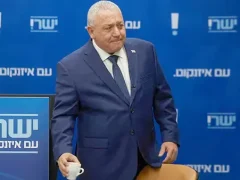






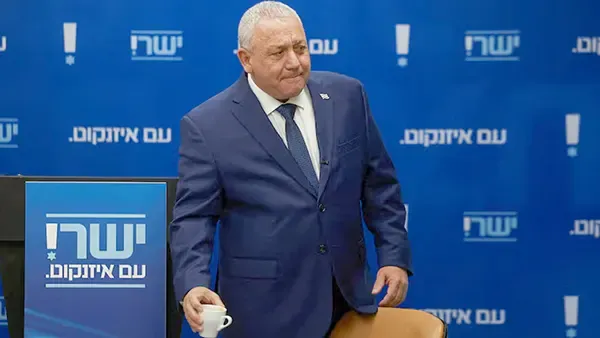
Former Israeli military chief Gadi Eizenkot faces a new crisis in his efforts to oust Prime Minister Benjamin Netanyahu. The left-wing political alliance, ‘The Democrats,’ has suspended negotiations with him regarding the formation of a government—a development that further complicates Eizenkot’s path to power.
The Democrats announced the suspension of talks on Tuesday. On the same day, however, Eizenkot’s party, ‘Yashar,’ revealed that it had reached an agreement to form an alliance with the right-wing party ‘Yisrael Beiteinu’ (Israel Our Home)—a group whose support is considered crucial for forming a government.
A political stalemate has gripped Israel following the October 27 elections, as no side secured a clear majority. Neither Netanyahu nor Eizenkot has managed to garner the number of seats required to form a government.
Eizenkot has been given until December 6 to form a government, a deadline that could potentially be extended by another 14 days if necessary.
Left-wing Dissatisfaction Over Unity Government Talks
Among Eizenkot’s potential coalition partners is Avigdor Liberman, leader of the right-wing ‘Yisrael Beiteinu’ party. Liberman and several other prospective allies of Eizenkot have opposed forming an alliance with Arab-led parties—even though the support of these parties could be vital for achieving a parliamentary majority. Yair Golan, leader of ‘The Democrats,’ has expressed his frustration over this stance.
Golan had been pressuring Eizenkot to reach an understanding with parties representing Israel’s Arab minority—who make up 21 percent of the population—in order to fulfill the election promise of removing Netanyahu from power.
Furthermore, Golan is also dissatisfied with Eizenkot’s engagement in talks involving Netanyahu’s right-wing Likud party and various ultra-Orthodox factions. Eisenkot’s party was exploring the possibility of forming a unity government that would include these parties.
According to the Yesh Atid party, their discussions with Likud and the ultra-Orthodox parties reflect a sincere commitment to forming the broadest possible government. They aim to examine every available option to avoid fresh elections.
However, in a statement released on Tuesday night, The Democrats announced that they were suspending coalition talks with Yesh Atid, asserting that “the prospect of a unity government must be taken off the negotiating table.”
The statement further noted that, in recent days, they had observed with concern that the discussions with Likud and the ultra-Orthodox parties were influencing the broader coalition-building negotiations.
Meanwhile, Yesh Atid and Lieberman’s Yisrael Beiteinu (“Israel Our Home”) have reached an agreement regarding the formation of a coalition. This marks the first coalition deal secured by Eisenkot since he was tasked with forming a government on November 8.
Both sides remain far from a majority.
In the election, the parties potentially aligned with Eisenkot—including The Democrats and Yisrael Beiteinu—secured a total of 48 seats. Forming a government in Israel’s 120-member parliament, the Knesset, requires 61 seats; thus, they remain 13 seats short of a majority.
Should any party withdraw from this bloc, the path for Eisenkot to form a government would become even more complex. Conversely, the far-right and ultra-Orthodox parties—typically aligned with Netanyahu—have secured 53 seats, leaving them eight seats short of a majority.
Arab-led parties achieved a record 19 seats in the election—a result they view as a reflection of public sentiment against the racist policies of the Netanyahu government.
It was only after the Arab parties endorsed Eisenkot as the most suitable candidate for Prime Minister that the country’s President tasked him with forming a government. If Eisenkot fails to form a government, the task may fall to Netanyahu. Should he also fail, there is a possibility that the country will head to fresh elections.
Meanwhile, as negotiations for forming a coalition continue—and until new elections are held—Netanyahu is serving as the caretaker Prime Minister.