







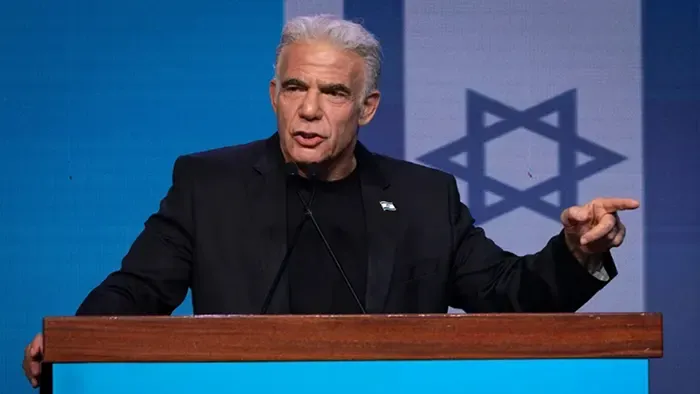
Israeli opposition leader Yair Lapid has stated that discussions regarding the formation of a new government in Israel are progressing quietly, away from the cameras. He asserts that although Benjamin Netanyahu’s coalition failed to secure a majority in the preliminary election results, it has suffered a significant setback.
Furthermore, Lapid claims that the opposition-led ‘Change Bloc’ has emerged victorious. In a post on his verified X (formerly Twitter) account on Friday, Lapid noted that the process of forming a government bears no resemblance to an election campaign; while campaigns are conducted in the public eye, government formation talks take place in small rooms, step-by-step, and behind the scenes.
The former Israeli Prime Minister remarked, “I know that people generally dislike uncertainty. If you are wondering whether anything is happening behind the current silence—the answer is yes.”
According to preliminary results, no single coalition has managed to secure the majority required to form a government. However, Lapid views the number of seats won by Netanyahu’s coalition as a major defeat.
By his calculation, Netanyahu’s coalition has secured 53 seats. This includes 7 seats for the ultra-Orthodox party United Torah Judaism and 6 seats for Shas.
According to Lapid, these two parties are anti-Zionist; consequently, Netanyahu’s own core camp holds only 40 seats—a number insufficient for him to form a government, Lapid argues.
He wrote, “By this count, we have won. It wasn’t a knockout victory—it was a win on points. But points count, too. Besides, a win is a win.”
The anti-Netanyahu parties have collectively secured 67 seats, exceeding the 61 seats required to form a government. This figure includes the seats held by Arab parties. The Arab bloc Ra’am secured 8 seats, while the Joint List won 11. Meanwhile, the four parties comprising the ‘Change’ bloc collectively obtained 48 seats.
However, a complication has arisen regarding the formation of a coalition that includes the Arab parties. Within the ‘Change’ bloc, parties such as Lapid’s ‘Together’ party, as well as Yesh Atid and Yisrael Beiteinu, are unwilling to form a government that includes the Arab parties.
Only the left-wing ‘Democrats’ party has maintained a relatively more flexible stance on this issue.
Lapid stated that the ‘Change’ bloc, under the leadership of Gadi Eisenkot of the Yesh Atid party, will make every effort to form a government. He acknowledged, however, that the task is difficult and there is no guarantee of ultimate success.
Addressing the Israeli public, Lapid urged patience during these uncertain times. His remarks suggest that while there is little visible political activity, discussions regarding the formation of a government are continuing behind the scenes.