





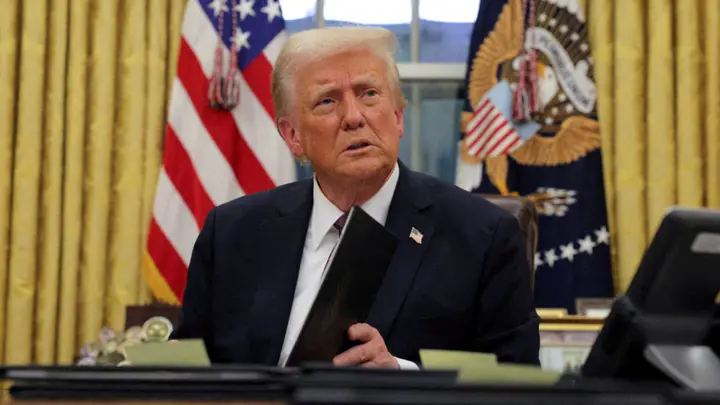
The Democratic National Committee (DNC) has filed a lawsuit against US President Donald Trump. The suit, filed on Wednesday, alleges that television advertisements funded by public money were used to promote Trump’s political policies.
Ken Martin, the head of the Democratic Party’s leadership body, alleged that these advertisements were created to boost Republican prospects in the upcoming November 3rd midterm elections.
In a statement on Wednesday, Martin said, “Donald Trump is using millions of taxpayer dollars to air blatant campaign ads in a desperate attempt to save Republicans this November.”
On the same day, the democracy watchdog group Common Cause filed a separate lawsuit against the same advertisements. The group alleges that the ads were created openly for political purposes, thereby violating legal prohibitions against using public funds for political campaigning.
In its lawsuit, Common Cause stated that while Trump presented these ads as public service announcements, they are not public service announcements at all; rather, they constitute pure self-promotion and political campaigning.
Both lawsuits allege that to produce these ads, Trump diverted $20 million—funds allocated by Congress for border security-related commemorative events—to a different purpose. Those funds were originally designated for events honoring individuals who had lost their lives in the line of duty.
The plaintiffs argue that by using these funds for advertising, Trump violated the constitutional principle of the separation of powers. The Common Cause lawsuit notes that the framers of the Constitution established more than two centuries ago that the executive branch may spend funds only for the specific purposes designated by Congress.
Both lawsuits cite the congressional appropriations laws that prohibit the use of taxpayer money for “publicity or propaganda purposes.”
In addition to seeking a declaration that the advertisements are illegal, both lawsuits demand an end to the use of public funds for them. There are also demands for necessary steps to be taken to recover the funds already spent.
The Democratic Party has filed a lawsuit in Washington D.C., while the case brought by Common Cause is set to be heard in the Southern District of New York.
Trump has faced criticism ever since these advertisements began airing in September. According to AdImpact, a firm that tracks media advertising spending, more than $12 million has been spent on these ads so far.
The $20 million used for Trump’s advertisements was part of a $175 million package allocated by Congress. These funds had been granted to the Department of Homeland Security as part of immigration control initiatives.
Critics point out that one of the advertisements bears a striking resemblance to a television spot from Trump’s 2024 presidential re-election campaign.
Three advertisements have aired to date. In one, a choir sings “Love Me” while various images of Trump are displayed; in it, Trump declares that the United States will “never be a communist country.”
Another advertisement features images of Mount Rushmore as Trump speaks of a new “golden age” for the United States.
The third advertisement employs harsher language and imagery. In a black-and-white sequence, Trump walks toward the camera, warning of a “final battle” against the “Deep State” and other alleged adversaries.
A survey released on Wednesday by Reuters and the research firm Ipsos revealed widespread dissatisfaction among the American public regarding these advertisements. Eighty-six percent of Americans surveyed stated that it was inappropriate for Trump to use public funds for these ads—a view shared by four out of five Republicans.
Trump, however, has defended the advertisements, describing them as “promotional campaigns for the country.” He has also claimed that these ads are similar to promotional initiatives undertaken by previous administrations. However, facing criticism from both parties, Trump stated on Monday that taxpayer money would not be used for any future advertisements. Yet, he made no pledge to reimburse the funds already spent.
Some members of Trump’s own Republican Party also criticized the advertisements.
Republican Senator Thom Tillis of North Carolina remarked that the ads resembled the kind of propaganda promoted by former Hungarian leader Viktor Orbán.
On the other hand, Senate Majority Leader John Thune said he agreed with the message conveyed in one of the advertisements, but maintained that “taxpayer money should not be used for this.”