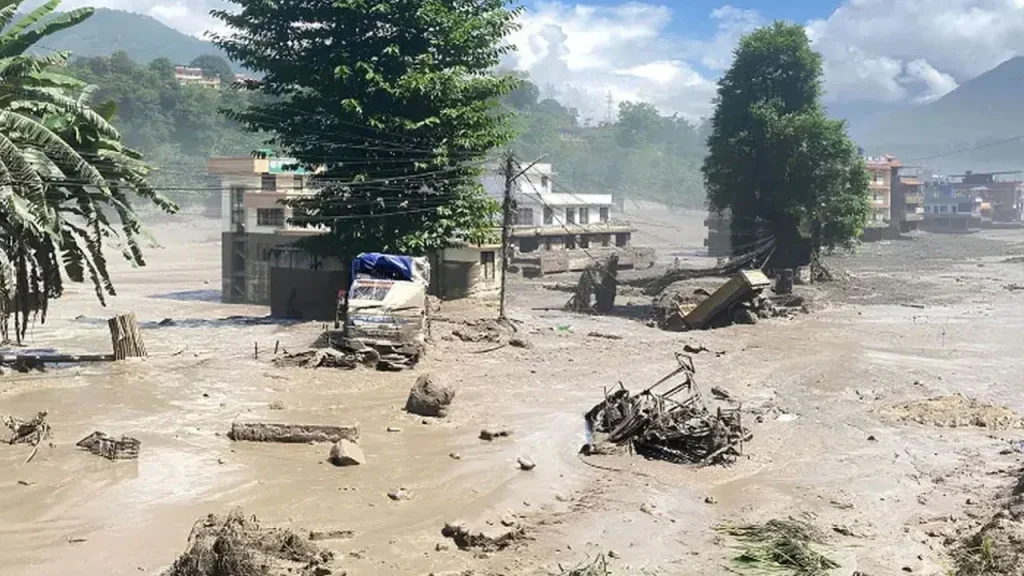
The death toll from devastating flash floods in Nepal’s northern border district of Rasuwa has risen to 95. Approximately 500 people remain missing following the incident. News agency PTI reported this information, citing relevant officials.
The flash floods struck Nepal and the Tibet Autonomous Region of China on Wednesday, trapping hundreds of people beneath mud and floodwaters. Among the missing are 105 Indian nationals—the largest group from any single country—along with citizens from other nations.
NDTV reported that people and infrastructure along the banks of Nepal’s Bhote Koshi River suffered the most damage. Kailash Mansarovar, located in Tibet, China, is a sacred site for Hindus, who believe it to be the abode of Lord Shiva; it also holds sacred significance for Buddhists and Jains.
According to the Nepal Tourism Board, the list of missing foreign nationals also includes 17 Malaysians, four South Africans, three US citizens, and one citizen each from Australia and the Netherlands. However, the nationalities of another 111 individuals on the list have not yet been confirmed.
High number of Indians among the missing
A significant number of the missing individuals are Indian nationals. In addition to 105 ordinary Indian citizens, there are 37 Non-Resident Indians (NRIs); thus, the whereabouts of a total of 142 Indians and NRIs remain unconfirmed.
Furthermore, 12 UK citizens are also unaccounted for. The Nepal Tourism Board stated that efforts to identify the nationalities of the missing and gather information on their whereabouts are ongoing; consequently, the figures or nationality details on the list may change later.
Rijan Bhakta, a professor and climate researcher at Kathmandu University, stated that preliminary investigations revealed an ice avalanche occurred in a local river named Lende. This blocked the river’s flow, causing water to accumulate instead of draining away naturally.
When the flash floodwaters surged into Nepal around 9:00 AM on Wednesday… At that time, a magnitude 4.4 earthquake struck Tibet. It is believed that the earthquake caused the ice to shift, sending the waters of the Lende River surging down into the Bhote Koshi River all at once.