The US Department of Defense (Pentagon) has called upon the country’s arms manufacturers to rapidly increase weapons production. This move comes as stockpiles have dwindled due to various factors, including the ongoing conflict involving Iran.
Pentagon spokesperson Sean Parnell stated on Saturday that the Department of Defense is pushing for increased procurement to ensure the military is quickly supplied with necessary weaponry. Several measures have been taken over the past week to accelerate this process.
However, Parnell noted that this initiative was not prompted solely by the five-month-long conflict involving Iran; a major effort to modernize US weapons stockpiles had already been underway.
US Under Secretary of Defense Steve Feinberg sent a letter to the heads of arms manufacturing companies last Wednesday. The letter gave them a maximum of 21 days to outline plans for accelerating the production and delivery of critical weapons and military equipment. The Washington Post obtained a copy of the letter.
“US Under Secretary of Defense Steve Feinberg sent a letter to the heads of arms manufacturing companies last Wednesday. The letter gave them a maximum of 21 days to outline plans for accelerating the production and delivery of critical weapons and military equipment.”
In the letter, Feinberg wrote that the long-standing pace of weapons production is no longer acceptable. He emphasized the need for much faster production and an expansion of manufacturing capacity.
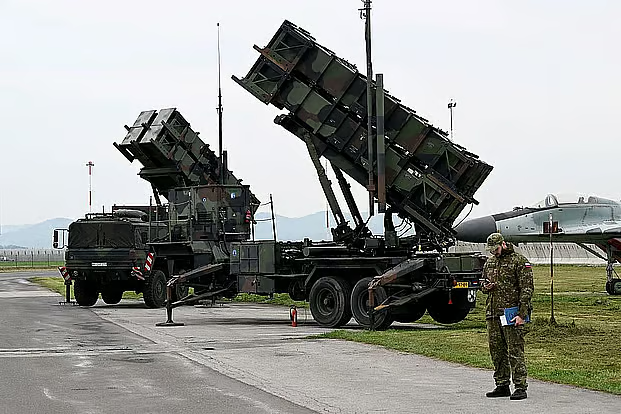
US stockpiles of advanced missile-defense systems were already depleting, and the recent conflict involving Iran has placed further strain on these reserves.
Experts warn that a shortage of both offensive and defensive weaponry could expose US troops to security risks.
An analysis by the Washington-based Center for Strategic and International Studies (CSIS) suggests that dwindling stockpiles of Patriot and THAAD missile defense systems might force the US and its Middle Eastern allies to be more cautious in their deployment. For instance, US forces might fire fewer interceptor missiles to counter drones and missiles launched by Iran, thereby increasing the risk that Iranian projectiles could penetrate US defenses. “Before the war began, the United States possessed 2,330 Patriot defense missiles. By the time the ceasefire took effect in April, that number had dropped to 1,030.”
US President Donald Trump reacted angrily to reports regarding the depletion of weapons stockpiles. Last Thursday, he reiterated that the US had not faced any strategic issues regarding its weapons inventory during the five-month-long conflict.
Writing on his own social media platform, Truth Social, Trump stated that the US holds vast quantities of weapons, with particularly large stockpiles of certain types. He also claimed that large shipments of weapons are being manufactured and sent to the US as needed. According to him, defense companies are building more weapons-manufacturing facilities than at any other time in US history.
On Saturday, Pentagon spokesperson Parnell confirmed reports that Feinberg had sent a letter directing a rapid increase in weapons production. This directive will inform the budget for the 2028 fiscal year, which is to be submitted to Congress for funding approval. He noted that this move aligns perfectly with ongoing efforts to revitalize the US defense industrial base.
“Earlier this month, the US Department of Defense signed new contracts with major defense firms Lockheed Martin and Northrop Grumman to ramp up production of various components used in missile defense systems.”
Meanwhile, a defense spending bill remains stalled in the US Congress. Lawmakers are expressing frustration over Trump’s military actions against Iran. They are also objecting to the White House’s request to increase the Pentagon’s budget from approximately $900 billion last year to $1.5 trillion.
Experts warn that even with a massive new allocation of funds, it could take at least three years to fully replenish the stockpiles of Patriot and THAAD missile defense systems to pre-war levels.
According to estimates by the Center for Strategic and International Studies, the US held 2,330 Patriot defense missiles before the war started. By the time the ceasefire came into effect in April, that figure had fallen to 1,030. Following recent fighting, the stockpile is estimated to have further declined to between 759 and 827 units. This represents a reduction of at least 65 percent compared to pre-war levels.
Stocks of THAAD interceptor missiles have also decreased. Before the war, the United States held 452 such missiles. By the start of the ceasefire in April, the inventory had dropped to a range of 232 to 262. Although some missiles were subsequently added, bringing the count to between 234 and 278, the stockpile remains at least 38 percent lower than it was before the war.