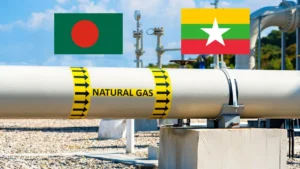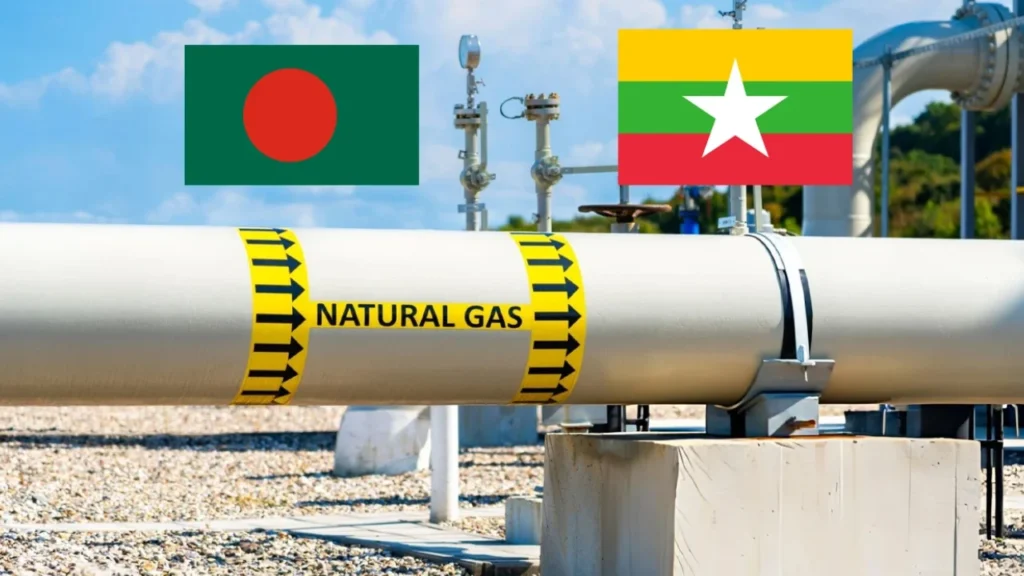
Implementation of the proposed cross-border gas pipeline project between Myanmar and Bangladesh requires the explicit approval of the Arakan Army (AA). Political analysts observe that since the Arakan Army currently controls vast swathes of Rakhine (Arakan) State and the entire border region between the two countries, moving the project forward without their consent is not feasible.
The proposal gained fresh momentum following a meeting in Dhaka on August 2 between Bangladesh’s Minister of Power, Energy and Mineral Resources, Iqbal Hasan Mahmud, and Myanmar’s Ambassador, U Kyaw Soe Moe. During the meeting, Bangladesh formally expressed interest in importing natural gas from Myanmar’s offshore Shwe gas project and transporting it to Chattogram via a pipeline. Bangladesh plans to utilize this gas to address the country’s growing energy crisis.
However, regional experts point out that the Myanmar junta government does not hold control over the territory required to execute such a commitment.
U Myo Kyaw, a political analyst specializing in Arakan affairs, stated, “The Arakan Army controls approximately 90 percent of Arakan State, including the border areas with Bangladesh. Their consent is essential for transporting gas through Arakan territory. There is no way to advance this project without their approval.”
Since the beginning of 2024, the Arakan Army has established full control over key border towns—including Buthidaung and Maungdaw—as well as Paletwa Township in the neighboring Chin State. Consequently, cross-border transit corridors have effectively come under their administration.
Meanwhile, fierce fighting continues in the vicinity of the strategically important cities of Sittwe and Kyaukphyu.
Despite the ongoing military conflict, some analysts believe that if managed effectively, the project could create strategic opportunities for the ethnic armed organization.
U Aung Min Oo, Editor-in-Chief of the Development Media Group (DMG), said that the Arakan Army might support the project if it ensures direct economic benefits for the local population and creates an opportunity to gain some level of international recognition. He said, “Whether it is gas or oil, transporting anything across Arakan territory requires some level of recognition from the Arakan Army. Politically, this project could help the Arakan Army establish a foothold in the international arena. They welcome foreign investments that ensure mutual benefit.”
Major General Twan Mrat Naing, the Commander-in-Chief of the Arakan Army, has previously acknowledged the need to build good relations with Dhaka. However, opportunities for formal communication between the Bangladesh government and the Arakan Army remain limited.