
Indian Prime Minister Narendra Modi and Israeli Prime Minister Benjamin Netanyahu during a visit to Israel. A roadmap for further expanding defense cooperation between the two nations was established during this visit. Jerusalem, February 26. File photo: Reuters.
Arms Exports to Israel Amidst Ethnic Cleansing in Gaza
A report by the international human rights organization Amnesty International has revealed that thousands of shipments containing arms and military equipment were exported from India during Israel’s military operations in Gaza.
The report states that between October 7, 2023—following the Hamas attack—and November 30, 2025, at least 2,596 shipments of arms, ammunition, components, and military equipment were sent to Israel. India continued these exports despite the risk that the equipment could be used in violations of international law and human rights in Gaza.
The UK-based organization released a 42-page report yesterday, Thursday, titled “Made in India: The Supply of Weapons and Ammunition to Israel.” The report analyzes shipment-level data regarding defense trade between India and Israel.
Under the leadership of Prime Minister Narendra Modi of the Hindu-nationalist BJP, India has emerged as one of Israel’s strongest allies. This marks a significant shift in the country’s foreign policy, given that this South Asian nation has historically advocated for the establishment of a Palestinian state.
Amnesty International’s report notes that by exporting arms while Benjamin Netanyahu’s forces were conducting major military operations in Gaza, India risked becoming complicit in violations of international law and human rights.
The report mentions both state-owned and state-controlled Indian companies, as well as private firms, that are conducting direct transactions or operations with Israeli companies and forces. The report states that during this period, Indian companies supplied Israel’s defense sector with at least 390,516 military-grade small arms components, 564,970 explosive weapon components—including drone warheads and artillery shell casings—and 298 military vehicle components. However, shipments intended for potential civilian use or equipment for missile defense systems designed to protect civilians were excluded from these figures.
Amnesty claims that the Indian government has cultivated close and lucrative ties with Israel’s defense industry through various state-owned and private entities. Many of these companies have supplied military equipment directly to firms that work with the Israeli military.
Amnesty International Secretary General Agnès Callamard stated that even after the International Court of Justice (ICJ) issued an interim order highlighting the risk of potential genocide against Palestinians in Gaza, India failed to impose adequate controls on arms exports; instead, the country further strengthened its defense cooperation with Israel.
Agnès Callamard said, “The International Court of Justice ordered interim measures in light of the potential risk of genocide against Palestinians in Gaza. Under these circumstances, Indian authorities cannot credibly claim they were unaware that supplying arms posed a risk of violating international law.”
The report notes “serious structural flaws” in India’s arms export control system. These include the absence of any specific obligation to conduct proper human rights due diligence before approving military equipment exports and a lack of transparency in export-related decisions. It also mentions that India has not yet acceded to the Arms Trade Treaty (ATT).
Amnesty International has urged the Indian government to join the Arms Trade Treaty and align its export control system with international standards. According to Amnesty, a significant portion of the shipments from India went to three major Israeli defense companies: Elbit Systems, Israel Aerospace Industries (IAI), and Rafael Advanced Defense Systems. The materials supplied during this period included machine gun parts, components for 155mm high-explosive artillery shells, explosive warheads for SkyStriker loitering munitions, and parts for armored vehicles.
Callamard stated that Indian companies profited by supplying arms while the Israeli military was carrying out killings and destruction against Palestinians in Gaza.
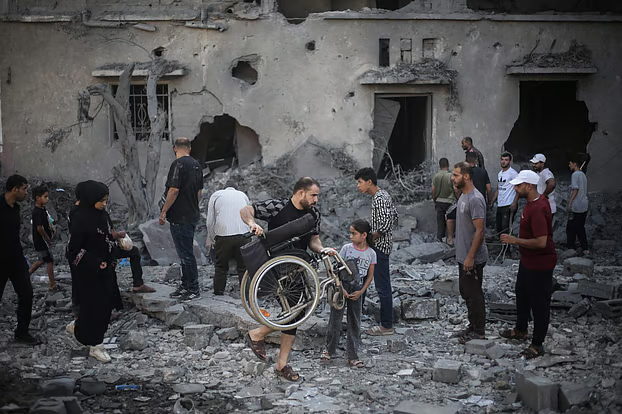
As always, Israel has denied allegations of genocide in Gaza. The country has dismissed the genocide charges brought by South Africa at the International Court of Justice as “false” and “grossly distorted.”
Defense ties between India and Israel have strengthened significantly over the past few years. According to data from the Stockholm International Peace Research Institute (SIPRI), approximately 29 percent of Israel’s total arms exports between 2020 and 2025 went to India. Conversely, India has also emerged as one of Israel’s major defense partners.
In February of this year, Indian Prime Minister Narendra Modi visited Israel for the second time during his tenure. During the visit, the two nations elevated their relationship to a “special strategic partnership for peace, innovation, and prosperity.” A framework for further expanding defense cooperation was also established. Prior to this, in November of the previous year, the two countries had signed a Memorandum of Understanding (MoU) regarding defense cooperation.
June 27, 2024
Israeli forces have been conducting attacks in Gaza since October of last year.
The report also mentions an incident from May 2024, when a ship carrying arms—en route from Chennai, India, to the port of Haifa in Israel—was denied permission to dock at the Spanish port of Cartagena. The vessel was carrying 20 tons of rocket engines, 12.5 tons of rockets equipped with explosives, and 1,500 kilograms of specialized explosives.
Spain’s then-Foreign Minister, José Manuel Albares, stated, “This is the first time we have taken such a measure, because it is the first time we have detected a ship carrying arms to Israel that sought to dock at a Spanish port.”
Noting that the Middle East needs peace rather than weapons, Albares added that this policy would apply to all ships carrying arms to Israel that seek to dock at Spanish ports; the Foreign Ministry would routinely reject such requests for stopovers for a clear reason.
The report further notes that a month later, following an Israeli strike on a school in the Nuseirat refugee camp in Gaza—an attack that killed 33 Palestinians—parts of weapons bearing the inscription “Made in India” were found amidst the wreckage.