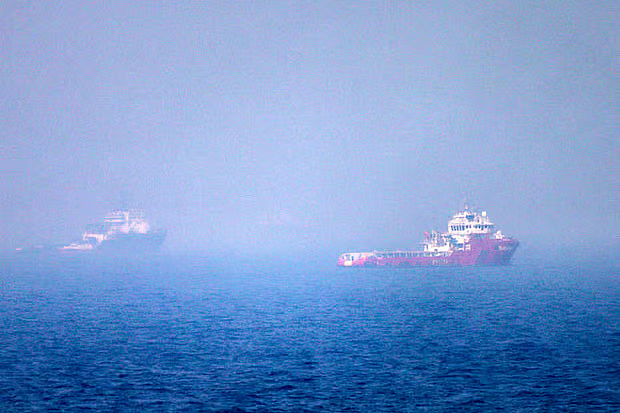
Explosions have occurred on two oil tankers transiting the Strait of Hormuz, resulting in massive fires breaking out on both vessels.
In a statement, Iran’s Islamic Revolutionary Guard Corps (IRGC) claimed that the two oil tankers had attempted to pass through the “unsafe southern section” of the Strait of Hormuz.
Iran’s state broadcaster, IRIB, published the IRGC statement, which noted that rescue teams had successfully rescued the crews from both tankers.
IRGC also issued a warning to shipping companies operating in the Strait of Hormuz. The statement urged them not to rely on “false information” provided by US forces and to “avoid maritime routes designated as dangerous.” Iran called for adherence to these guidelines to ensure the safety of sailors navigating the Strait.
The IRGC statement further declared that as long as the US continues its “malicious activities” in the region, passage through the Strait of Hormuz would be halted. It asserted that not a single drop of oil or gas—nor even a package of chemical fertilizer—would be exported from the region.
In a post on the social media platform X, the US military’s Central Command (CENTCOM) announced the conclusion of a series of operations against Iran conducted on Monday night. Strikes were carried out against various facilities to counter Iran’s capability to attack cargo vessels in the Strait of Hormuz.
CENTCOM stated that strikes targeted Iranian military command centers, maritime capabilities, missile and drone launch sites, and air defense systems.
Qatar seeks compensation
Qatar has sent multiple letters to UN Secretary-General António Guterres and the UN Security Council. In these letters, the Gulf nation has detailed the repeated attacks carried out against it by Iran.
The letters cite the Iranian attack on the Qatari tanker ‘Al Rakayyah’ on July 7 and a missile attack on Qatari territory on July 12. Doha stated in the letters that its armed forces repelled the July 12 attack.
Qatar also noted that these attacks were carried out in violation of international law and UN Security Council regulations. The country has demanded compensation for the damage caused by the attacks and warned that it reserves the right to respond to them.
These letters from Qatar have come to light at a time when tensions in the Middle East surrounding the Strait of Hormuz are at a peak, with reports of successive attacks on commercial vessels in the strait.