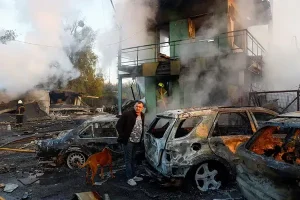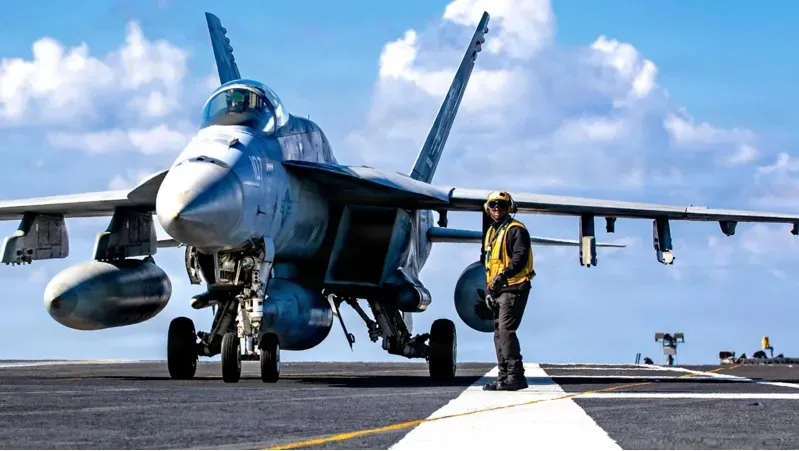
Following renewed US attacks in southern Iran, the country has launched a strike against a US airbase located in the Middle East. Iran’s Islamic Revolutionary Guard Corps (IRGC) made this claim. However, Kuwait stated that it successfully thwarted the threat of hostile missile and drone attacks; the country did not, however, confirm the specific target of the strike. Notably, the United States maintains an airbase within Kuwait. Prior to this missile attack by Iran, the US shot down an Iranian drone over the Strait of Hormuz and struck a military installation in Bandar Abbas—a strategic port city in southern Iran. This marks the second time in three days that the United States has conducted strikes inside Iranian territory. Washington asserts that these attacks were carried out in self-defense. With the resurgence of conflict, the fragile ceasefire between Washington and Tehran now faces a serious threat. This report was provided by BBC Online.
Citing the state broadcaster IRIB, the IRGC announced that the attack on the US airbase took place in the early hours of Thursday morning. It described the strike as a retaliatory blow aimed at the staging ground from which previous US attacks against Iran had been launched. The US Central Command (CENTCOM) characterized Iran’s attack on Kuwait as a “flagrant violation” of the ceasefire agreement. CENTCOM further claimed that, just hours prior to this attack, Iranian forces had dispatched five suicide drones in the vicinity of the Strait of Hormuz, thereby posing a clear and imminent threat. CENTCOM confirmed that all five drones were successfully shot down, and a sixth drone—launched from a ground control station in Bandar Abbas—was also successfully intercepted.
US forces described their actions as proportionate, entirely defensive in nature, and undertaken with the specific objective of preserving the ceasefire. Meanwhile, Iranian Foreign Ministry spokesperson Ismail Baghaei condemned the US attacks, characterizing them as a violation of the ceasefire agreement. Quoting IRIB, he stated that the Islamic Republic would take all necessary measures to safeguard its national sovereignty.
Kuwait’s Foreign Ministry also issued a strong condemnation of what it termed “Iran’s criminal attacks” targeting its territory. Earlier this week, the United States confirmed that it had carried out defensive strikes in southern Iran on Monday. The attack targeted Iranian missile installations as well as vessels attempting to lay mines in the Strait of Hormuz.
CENTCOM stated that the objective of the strike was “to protect our troops from threats posed by Iranian forces.” Concurrently, the United States imposed sanctions on the Strait of Hormuz Passages Authority. This Iranian entity is responsible for collecting fees from ships transiting through the Strait of Hormuz. The U.S. Department of the Treasury warned that any vessel making payments to this authority could face the risk of sanctions. U.S. Treasury Secretary Scott Bessent also issued a warning to Oman. Addressing Oman—a traditional U.S. ally situated on the southern coast of the Strait of Hormuz—he stated that Washington would not tolerate any attempt to impose a toll system on this vital maritime route.
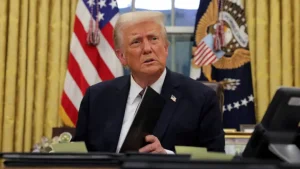
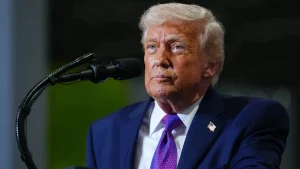
In a post on X on Thursday, Bessent wrote that Oman, in particular, should be aware that the U.S. Treasury would aggressively target anyone involved in such activities. The previous day, Iranian state television claimed that, as part of a draft agreement between the U.S. and Iran, Oman would join Iran in managing the Strait of Hormuz once it was reopened. Later, speaking to reporters during a cabinet meeting, Donald Trump remarked, “Oman has to behave like everyone else; otherwise, we’ll have to blow them up.”
Approximately one-fifth of the world’s total liquefied natural gas and oil is transported through the Strait of Hormuz. The closure of the strait has had a significant impact on the global energy trade. On Monday, Iranian Foreign Ministry spokesperson Baghai stated that Tehran is collecting fees for maritime navigation services and would continue to regulate traffic within the Strait of Hormuz. Scott Bessent characterized this move as the Iranian military’s latest attempt to hold global maritime trade hostage, and as evidence of Iran’s desperation amidst a financial crisis.
On Tuesday, the IRGC further claimed to have shot down a U.S. drone and opened fire on a fighter jet and another drone that had entered Iranian airspace. However, the specific timing of these incidents was not disclosed. During a Cabinet meeting on Wednesday, Trump stated that Iran is currently negotiating with all its might and that the November midterm elections would not influence his war policy. He remarked, “We may have to go back and finish the job—or we may not.”
During that same meeting, Trump urged Gulf nations to join the Abraham Accords to normalize relations with Israel.