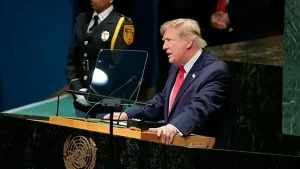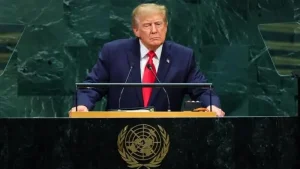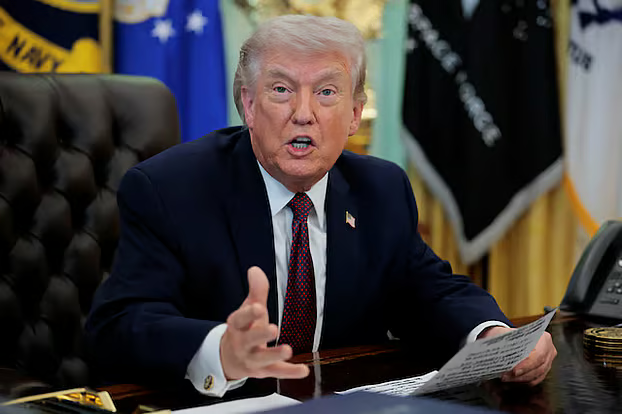
US President Donald Trump has announced his intention to speak with Taiwan’s President, Lai Ching-te, regarding potential arms sales to the island nation. In making this decision, Trump has broken with long-standing diplomatic protocol that has traditionally guided US foreign policy.
Since 1979—when the United States officially recognized the government of China and severed formal diplomatic ties with Taiwan—no US president has directly spoken with a Taiwanese leader.
China claims Taiwan as its own territory and has not ruled out the use of force, if necessary, to seize control of the island.
Taiwan’s current President, Lai Ching-te—who assumed office in 2024—has taken the most significant steps in recent years to bolster the island’s defense capabilities.
In 1979, the United States passed the “Taiwan Relations Act.” This legislation stipulates that the US may provide Taiwan with “arms of a defensive nature.” It is under the authority of this act that Washington has consistently sold arms to Taiwan.
While legally obligated to supply arms to Taiwan, the United States must constantly maintain a delicate balance in order to preserve its diplomatic relations with Beijing.
Yesterday, Wednesday, when asked by reporters whether he would speak with Lai Ching-te prior to making a final decision on US arms sales to Taiwan, Trump replied: “I will speak with him. I speak with everyone… We will work on the Taiwan issue.”
At the same time, referencing the two-day bilateral summit held in Beijing last week, Trump described his relationship with Chinese President Xi Jinping as “extraordinary.”
Earlier last week—while en route back to the US aboard Air Force One following his visit to Beijing—Trump had also addressed the issue of arms sales to Taiwan, stating: “I will make a decision very shortly. I need to speak with the person currently running Taiwan—you know who that is.”
A decision regarding the potential sale of approximately $14 billion worth of arms to Taiwan—aimed at bolstering its defense capabilities—currently remains pending. Reports indicate that this arms package includes counter-drone equipment and air defense missile systems. According to a report by the Financial Times, Beijing has currently blocked a proposed visit to China by Elbridge Colby, a top policymaking official at the U.S. Department of Defense (the Pentagon). China maintains that it will not authorize this visit until it sees what decision Trump makes regarding the arms deal in question.
During Trump’s visit to Beijing, China made it clear that Taiwan constitutes the most sensitive issue in U.S.-China relations. Xi Jinping warned that if this matter is not handled properly, it could lead to “conflict” between the two superpowers.
Trump has dismissed the possibility of a conflict between the United States and China over Taiwan. However, he acknowledged that Xi Jinping holds a “very tough” stance regarding the island. Speaking to reporters aboard Air Force One on the subject, Trump stated, “I haven’t made any promises to either side.”
Following the meeting between Trump and Xi, Taiwan’s President Lai Ching-te issued a statement declaring that Taiwan is a “sovereign, independent, and democratic nation,” and that peace in the Taiwan Strait would not be “sacrificed or traded” for anything.
Lai Ching-te emphasized that U.S. arms sales serve as one of the “key factors” in maintaining peace and stability in the region.
Of course, this is not the first instance of Trump breaking diplomatic protocol. Previously, in 2016—while President-elect—he spoke by phone with Taiwan’s then-leader, Tsai Ing-wen; an act that prompted China to lodge a formal and strong protest with the United States.
Furthermore, Trump has claimed that he engaged in “detailed discussions” with Xi Jinping regarding this arms sale. If true, this would constitute a major violation of established U.S. policy. This is because, under a 1982 agreement, the United States assured Taiwan that it would not consult with Beijing regarding arms sales to the island.
When asked about this commitment while returning from Beijing, Trump remarked, “That was a long time ago.” As recently as last December, the United States authorized the sale of $1.1 billion worth of weaponry to Taiwan—a move that drew Beijing’s ire. To counter China’s escalating military pressure, Taiwan—under President Lai—has increased its defense budget to a record high.
Although the majority of Taiwan’s citizens view themselves as an independent state, they largely favor maintaining the status quo; this means they will neither formally declare independence nor integrate with China.