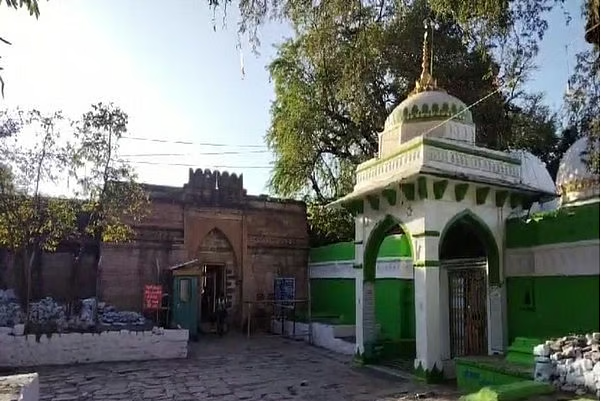
The Madhya Pradesh High Court has ruled that the site of the Bhojshala–Kamal Maula Mosque in the Dhar district of Madhya Pradesh, India, is a Saraswati temple. Delivering this verdict today, Friday, a Division Bench of the High Court’s Indore Bench—comprising Justice Vijay Kumar Shukla and Justice Alok Awasthy—stated that the district’s Muslim community may apply to the government for the allotment of alternative land to construct a mosque. The government should consider such an application with due seriousness.
The verdict stipulates that the responsibility for the maintenance and management of Bhojshala will remain with the Archaeological Survey of India (ASI). However, the right to worship at the site will be reserved exclusively for Hindus.
Much like the Babri Masjid in Ayodhya, Uttar Pradesh, the mosque at Bhojshala has been the subject of a long-standing dispute. Hindus claim that the temple dedicated to Saraswati—the Hindu goddess of knowledge—was established at Bhojshala during the reign of King Bhoja (1010–1055) of the Parmar dynasty in the Malwa region of Madhya Pradesh. A Sanskrit seminary also reportedly existed at the site.
Devout Muslims, conversely, assert that the site is the “Kamal Maula Dargah and Mosque.” They contend that Bhojshala was destroyed during the reign of Alauddin Khilji, and subsequently, during the era of Dilawar Khan Ghori, a mosque was established within a section of the premises. According to the Archaeological Survey of India (ASI), following the death of the Sufi saint Kamaluddin in the 14th century, he was interred within the complex; a mosque was subsequently built there, which became known as the “Kamal Maula Mosque.”
As the Ayodhya movement intensified, hardline Hindu groups raised demands to determine the religious character of Bhojshala—much like the sites in Kashi and Mathura. A movement ensued, and the responsibility for determining the site’s character was entrusted to the ASI. Friday’s High Court verdict follows a thorough review of the reports submitted in this regard. It now remains to be seen whether the Muslim community will approach the Supreme Court in light of this verdict.
The High Court’s ruling upholds the protected status of Bhojshala, affirming that the architectural site remains a protected monument in accordance with the legislation enacted in 1958. The responsibility for the preservation of the structure will also remain with the ASI.
Since the time of the Hindutva movement demanding the construction of a temple at the site of the Babri Masjid in Ayodhya, activists have also raised a dispute regarding the Bhojshala. At that time, the administration granted permission for Hindus to perform worship there every Tuesday and for the Muslim community to offer prayers every Friday. Additionally, Hindus were granted permission to worship Goddess Saraswati on the day of Basant Panchami.
The administrative order also stipulated that if Basant Panchami were to fall on a Friday, the government must make arrangements to ensure that both communities could practice their respective faiths without hindrance. On other days, even if members of both communities visited the site, they were not permitted to perform worship or offer prayers.
The Madhya Pradesh High Court delivered this verdict today based on a scientific survey conducted by the ASI. On Friday, a Division Bench observed that Hindus have been worshipping at the site continuously; this continuity has never been interrupted. Historical literature also corroborates that the disputed site served as a center for Sanskrit learning. The Bench affirmed that the structure in question is, unequivocally, a temple dedicated to Goddess Saraswati.
As this verdict identifies the disputed structure of the Bhojshala as a Hindu temple, Muslims no longer retain the right to offer prayers there. The ASI had originally granted this right to the Muslim community in 2003.
The High Court’s verdict further states that the Muslim community may submit a petition to the State Government requesting suitable land for the construction of a mosque. The government is mandated to give due consideration to this request.
Concurrently, the State Government has been directed to ensure the maintenance of law and order, as well as security, in the vicinity of the structure.
The petitioners have claimed that the idol of Goddess Saraswati, which was once housed in the Bhojshala, has been kept in a museum in London for many years. The government has been directed to examine the veracity of this claim. Furthermore, the Central Government has been asked to assess the feasibility and acceptability of the demand to retrieve the idol and reinstall it at the Bhojshala.