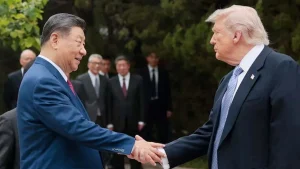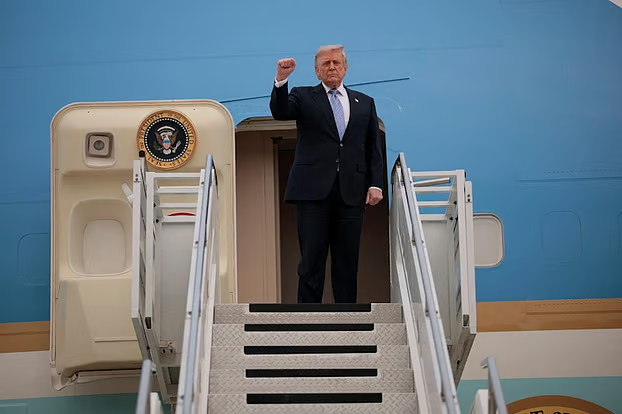
The historic meeting (the second day of talks) between Chinese President Xi Jinping and U.S. President Donald Trump has concluded. Following the meeting, Trump is departing Beijing.
This meeting—which holds far-reaching implications for global politics and economics—has captured the attention of the world. The U.S. President stated that solutions have been found for “many different problems” between the two nations.
However, no specific agreements have yet been announced regarding the core and sensitive issues that directly impact the bilateral rivalry between these two superpowers.
During the meeting, Xi Jinping issued a direct warning to Trump regarding Taiwan—the most sensitive issue in China-U.S. relations. Xi explicitly stated that Taiwan constitutes the “most important issue” within the context of bilateral relations between China and the United States.
President Trump revealed that he and Xi Jinping engaged in detailed discussions regarding the overall situation in Iran. They reached a consensus on the fundamental principle that Tehran should not possess any form of nuclear weaponry.
Concurrently, Trump clarified his stance regarding the Strait of Hormuz—one of the primary maritime routes for global energy supplies. He asserted that the United States has absolutely no need to keep this waterway open—or, at the very least, the U.S. does not require it to the same extent that China does.
Meanwhile, addressing the ongoing tensions in the Middle East, China’s Foreign Ministry issued a statement declaring that a war with Iran “should never have happened.”
During the meeting, Xi Jinping issued a direct warning to Trump regarding Taiwan—the most sensitive issue in China-U.S. relations. Xi explicitly stated that Taiwan constitutes the “most important issue” within the context of bilateral relations between China and the United States.
Issuing a stern caution to Washington, Xi warned that if this sensitive matter were to be mishandled in any way, it could potentially precipitate an “extremely dangerous situation” in the future.
Following this warning from the Chinese President, U.S. Secretary of State Marco Rubio stated that the United States’ position on this matter remains “unchanged.”