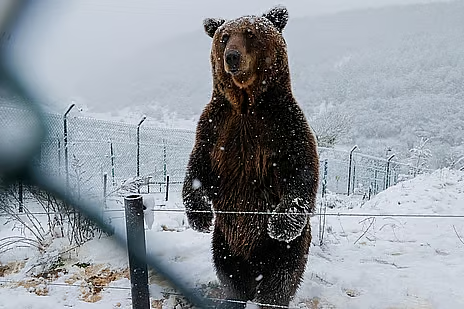
The word “bear”—hearing it typically conjures images of everyone’s beloved “Teddy Bear” or Disney’s famous character, “Winnie the Pooh.” This honey-loving character, with his inherent innocence, continues to charm both children and adults alike. Japan—including its capital, Tokyo—is home to numerous Disney stores; consequently, the country boasts a sizable fan base for “Winnie the Pooh.”
However, in Japan today, the mere mention of bears no longer evokes such gentle sentiments; instead, it sends a shiver of terror down the spine—particularly for those living in the country’s northern regions. Over the past few years, a spate of bear attacks has occurred one after another, leading to a rising number of casualties. This year, too, the first fatality resulting from a bear attack has already been reported, sparking widespread panic among the public.
The incident took place on April 21, when the body of a 55-year-old woman was recovered from the Shiwa area in Japan’s northern Iwate Prefecture. She is the first person to be killed in a bear attack this year—a fact confirmed by Japan’s Ministry of the Environment.
Meanwhile, the body of another woman was discovered in the mountainous terrain of Iwate. It is suspected that she, too, fell victim to a bear attack. Japan’s public broadcaster, NHK, reported this news last Friday, citing police sources.
According to reports, the 69-year-old victim—a resident of Hachimantai City in Iwate Prefecture—had ventured into a mountain forest last Wednesday to gather wild edible plants. Police and rescue teams discovered her body the following morning; she bore claw marks on her face and head.
Citing the Ministry of the Environment, Japan’s Kyodo News agency reported that, in addition to these two incidents in Iwate, the body of a 78-year-old man was found in a forest in the Sakata area of Yamagata Prefecture. The victim showed signs of injury to his head and hands. A bear emerged from the woods adjacent to the spot where the body was found; a hunter immediately shot and killed the animal.
These three incidents suggest that fatal bear attacks are occurring much earlier this year compared to last year. In 2023, the first fatality occurred toward the end of June; this year, it has happened in April. The cause of death for the last two victims has not yet been officially confirmed. If confirmed, the death toll from bear attacks in April alone would rise to three.
Incidents of bear attacks have been on the rise for several years. According to data from Japan’s Ministry of the Environment, the number of casualties—both injured and killed—resulting from bear attacks across Japan reached an all-time high during the 2025 fiscal year, which concluded in March of this year. A total of 238 people were injured, and 13 lost their lives. Among the deceased, five died in Iwate Prefecture, four in Akita, two in Hokkaido, and one each in Miyagi and Nagano.
Prior to this, during the 2023 fiscal year, Japan recorded its highest death toll from bear attacks at the time—six fatalities—while 219 people sustained injuries.
Hibernation and Seasonal Variations
According to experts, the reason for such early fatalities this year is that bears have emerged from hibernation sooner than usual.
In Japan, bears typically seek shelter in trees or caves to hibernate through the spring season. Consequently, the animals consume large quantities of food during the autumn to prepare for this period. This behavioral pattern is primarily observed among the brown bears of Japan’s Hokkaido region and the Asian black bears found in northeastern Japan. Conversely, the Asian black bears in Iwate Prefecture tend to enter hibernation in early November, remaining asleep until the beginning of May the following year.
Food is scarce during the winter months; therefore, bears prefer to spend this period in hibernation. The fat reserves accumulated in their bodies serve as their primary energy source during this time. It is generally uncommon for bears to wake up and emerge from their caves during the hibernation period.
Analysts suggest that if winter temperatures remain relatively mild, bears may wake from their hibernation and venture outdoors.
Furthermore, bears that failed to secure sufficient food during the autumn—and thus could not make the necessary physiological preparations for a prolonged period of sleep—may forgo hibernation entirely and continue to roam about. Some of these bears are carnivorous in nature.
Carnivorous and Urban Bears
Bear experts note that even when food sources such as nuts are abundant, some bears still exhibit a preference for consuming meat. Consequently, certain bears of this disposition choose not to enter hibernation, opting instead to roam the wilderness amidst the biting cold of winter. Hunting becomes difficult during the winter season, and prey is scarce. Consequently, hungry bears tend to be highly agitated. Under such circumstances, they may attack humans if encountered. This particular species is among those responsible for bear attacks on humans reported across Japan.
However, “urban” bears have now become a cause for concern among the Japanese public. These bears are increasingly spotted in densely populated cities and urban centers, having grown accustomed to close proximity with humans. They have even been observed descending from the mountains to rummage through household waste bins in residential areas.
Experts suggest that bears venturing into human settlements have learned that food is readily available in residential homes—and that they can safely retreat to their mountain dens with their spoils. Consequently, these bears now effortlessly enter settlements in search of food; moreover, they no longer perceive humans as a threat.
While bears often venture out in search of food prior to the onset of hibernation, it is typically rare to spot them near human settlements in the spring, following their emergence from winter slumber. This is because, during that period, bears typically rely on mountain foliage and wild vegetation for sustenance. This year, however, has proven to be an exception.
An Early Arrival
As early as April of this year, Japanese media outlets reported sightings of bears in urban areas across the Tohoku region of northeastern Japan. On April 19, in a residential neighborhood of Sendai, a bear was observed wandering through the shrubbery within the grounds of an apartment complex throughout the morning. The bear was eventually subdued using a tranquilizer gun.
Of particular concern is the fact that this incident occurred in close proximity to the city’s main train station. Consequently, local residents are deeply apprehensive regarding the intrusion of bears into such densely populated urban zones.
Notably, two-thirds of all bear attacks reported across Japan during the 2025 fiscal year occurred in the Tohoku region. This spring, bears have been sighted there at an increased frequency—and much earlier in the season than usual.
Compared to last year, bear-related warnings were issued significantly earlier this time around: 11 days earlier in Japan’s Aomori Prefecture, 24 days earlier in Akita, two months earlier in Iwate, and more than three months earlier in Miyagi Prefecture.
Reasons Behind the Rise in Attacks
Experts point to several factors behind the sudden surge in bear attacks across Japan. One key factor is a decline in nut harvests; consequently, hungry bears are venturing into urban and tourist areas in search of food. Furthermore, climate change has resulted in warmer winters, disrupting the bears’ hibernation patterns. This alteration is increasing the likelihood of encounters between bears and humans.
Japan’s rural communities have aging populations, and many elderly residents are unable to regularly clear the brush and vegetation surrounding their homes. Fields adjacent to residential areas often become overgrown with weeds; these neglected spaces are increasingly serving as foraging grounds for bears.
Additionally, Japan has imposed strict regulations regarding hunting licenses and the use of firearms. These restrictions are also playing a role in the steady rise in both the bear population and the number of attacks.
To address this alarming situation, the Japanese government is prioritizing immediate solutions that include relaxing restrictions on shooting bears in high-risk areas, as well as stepping up patrols.
Concerns Among Business Owners
Tourism operators in northern Japan are growing increasingly anxious as bear attacks continue to rise. Since last autumn, the volume of tourist traffic in the region has declined. Consequently, as the warmer season begins, event organizers and tourism businesses are proactively implementing various bear-deterrent measures.
According to the Mainichi Shimbun, fireworks were deployed in late April to keep bears away from a marathon event held in Fukushima. Similarly, last month—during the cherry blossom viewing season—specialized drones were flown over a park in Iwate Prefecture to ensure the safety of visitors. Camping facilities in Yamagata plan to play loud music to deter bears. In some areas, drones are being utilized to detect the presence of bears, and electric fences are being installed. The local administration has issued warnings.