



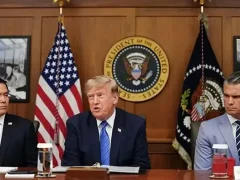
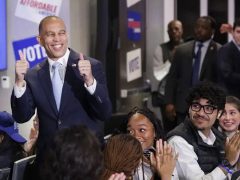

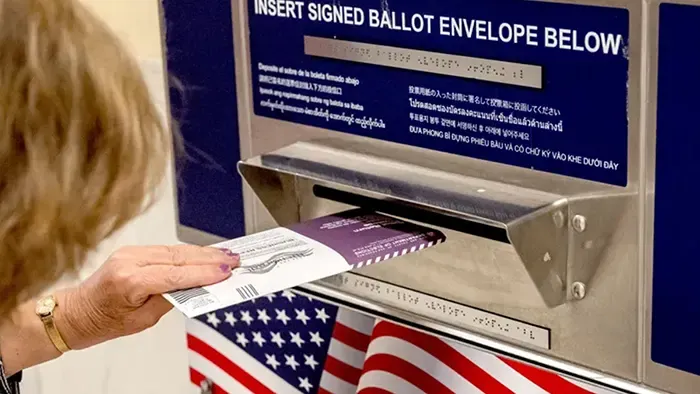
The Democratic Party is anticipating a major victory in the US midterm elections. With a Republican president who is historically unpopular, a public frustrated by rising prices for food and essential goods, and opinion polls that have consistently favored them for months, the party is hopeful for a strong performance in Tuesday’s election.
Polls indicate that Democratic candidates are well-positioned to secure more than the 218 seats required to wrest control of the House of Representatives—the lower chamber of Congress—from the Republicans. Meanwhile, in key Senate races, Democrats are either running neck-and-neck with their opponents or holding a narrow lead.
A recent *New York Times* poll shows a tight contest between the two parties’ candidates in the South Carolina Senate race.
In the 2020 presidential election, Donald Trump won this state by an 18-percentage-point margin. Conversely, recent CNN polls suggest that Democratic candidates are leading in Texas, Kansas, and Maine.
But how accurate are these opinion polls?
There are numerous instances in recent US political history where polls conducted just days before an election proved to be incorrect. In both 2016 and 2020, Trump performed better than the polls had predicted during his bids for the White House. Similarly, ahead of his narrow defeat in 2020, most polls had projected a landslide victory for Democratic candidate Joe Biden.
Earlier this year, polls predicted a double-digit victory for Abdul El-Sayed in the Democratic primary for a Senate seat in Michigan; however, he ultimately won by a margin of only 1 percent. In the Democratic primary for the gubernatorial race in Wisconsin, a candidate who was polling with a lead of nearly 20 points ended up losing by less than 1 percent. According to Clifford Young, president of Ipsos Public Affairs—a firm that conducts political and market research—carrying out public opinion polls has become increasingly difficult in recent years. This is largely because many Americans have abandoned landline phones and often decline calls from unknown numbers. Furthermore, even when pollsters manage to make contact, many individuals are simply unwilling to share their opinions.
“Conservatives—especially those on the far right—are inherently deeply opposed to the established system,” says Young. “They don’t want to participate in anything; they despise the entire system. That is the major challenge.”
If a segment of Republican voters is consistently underrepresented in polls—and if polling organizations fail to account for this when constructing their voter models—the results may skew in favor of the Democrats.
This makes it increasingly difficult for pollsters to accurately gauge the composition of the electorate and predict who will actually show up to vote.
One explanation for why Donald Trump performed better than the polls predicted in previous presidential elections is that many of his supporters were not regular voters; yet, when the election arrived, they turned out at the polls in numbers far greater than anticipated.
This unpredictable behavior among voters is a key reason for the significant errors seen in recent public opinion polls. While most credible polls remained within a margin of error of just a few percentage points, in a tightly contested race, even such a small margin can determine the difference between victory and defeat.
Many of the critical Senate races this year appear to be heading toward similarly close contests.
However, in recent years, public opinion polls for midterm elections have proven to be relatively more accurate. One reason for this is that these elections did not feature a presidential candidate—like Trump—capable of generating such an intense, widespread response among the electorate.
In the 2022 midterm elections, polls indicated that despite President Biden’s low approval ratings, the Democrats were able to defy conventional political expectations and avoid a major electoral disaster. Although the party ultimately lost control of the House of Representatives, the margin was narrow. They did, however, manage to retain control of the Senate.
Young notes that while this year’s primary elections have seen some significant, unexpected outcomes, the process of selecting candidates is historically quite unpredictable. Voters in these elections often change their minds at the last minute. Therefore, it would be incorrect to assume that current general election polls are flawed simply because of the results seen in the primaries.
Challenges for Democrats, even as Trump’s popularity wanes
Typically, the party of an incumbent president faces poor results in U.S. midterm elections. A notable recent example is the 2010 midterm election, in which Republicans gained more than 60 seats in the House of Representatives and also increased their standing in the Senate.
At that time, the U.S. economy was struggling to recover from a global economic downturn. Simultaneously, President Barack Obama’s healthcare reforms had sparked concern among conservatives.
Although public opinion polls had predicted a defeat for the Democrats, the scale of that loss was far greater than anticipated.
The situation is now reversed. The Democrats are in the opposition, and the economy has taken center stage for voters. However, given Trump’s low approval ratings and historical trends, the Democrats might not achieve the strong results they are hoping for. There are several reasons for this.
First, many of the areas being contested in this election are places where Trump won easily in the presidential election just two years ago; consequently, these regions are considered Republican strongholds.
Second, the periodic redrawing of congressional district boundaries over the years has reduced the likelihood of seats shifting between the two parties.
Third, deep political polarization in the United States has led to a decline in the number of swing voters. Some experts describe the current electoral landscape as largely static or unchangeable.
Furthermore, in the final weeks of the campaign, the Republicans have had the resources to spend vast sums of money on advertising against their opponents—a financial advantage amounting to hundreds of millions of dollars.
How reliable are the averages of opinion polls?
Public opinion polling models are designed by taking into account shifting voter sentiments and the fundamental conditions of an election. A well-designed poll also accounts for factors that could potentially undermine the reliability of its results.
Every poll carries a margin of error, a statistical uncertainty determined by the size of the sample relative to the total voting population. However, analyzing the average of multiple polls—rather than relying on a single one—can provide a more accurate picture.
Current polling trends suggest that even if the same types of discrepancies seen in the last presidential election were to recur, the Democrats still appear well-positioned for a strong performance on November 3rd. Moreover, polling errors do not always skew in one direction. In various state-level and special elections held over the past year, the Democrats performed better than most polls had predicted, as their supporters turned out to vote in greater numbers than anticipated. The fact that Trump has been holding campaign rallies in states he won easily in 2024—even in these final days of the campaign—has given Democrats reason for optimism. They suspect that internal Republican polling may be revealing concerns regarding the standing of the party’s candidates.
However, voter sentiment can shift right up until Election Day. Significant last-minute changes among the electorate can alter the landscape of an electoral contest. Conversely, a large portion of those who remain undecided could ultimately end up casting their ballots for the same candidate.
There will always be a degree of uncertainty in public opinion polls; managing that uncertainty is an inherent part of the science and methodology behind conducting such surveys.
Young notes, “I think we are doing a better job than before. But a persistent challenge we face is that this isn’t just about the pollsters—we are dealing with human behavior, and human beings are not easy to understand.”