US President Donald Trump has once again claimed that negotiations with Iran are underway, though Tehran has denied this. Amidst this situation, Trump stated that this is Iran’s “last chance” to reach an agreement; otherwise, the country would face a difficult situation.
Speaking to reporters at the White House on Monday, Trump said he agreed to continue talks with Iran at the request of several nations, including Saudi Arabia, the United Arab Emirates (UAE), and Qatar.
Trump said, “We are currently holding talks. This is their last chance to secure a good deal. I want to give them one final opportunity before the situation worsens.”
However, on the same day, Iran’s Foreign Ministry stated that no negotiations with Washington were taking place. Despite Tehran’s statement, Trump remained firm in his claim.
The US President noted that two issues are being prioritized in the talks with Iran. One is the reopening of the Strait of Hormuz.
According to him, this could happen “as early as tomorrow.” The other issue is Iran’s nuclear disarmament, though he acknowledged that implementation in this regard might take some time.
Tensions over the Strait of Hormuz
Conflict between the two sides has persisted since the US and Israel launched surprise attacks on Iran on February 28. Although diplomatic discussions have occurred sporadically, tensions have not fully subsided even after more than five months.
Iran retains the capability to launch missile and drone attacks targeting the US and its allies in the Middle East. At the same time, the country has maintained its stockpile of enriched uranium.
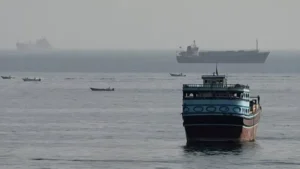
Meanwhile, on Tuesday morning, the UK Maritime Trade Operations (UKMTO) reported that a cargo ship in the Strait of Hormuz, off the coast of Oman, was struck by a “missile from an unknown source.” However, details regarding the ship’s name, casualties, or extent of damage were not disclosed. The agency stated that the incident is under investigation.
Last week, Trump had threatened a major attack on Iran’s energy infrastructure. However, on Saturday, he softened his stance slightly, stating that the “framework” for an agreement was nearly ready. Conflicting Statements Regarding Talks
In a social media post, Trump stated, “Whether Iran admits it or not, we are indeed discussing a solution to the crisis they have created over many years.”
He added that US counter-sanctions against Iranian ports remain in effect.
He asserted that nothing would be allowed to reach Iran without US permission, noting that this stance would not change without a deal or “total surrender.”
Meanwhile, Iranian Foreign Ministry spokesperson Esmaeil Baghaei stated that discussions are underway with Oman to ensure safe shipping through the Strait of Hormuz.
He said, “We are close to reaching an agreement that is acceptable to both sides—one that respects the sovereign rights, national interests, and security of both nations.”
However, Baghaei clarified that even if an agreement is reached, there is no likelihood of fully opening the Strait of Hormuz immediately.
Dispute Over Nuclear Program
Trump has maintained from the outset that this confrontation is necessary to curb Iran’s nuclear program.
On Monday, he reiterated, “We must ensure Iran’s nuclear disarmament.”
Western nations allege that Iran is secretly attempting to develop nuclear weapons; however, Tehran maintains that its nuclear program is conducted solely for civilian purposes.
Speaking to reporters aboard Air Force One over the weekend, Trump mentioned that several US allies in the Middle East had urged him not to launch a new attack on Iran.
He claimed that such an attack could have been one of the largest since World War II.
However, Iranian state media has denied Trump’s claim.
A ceasefire agreement reached last month ultimately collapsed; that deal was intended to open the Strait of Hormuz for the passage of oil tankers from the Gulf region.
Before the conflict, ships navigated this vital waterway freely. Currently, Iran is permitting vessels to use routes closer to its own coast. Tehran seeks to retain control over the Strait of Hormuz and collect fees for passage—a move the United States refuses to accept.