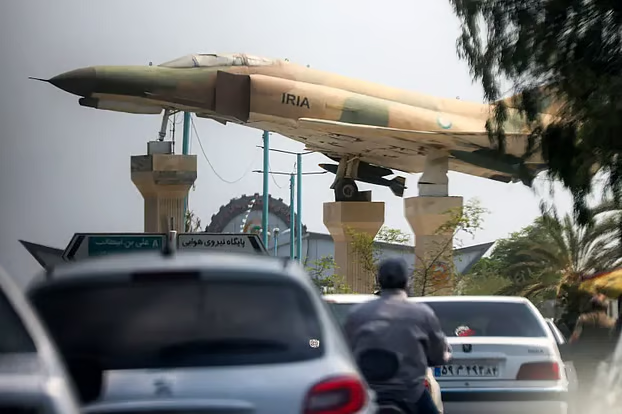
Qatar has denied claims that it is detaining Iranian pilots. The country stated that earlier this year, Iranian pilots violated Qatari airspace and failed to respond to attempts to establish contact.
A spokesperson for the Qatari Ministry of Foreign Affairs wrote in a post on the social media platform X on Saturday that search and rescue teams later recovered the body of one of the pilots. Communication has been established with Iran to coordinate the handover of the body.
The spokesperson added that Qatar has invited Tehran to review the details of the operation, an invitation to which Iran has not yet responded.
An Al Jazeera report noted that Majed Al-Ansari, the spokesperson for the Qatari Ministry of Foreign Affairs, expressed surprise on Saturday at the “misleading statements” made by Iranian officials. He confirmed that Qatari forces had not detained any surviving pilots or crew members.
In his post on X, Majed Al-Ansari wrote, “We unequivocally reject the claims circulating about the detention of Iranian pilots. We are also surprised by such misleading statements at a time when diplomatic efforts and various initiatives to de-escalate regional tensions are underway.”
Prior to Majed’s statement, Tehran had demanded the release of its pilots. A report by Iran’s Fars News Agency stated that General Mohammad Bagherzadeh of the Iranian Armed Forces claimed, in a letter to the International Committee of the Red Cross (ICRC), that three pilots—Javad Salehi, Abdolmajid Dashtian, and Omran Behravashian—were detained alive by Qatar following the crash of their Su-24 fighter jet in March. According to a report by Iran’s Fars News Agency, General Mohammad Bagherzadeh of the Iranian Armed Forces claimed in a letter to the International Committee of the Red Cross (ICRC) that three pilots—Javad Salehi, Abdolmajid Dashtian, and Omran Behravashian—were captured alive by Qatar after their Su-24 fighter jet crashed in March.
General Bagherzadeh further wrote that the pilots have been held in detention for six months without access to anyone; they have been denied contact with their families or diplomatic representatives. He called for international humanitarian intervention in the matter.
Iran had previously stated that one of its pilots was killed and others went missing following a mission involving Qatar. However, detailed information regarding allegations of their detention had not been made public until now.
Doha confirmed that last March, after multiple fighter jets entered Qatari airspace without authorization, Qatari air defense forces established contact and issued warnings. When no response was received, Qatari forces engaged the aircraft.
Subsequently, a Qatari search and rescue team recovered the body of Iranian pilot Majid Kazemi. Qatar also coordinated with Iranian authorities regarding the repatriation of his remains.
On Saturday, Majed stated that Qatar had contacted the Iranian side to coordinate the handover of the recovered pilot’s body, in accordance with relevant provisions of international humanitarian law.
The Qatari official added, “Furthermore, an Iranian team was invited to visit Qatar to receive details about the search and rescue operations conducted in April, but Iranian authorities have not yet responded to the invitation.”
The incident involving the downing of the Iranian fighter jet occurred near Qatar’s Al-Udeid Air Base. This base is the largest US military installation in the region and houses personnel from the US Central Command (CENTCOM).
In early March, Qatar’s Ministry of Defense announced that it had shot down two Iranian Sukhoi Su-24 bomber aircraft. This marked the first instance of a Gulf nation reporting the downing of an Iranian warplane since the conflict with Iran began.
On February 28, the United States and Israel launched a joint attack on Iran, prompting a retaliatory response from Tehran. The two Iranian warplanes were shot down amidst this wave of reciprocal attacks that swept across the Gulf region.
Although a ceasefire brokered by Pakistan last April temporarily halted major military hostilities, negotiations regarding a peace framework collapsed in June. Consequently, sporadic clashes erupted near the Strait of Hormuz, accompanied by renewed attacks on regional shipping and infrastructure.
Despite this ongoing conflict, Qatar remains actively engaged as a key mediator, continuing its efforts to facilitate a negotiated settlement between Iran and the United States.