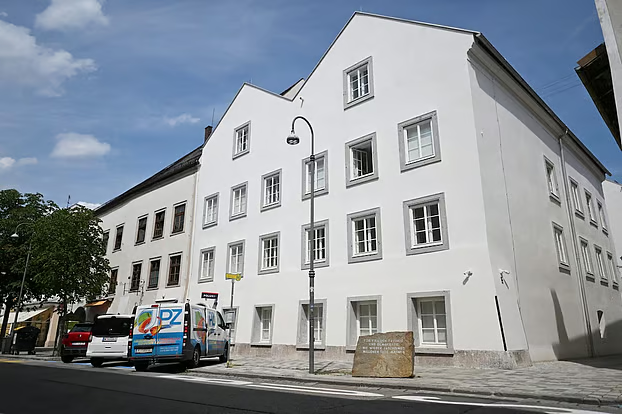
Several cars are parked outside the birthplace of Nazi leader Adolf Hitler. July 16, 2026, Braunau (Reuters).
Nazi leader Adolf Hitler was born on April 20, 1889, in the town of Braunau—specifically Braunau am Inn—on the banks of the Inn River in Austria. The house where he was born has undergone renovation over the past several years and is now set for state use. Today, Wednesday, the building is being officially inaugurated as a police station.
Hitler’s parents once lived in the house as tenants, though they moved elsewhere just months after his birth. The building’s history has shifted many times since then. After Austria was annexed by the German Reich in 1938, the Nazi Party (NSDAP) purchased the property. They established a cultural center there dedicated to their ideology and their ‘Führer’ (leader).
Following World War II, the building was returned to its original owners, and the Austrian government later leased it. Over the years, it served various purposes, including a library, a school, and finally, a workshop for people with disabilities. It had remained vacant since 2011.
In 2016, the Austrian government decided to acquire the privately owned building to prevent neo-Nazis from using it as a pilgrimage site. Despite this, neo-Nazis and Hitler sympathizers were frequently seen visiting the location.
Subsequently, the Austrian Ministry of the Interior established a commission tasked with determining a historically appropriate use for Adolf Hitler’s birthplace. The commission recommended that the building be utilized for social welfare purposes or government administration.
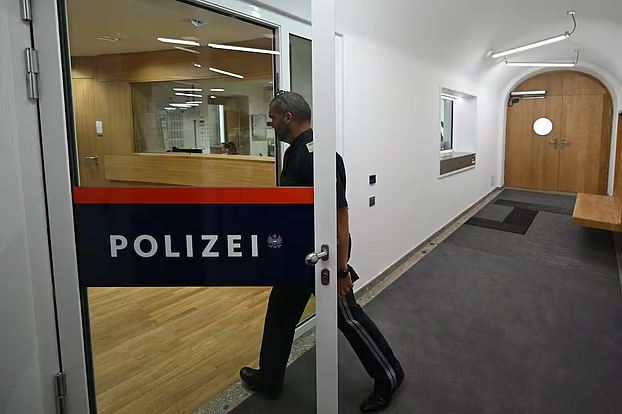
After years of renovation work, Adolf Hitler’s birthplace is now ready for state use. Today, Wednesday, the building will be officially inaugurated as a police station. The renovation cost approximately 20 million euros. Officers from the local police command and inspection center will be on duty across the entire site, covering the main building, surrounding structures, and the inner courtyard. No information plaques have been affixed to the exterior walls of the new building.
Oskar Deutsch, a member of the commission established to determine the historically appropriate use of Adolf Hitler’s birthplace, told the German media outlet Deutsche Welle, “Our primary objective was to ensure that this house would not become a pilgrimage site for Nazis.”
The Interior Minister noted that other uses had been considered but emphasized that the site would now house a police station belonging to a democratic constitutional state—an institution tasked, among other things, with countering any resurgence of Nazi ideology.
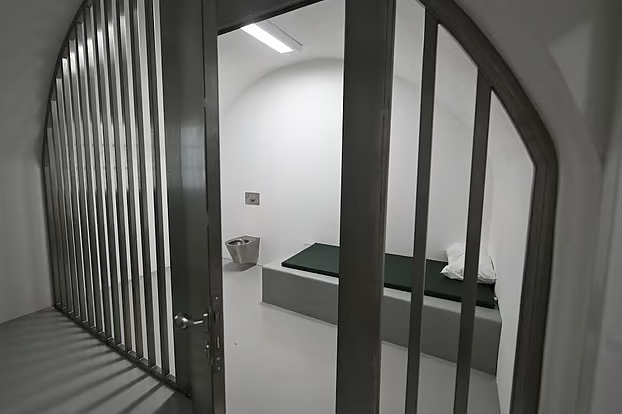
Another commission member, historian Oliver Rathkolb, said, “We had unanimously proposed handing the building over to a humanitarian welfare organization called Volkshilfe initially, but that proposal was rejected. Now that a police station is located here, Hitler admirers will be discouraged from standing in front of the transformed building to take selfies.”
Citizens of Braunau have mixed reactions to the matter. Eveline Doll, a Braunau resident and spokesperson for the local citizens’ initiative “Diskurs Hitlerhaus,” told Deutsche Welle, “The city is not responsible for this history. Yet, Braunau will forever be known worldwide as the place where one of the greatest mass murderers in human history was born.”
In recent years, Adolf Hitler’s birthplace had become a gathering point for neo-Nazis. The house at Prinzregentenplatz in Munich—Hitler’s last registered address in Germany—is also currently used as a police station. Following Hitler’s death, that building came under the ownership of the state of Bavaria and was utilized for various government functions.
A police station was established in that building in 1998. Recently, this police station has been opened to the public during certain events to demonstrate that a site once associated with a harsh and dark past now serves as a symbol of democratic values.