








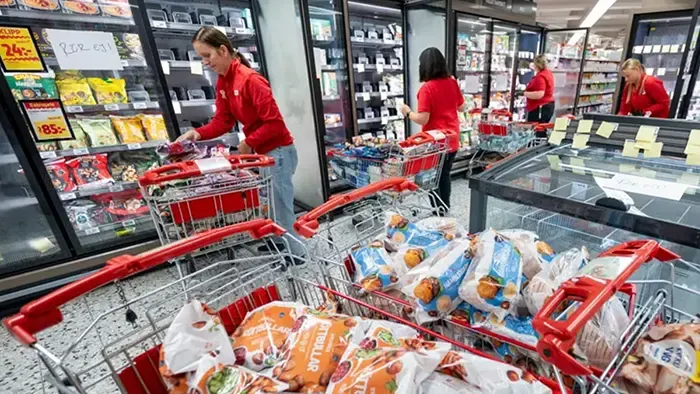
A series of cyberattacks has targeted the refrigeration and freezing systems of supermarkets in at least 10 European countries. The resulting spoilage of large quantities of food has raised concerns about potential disruptions to the food supply chain. In light of the situation, the European Union (EU) has issued a warning to consumers.
Meanwhile, various European nations remain on high alert, anticipating further cyberattacks.
This week, such attacks occurred at supermarkets in Belgium, Estonia, Finland, Ireland, Italy, Luxembourg, the Netherlands, Portugal, Germany, and Sweden.
Authorities reported that the cyberattacks caused temperatures in supermarket freezers to rise abnormally—in some instances, reaching as high as 50 degrees Celsius (122 degrees Fahrenheit). Consequently, the stored food perished, forcing businesses to discard it.
No individual or group has yet claimed responsibility for these attacks. However, the European Union has expressed concern regarding this series of incidents.
Just three weeks earlier, a similar cyberattack in France affected approximately 700 grocery stores, resulting in the loss of food products estimated to be worth tens of millions of euros.
Beyond freezing systems, these events have sparked renewed concerns regarding the security of other equipment that can be controlled or monitored remotely. Experts fear that these incidents could be part of a broader strategy involving state-sponsored “hybrid” attacks.
Christophe Hansen, the European Commissioner for Agriculture and Food, stated that the EU is treating these recent events with the utmost seriousness. He further warned of the potential for even greater disruption in the future.
European Commission spokesperson Thomas Regnier did not explicitly assign blame to any specific party. However, he noted, “These incidents have once again demonstrated how cyberattacks can disrupt essential services and impact the daily lives of citizens.”
He added, “These are not isolated incidents. We must collectively become more resilient and better prepared to counter such cyberattacks.”
**Supermarkets Affected in Italy**
In Italy, Prime Minister Giorgia Meloni’s government—following a meeting with intelligence agency chiefs—stated that the impact of the attacks in the country remains limited for now. Much of the food supply infrastructure already employs advanced security measures to prevent such attacks.
The country’s National Cybersecurity Agency reported that at least four cooperative supermarkets in Sicily and one business in Tuscany were targeted.
Meloni’s office indicated that most of the affected establishments were using outdated security systems; their interfaces were directly connected to the internet, and their security verification protocols were inadequate.
**Freezing Systems Fail in Dozens of Belgian Stores**
Belgium is among the countries most severely affected by the recent wave of attacks. Reports indicate that refrigeration and freezing systems have failed in dozens of supermarkets across the country. Federal prosecutors have launched an investigation into the matter.
Mathieu Tillmann, a manager at a Delhaize supermarket in Belgium, told the BBC that he was shocked by such an attack.
“I cannot fathom how someone could do this,” he said. “Why are we forced to discard so much food? It is truly painful. Situations like this make me want to quit my job.”
**Disruptions in Ireland and the Netherlands**
In Ireland, 13 stores within the SuperValu chain were affected by the cyberattack. The Musgrave Group, which owns the chain, described the incident as a major attack.
On Monday, a company spokesperson stated that efforts are well underway to restock chilled and frozen food products in the affected stores. Several small supermarkets in the Netherlands have also been targeted. Last month, the Dutch supermarket chain Albert Heijn was forced to suspend some of its services due to a separate cyberattack.
In Germany, a cyberattack on a systems provider called Danfoss caused disruptions to the refrigeration systems at Rewe Busken supermarkets in the western part of the country. The company informed the BBC that the stores resumed operations on Monday afternoon, following the repair of the technical faults.
In Portugal, the Mosqueteiros Group stated that incidents at seven of its Intermarché chain stores were linked to a cyberattack. The company believes the attack targeted an external service provider responsible for managing their refrigeration systems.
Swedish supermarket chain ICA has not explicitly confirmed a cyberattack, though it did report issues with refrigeration systems in a limited number of its stores. The country’s national cybersecurity agencies are currently monitoring the situation.
In Finland, abnormal temperatures were detected in several small grocery stores owned by the Kesko Group; the company is currently investigating the matter.
In Estonia, at least one supermarket fell victim to a cyberattack. According to the national broadcaster ERR, hackers raised the temperature in the supermarket’s refrigeration units to as high as 50 degrees Celsius.
Alerts issued in the UK; concerns raised over potential AI-driven attacks.
Following recent events in Europe, the UK’s National Cyber Security Centre (NCSC) has advised the country’s retailers to update the software that controls the temperature of their refrigeration units.
The agency has warned that the UK’s critical national infrastructure could face cyberattacks driven by artificial intelligence (AI) within the next two years.
Richard Horne, head of the National Cyber Security Centre, told BBC Radio 4’s ‘Today’ programme that there have been instances in the UK where vulnerable technology was exploited following cyberattacks.
He stated, “We do not yet know the full extent of the impact of these incidents. However, we do know that in some cases, vulnerable technology has been exploited. We are currently working with the affected organisations.”
When asked whether British supermarkets—or specific brands and models of freezers—were being targeted, Horne explained that the issue is not limited to supermarkets alone; rather, it could have an impact across the entire food supply chain.
He added, “We have been working around the clock to alert various organisations. We are reaching out to those that have vulnerable technology and may be exposed to such risks.”