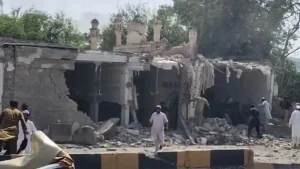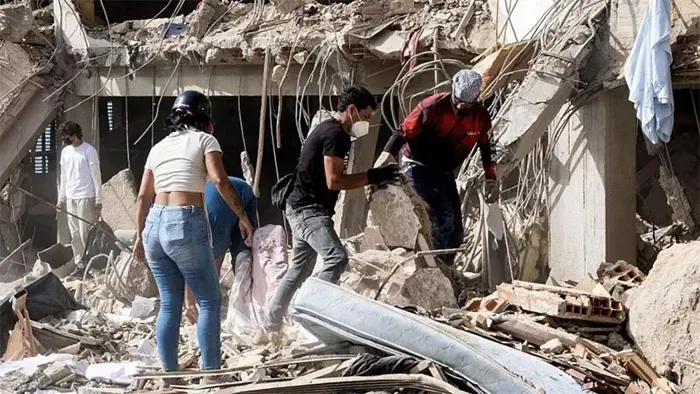
Debris is being cleared using bare hands and shovels. Drones are flying overhead, attempting to detect signs of life from above. Every moment and every step is now critical; the race to rescue survivors is a battle against time. Such efforts are underway to rescue missing persons in Venezuela. The coastal state of La Guaira, located on the border near the capital, Caracas, presents a scene of massive devastation as far as the eye can see. It is one of the hardest-hit areas following two powerful earthquakes that struck on Wednesday. This report comes from BBC Online.
Residents and their families are desperately searching the rubble for loved ones and valuables. They strain to hear even the faintest sound, hoping to detect signs of life beneath the concrete and iron rods. Officials have confirmed that at least 1,430 people have died in the two earthquakes, which registered magnitudes of 7.2 and 7.5. The 7.5-magnitude quake was one of the most powerful ever recorded in the country over the last century. Hundreds of buildings have collapsed, and thousands of people remain trapped under the debris. The death and injury tolls are rising by the hour. The United Nations estimates that approximately 50,000 people are missing. While local rescue teams are limited in number, international teams from Mexico, Spain, the United States, and Britain have arrived to assist—yet even this is not enough.
According to humanitarian aid organizations, the first 48 to 72 hours are the most critical for rescuing survivors. However, this window can be extended if those trapped have access to food and water. Jorge Rodríguez, President of the National Assembly, stated, “Every person rescued is a miracle. We will not hide anything regarding the severity of this tragedy.”
A shadow of despair hangs over the coastal city of Catia La Mar in La Guaira state; very few buildings remain standing intact there. Government forces are distributing food and water to survivors. Interim President Delcy Rodríguez stated that the government is conducting an all-out rescue operation during this critical period. Anxious people are waiting near the sites where their relatives are believed to be trapped. One of them is Jesús Suárez, who traveled nearly 200 kilometers to search for his son, Jean Suárez. He says no information is available; those who know his son say they did not see him escape. Pointing toward the rubble of a collapsed building, he says, “I believe he is right there.”
Suárez is facing a crisis shared by many people here. He notes that rescuing him is nearly impossible—there is no advanced equipment, and a single person cannot do it alone; it is extremely dangerous. At least the relatives of 31-year-old Carlos Eduardo know where he is; occasionally, they hear him speak or groan.
One of his cousins told BBC News Mundo, “We start calling out—’Carlos, Carlos…’—and then he makes a sound, a groan. That happened about an hour and a half ago.” He added, “We haven’t heard any sound since then. He hasn’t spoken or shown any signs of life. But he has done this before; on Saturday afternoon, too, he went silent after groaning. So, we are still waiting for help, hoping he can be rescued alive.”
Traffic congestion and crowds of people are often hindering rescue efforts. Soldiers and volunteers from Mexico are repeatedly asking everyone to remain silent so that any sounds of life from beneath the rubble can be heard. Everyone is helping in whatever way they can. Those with drones are trying to locate survivors or bodies in hard-to-reach areas. Family members watch the drone footage closely—hoping to spot a familiar piece of clothing, a lock of hair, or a personal item; anything that might bring news of their loved one. As the unofficial death toll rises over time, so too do the dire consequences of the situation.
Glendys Delgado says a stench is spreading—the smell of decomposing bodies—which threatens to make both adults and children ill. She notes that two buildings near her home have collapsed, yet no government assistance has reached the area. “No one from the government has come here,” she says, “but I thank God that people from Caracas have arrived to help us with food.”
Twenty-seven-year-old Deiyer Gabriel says that places like Macuto and Caribe have all been devastated, and everyone is affected by the foul odor. On Friday, authorities announced that 861 volunteers from various countries—including Mexico, the United States, El Salvador, Switzerland, and Colombia—had already arrived in Venezuela, with more on the way. Interim President Delcy Rodriguez stated that she spoke with US President Donald Trump and US Secretary of State Marco Rubio on Friday; they reiterated their pledge to send rescue teams and relief supplies.
A woman stands before her ruined home, her legs still trembling. She makes an impassioned plea: “We are waiting for humanitarian aid; they simply must come to help us.” She had returned to the house to retrieve her washing machine. “It is a dire situation,” she says. “We weren’t prepared for this. People work so hard and make so many sacrifices to build something, only for it all to collapse in the blink of an eye. Yet, life is what matters most.” Twenty-eight-year-old Alexandra Gabino faces a similar plight. She has two children—one aged seven and the other two. She was in the car with her husband and children when the earthquake struck. “The children started screaming,” she recalls. “We didn’t realize what was happening. Suddenly, the building next to us collapsed, and my husband quickly reversed the car.”
Now, the family of four is spending their nights in their car in the parking lot of Simón Bolívar International Airport in Maiquetía. The airport is closed due to damage, but the open, flat area away from the buildings offers a relatively safer place to take shelter. Alexandra waits outside the damaged building while her husband attempts to reach their 15th-floor apartment to retrieve essentials and important documents. “Just the absolute necessities,” she says, “because going inside is extremely dangerous. We can’t risk trying to save too much.” She speaks of the pain of losing everything: “My mother lost her home, and so did we. We have nothing left.” She tries to stay strong for her children, then voices a sentiment shared by so many: “People say that being alive is what matters most. Yes, that’s true. But what we are enduring is incredibly painful. Witnessing people’s suffering, hearing their screams, seeing children trapped in the rubble, and feeling the helplessness of being unable to do anything while trying to care for my own children—it is all deeply agonizing.” Finally, she adds that while she tries to remain strong, she is suffering deeply inside.