








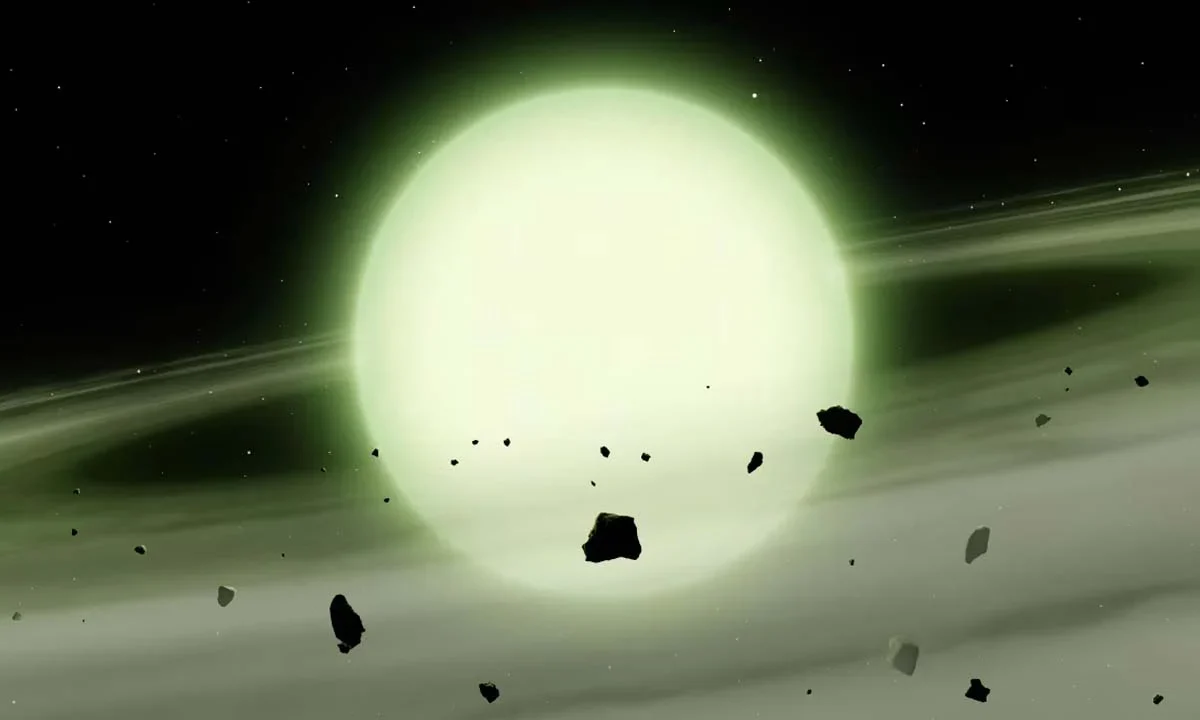
Scientists have discovered two white dwarf stars with rare characteristics in space. One of them may appear green to the human eye, while the other appears pink—or, more precisely, “salmon pink.” Astronomers at the University of Warwick in the United Kingdom made this extraordinary discovery while conducting research on white dwarfs, which are the remnants of dead stars.
Led by Mark Hollands, the research team observed several white dwarf stars located within approximately 65 light-years of Earth. By analyzing the light emitted by these stars, the scientists determined their likely colors. This process revealed the existence of a green-hued star, as well as another star with a pinkish tint, which features a dense layer of carbon.
Typically, a star’s color depends on its temperature, which is why stars often appear orange, white, or blue. However, the presence of various elements in a white dwarf’s atmosphere—combined with its unique physical environment—can alter the characteristics of the light it emits, causing some stars to display colors that deviate from the norm.
According to the researchers, the green star’s unusual color stems from the interaction between helium and other elements present in its atmosphere. They also detected metals such as calcium, sodium, and lithium on the star. To explain how these elements accumulated there, the scientists examined potential past events involving the star.
They hypothesize that if a rocky asteroid or a destroyed planet were to approach a white dwarf, the star’s intense gravitational pull could cause the object to break apart. The resulting debris—in the form of dust—would then integrate into the star’s outer layers. By studying the various chemical elements that accumulate on a star’s surface in this manner, scientists can gain insights into its past history. Scientists have compared this process to investigating a ‘crime scene’ in space. According to their explanation, planets or asteroids in the vicinity of a white dwarf star can be torn apart by gravitational forces. By analyzing the chemical traces left behind in the star’s atmosphere, researchers can uncover clues about these ancient cosmic events.
However, it is not possible to see the true colors of such distant stars with the naked eye or through standard telescopes. To overcome this, researchers analyzed the wavelengths and spectra of the light emitted by these stars. Based on this scientific data, they determined how these stars might appear to the human eye.
Researchers anticipate that with the help of new and advanced scientific instruments, it will be possible to analyze the light from a much larger number of stars in the future. This could lead to the discovery of more stars with such rare characteristics. They estimate that at least 10 to 12 additional green stars could potentially be identified.
The study has been published in the international scientific journal ‘RASTI’.