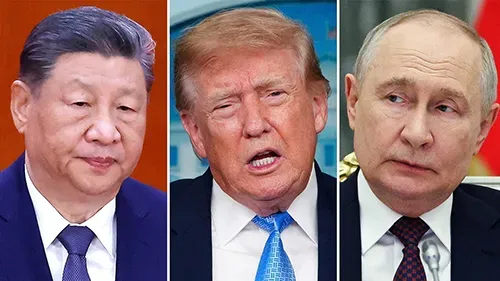
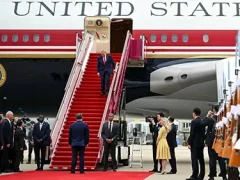





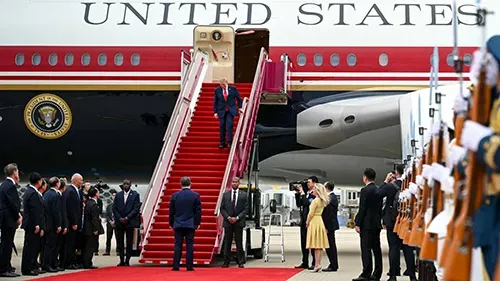
US President Donald Trump has arrived in Shenzhen, China, to attend the Asia-Pacific Economic Cooperation (APEC) summit. His welcome at the airport was marked by unprecedented arrangements; the number of people present to greet him was nearly double that seen for other heads of state. The most significant surprise was the personal presence of Chinese President Xi Jinping at the airport to welcome him. This gesture by a top Chinese leader—the first of its kind in nearly seven decades—carries special significance in international diplomacy.
According to a report by the *South China Morning Post*, young Chinese men and women stood in rows at the airport, holding bouquets of flowers along with the national flags of the United States and China. The welcoming ceremony also featured a performance by a military band.
A red carpet was laid out in front of the presidential aircraft, and a Chinese military honor guard stood in formation to salute the US President. As the crowd chanted slogans welcoming him, Trump was seen smiling and clapping.
However, the most notable aspect of this visit was Xi Jinping’s personal appearance at the airport. As he disembarked from the plane, Trump greeted Xi with a raised, clenched fist. The two leaders then shared a brief embrace at the foot of the aircraft stairs. This marks the first time in nearly seven decades that a top Chinese leader has personally gone to an airport to welcome a foreign head of state. The last such instance occurred in 1959, when then-Chinese leader Mao Zedong went to the airport to welcome Soviet leader Nikita Khrushchev.
Due to Xi Jinping’s presence, the joint US-Chinese motorcade accompanying Trump was exceptionally large, consisting of more than 20 limousines. Trump had previously received an elaborate, grand welcome during his state visit to Beijing this past May. On that occasion, he was welcomed at the airport by Chinese Vice President Han Zheng. During that visit, the leaders of the two nations agreed to build a constructive China-US relationship based on strategic stability.
Meanwhile, Russian President Vladimir Putin arrived in Shenzhen ahead of Trump’s visit. He was welcomed at the airport by Cai Qi, the fifth-highest-ranking official in China. This has drawn further attention to the special arrangements China made for Trump’s visit.
Chinese Fighter Jet Maneuvers in the Sky
A display by the Chinese Air Force added an extra dimension to the formal reception for Trump. Five J-10C fighter jets from the ‘August 1st’ Aerobatic Team of the Chinese People’s Liberation Army (PLA) Air Force flew over the airport, trailing red, yellow, and blue smoke.
Footage of this display was shared on social media by the state-run China News Service. Earlier, the *South China Morning Post* reported that the aerobatic team had been active in Guangdong Province; videos of the J-10C jets performing maneuvers in the skies over the province also circulated on social media.
The J-10C is regularly used by this Chinese aerobatic team. By trailing red, yellow, and blue smoke to form various shapes in the sky, the team showcases its capabilities during special events and state functions. The J-10 series has also garnered significant attention in military and international circles recently. Various reports claimed that during a conflict along the India-Pakistan border in May 2025, an Indian Rafale fighter jet shot down a J-10CE—the export variant of the aircraft—which was being operated by Pakistan. That incident sparked widespread international discussion regarding the aircraft’s capabilities.
This aerial display by China is also being compared to the arrangements made for Xi Jinping’s arrival at Joint Base Andrews, near Washington, D.C., last September. On that occasion, an aerial display featuring B-1B bombers, as well as F-22 and F-16 fighter jets, was organized by Trump. While Trump appeared visibly uncomfortable due to the deafening noise of the aircraft, Xi remained completely unfazed.
Meetings on Major Global Issues
Trump’s participation in this year’s APEC summit comes at a time when his administration is facing various pressures in both domestic and international politics. Just two weeks ago, his Republican Party suffered a significant defeat in the midterm elections. Meanwhile, the ongoing conflict with Iran and persistent diplomatic efforts to bring an end to the war in Ukraine have also emerged as critical issues in the international arena.
On the sidelines of the two-day Asia-Pacific Economic Cooperation (APEC) summit, Trump is scheduled to hold a high-level meeting with Xi Jinping—their third such encounter this year.
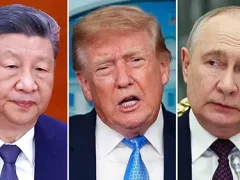
Furthermore, there is a possibility of a trilateral meeting between the leaders of China, the United States, and Russia. Such a meeting could address critical issues, including global security, the war in Ukraine, and the situation in the Middle East. Meanwhile, while speaking to journalists in Manila, Trump did not rule out the possibility of a meeting with North Korean leader Kim Jong Un.
All in all, Trump’s visit to Shenzhen in the context of the APEC summit extends well beyond mere formalities of economic cooperation. With Xi Jinping’s personal reception, a military display, and the potential for a trilateral meeting, the world is watching closely to see if a new equation is emerging in the relations between the United States, China, and Russia.