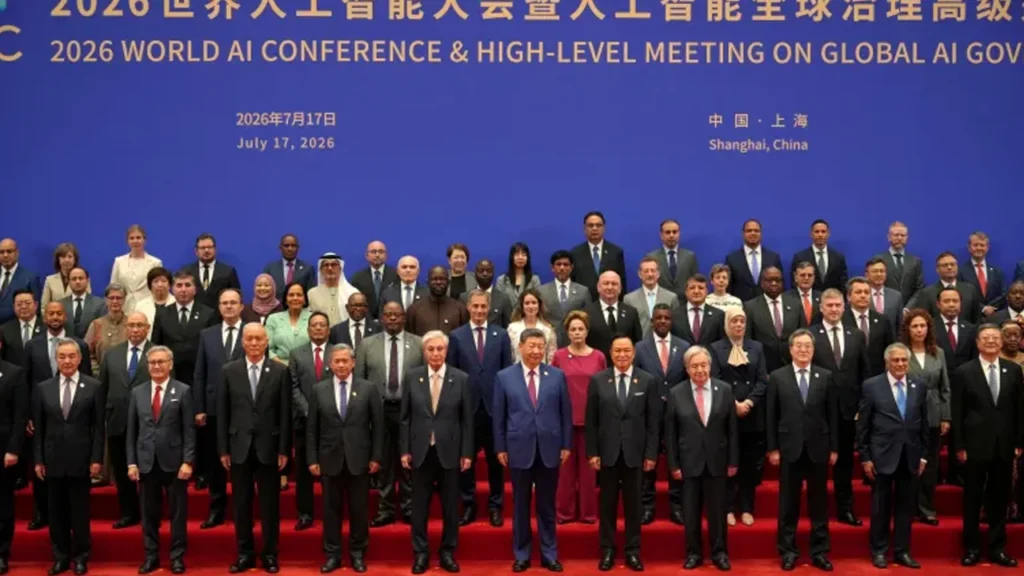
A four-day summit on artificial intelligence (AI) began in Shanghai, China on Friday. Through this event, Beijing is sending an important message not only to the world of technology but also to geopolitical issues.
At the opening ceremony of the conference, called the ‘World Artificial Intelligence Conference’ (WAIC), Chinese President Xi Jinping called on participating countries to increase cooperation in the AI sector.
He said that everyone should be careful not to establish exclusive dominance over this technology.
Analysts believe that his comment was aimed at the United States. The competition between the United States and China to establish dominance in the technology and AI sectors is now intense. Both countries believe that the progress of the opponent in this sector is part of a conscious effort to block the other side.
On the first day of the conference, China displayed all the cutting-edge technologies that can compete with the technological capabilities of the United States.
China-made AI models are gaining acceptance around the world. Beijing is trying to establish itself as the leader of a new global AI system. It is trying to challenge the influence of the United States in the development and regulation of this rapidly developing technology.
On Thursday, the day before the summit, China announced the formation of the ‘World Artificial Intelligence Cooperation Organization’ (WAICO). Representatives of the organization’s 29 founding member countries signed it in Shanghai. UN Secretary-General Antonio Guterres and representatives of various countries and international organizations were present there.
This is the ninth time since its inception in 2018. This year’s theme was ‘AI Partnership for a Brighter Future’.
What Xi Jinping said
Calling for the “historic opportunity” that open-source AI has brought, Xi Jinping said at the opening ceremony of the WAIC that China is playing a role in ensuring fair access to AI capabilities for developing countries so as to avoid “new historical inequalities.” He also announced plans to continue cooperation in the AI sector with countries in Africa, Latin America and Asia.
According to Xi Jinping, “AI development should not be a solo exhibition of any single country. It should be a concert of international cooperation.”
The Chinese president also said, “We must jointly oppose the idea of exaggerating the concept of national security in the AI sector or trying to put the security of one country above the security of another.”
Xi also emphasized the “human-centered” approach to AI development. He said that safeguards such as appropriate regulations, technological oversight, early warning and emergency measures must be put in place to ensure that “AI will always be under human control.”
What is WAICO?
The intergovernmental organization called the World Artificial Intelligence Cooperation Organization (WAICO) was officially formed last Thursday, but Beijing has been promoting the idea of forming a global AI alliance since last year.
The organization’s stated goal is to strengthen international cooperation and develop AI policies and regulations in different countries so that the technology is safe and beneficial for people.
The 29 founding members of the Shanghai-based WAICO include some important countries from the “Global South” such as Indonesia, Brazil, Malaysia, South Africa, Senegal, Russia and Pakistan.
Analysts believe that Beijing can use the alliance to influence AI-related policymaking at the United Nations.
Why it matters
Artificial intelligence is now a key pillar of China’s industrial policy. The country has invested heavily in building a self-sufficient domestic AI ecosystem, from chip production to consumer use.
This has intensified China’s “chip war” with the United States. The two world’s top economies are competing to establish control over the production of chip-based technologies, such as advanced military weapons and AI-based systems.
China still lags behind the United States in obtaining the most advanced semiconductors (the key ingredients for making chips). However, it is ahead in its ability to run the huge data centers needed to train and operate AI models. China also dominates the production of the important rare earth minerals needed to make chips.
China’s abundance of cheap electricity has also given it an additional advantage. The country is already generating more than twice as much electricity as the United States to meet the huge electricity demand for AI technology. This gap is expected to widen further as state-funded power infrastructure expands.
The United States has imposed restrictions on technology imports from China, citing national security concerns. Beijing claims the measures are aimed at hindering China’s AI progress.
Last May, the US Commerce Department reiterated its decision to impose restrictions on the export of key semiconductors to companies headquartered in China or affiliated with Chinese parent companies. In response, Beijing banned the export of dual-use technologies and key minerals to US companies.
Meanwhile, countries around the world are struggling to develop effective regulatory systems to keep pace with the rapid advancement of AI technology. In particular, there is a fierce debate about global policymaking, especially around issues such as the use of AI in the military.
In this context, Beijing has created an important position to influence the formulation of global policies related to AI by organizing the AI Conference and leading the WAICO alliance.
Where is WAICO in the global AI system
Chinese Premier Li Keqiang first announced plans to form WAICO in July 2025.
At that time, analysts believed that China did not want to limit itself to exporting its own AI infrastructure. Rather, it is trying to reflect its interests on the global stage by leading the way in establishing global AI policies and institutions before the United States.
According to many analysts, China has long been wary of the technology because of the origin of the Internet in the United States and its decentralized structure. For this reason, Beijing has tried to control the Internet within its own country and keep it in a separate structure.
According to analysts, taking the initiative to form an international framework before AI technology spreads widely around the world could create an opportunity for China to change that trend. Support, especially from middle- and low-income countries that are close to China, could further strengthen Beijing’s position at the United Nations.
“Beijing is showing interest in providing global leadership as Washington rapidly withdraws from global cyber and AI policymaking and reduces financial support for cyber diplomacy,” wrote good governance expert Arindrajit Basu in an analysis for the US-based think tank Carnegie Endowment for International Peace.
He added, “Through this, Beijing wants to make the state-centric approach to technology governance that China pursues with the support of countries in the global South internationally acceptable.”