








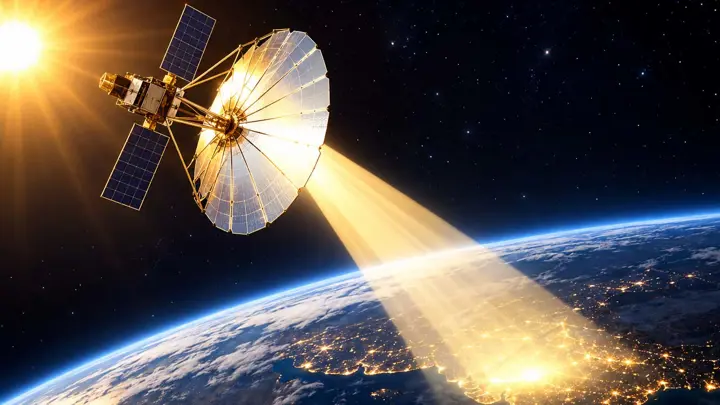
Reflect Orbital, a space startup based in California, USA, has proposed placing massive mirrors in space to bring sunlight to Earth during the night. The company aims to deploy thousands of mirror-equipped satellites into low Earth orbit to reflect sunlight toward specific locations as requested by customers. They envision using this technology for various purposes, such as boosting solar energy production, providing illumination in disaster-stricken areas, and facilitating rescue operations at night.
However, astronomers and environmentalists have raised concerns regarding the deployment of such a large number of mirror-satellites and the introduction of artificial light into the night sky. They fear that this initiative could increase light pollution, disrupt the natural life cycles of wildlife, and negatively affect human circadian rhythms—the biological cycles that regulate sleep.
Reflect Orbital has announced a partnership with the Indian space company Skyroot Aerospace to test this technology. According to the plan, the first experimental satellite, dubbed “Earendil-1,” is scheduled for launch in the second quarter of 2027. Previously, in July, the U.S. Federal Communications Commission (FCC) granted approval for the launch of this experimental satellite.
The company’s plan involves placing large, 18-by-18-meter reflective mirrors in low Earth orbit, approximately 645 kilometers above the planet’s surface. By controlling the position and orientation of these mirrors, it will be possible to reflect sunlight onto specific areas on Earth, even after the sun has set. The company claims that, in the initial phase, each mirror will be capable of illuminating an area of approximately five square kilometers.
To access this service, customers will need to use a mobile app to request illumination for a specific location. In exchange for a fee, the company will adjust the position and orientation of the space-based mirrors to direct sunlight to the requested area. As part of a long-term plan, Reflect Orbital aims to deploy 50,000 mirror-satellites into space by 2035. The company states that, initially, the light reflected by these mirrors will be comparable to the brightness of a full moon. As the number of satellites increases, both the intensity and duration of the light can be further enhanced. The company envisions potential applications for this technology, such as providing illumination for agricultural land, serving as an alternative to failed street lighting, and supplying solar energy for military operations.
Recently, the company conducted a demonstration of this technology near Mount Whitney, close to Lone Pine in California’s Sierra Nevada region. In an experiment organized in collaboration with a local rescue team, a powerful artificial light was directed onto a desert area. Local residents were taken aback by the sudden, intense light appearing in the darkness of the night; one resident described it as “dazzling.”
A spokesperson for Reflect Orbital suggests that search and rescue teams operating at night could be the first users of this service. The demonstration was intended to highlight how this technology could assist in saving lives during rescue operations.
Concerns Regarding Light Pollution and Biodiversity
A major concern surrounding the project involves the scattering of light within the atmosphere. A study published in August 2025 indicates that sunlight reflected from space would scatter upon colliding with air molecules and aerosol particles as it passes through Earth’s atmosphere. Even after reaching the ground, a portion of this light could reflect back and disperse further into the atmosphere. Consequently, not only the targeted area but also vast surrounding regions would become illuminated.
According to the study’s projections, the intensity of this light could exceed that of a full moon even at a distance of 14 kilometers from the primary illuminated zone. This implies that individuals who have not opted for this service—and are not paying for it—could still find themselves involuntarily exposed to the effects of this artificial light. In opposition to the project, four organizations—represented by the environmental legal group Earthjustice—filed a petition with the FCC last August, requesting a reconsideration of the approval. Jan Hasselman, a senior attorney at Earthjustice, criticized the plan, labeling it “foolish” and “insane.”
He noted that the evolution of all life on Earth has occurred in alignment with the natural rhythm of day and night—a system that should not be tampered with. He further expressed concern that if the plan to deploy 50,000 mirror-satellites is implemented, the night sky as we know it could be altered forever.
According to scientists, the survival-critical activities of birds, insects, and mammals—such as foraging for food, seeking shelter, and reproduction—depend on the natural cycle of day and night. An increase in artificial light during the night could disrupt the natural behaviors and life cycles of these creatures. Furthermore, there is a risk that it could interfere with the human biological clock, or circadian rhythm, which regulates sleep.
The American Astronomical Society has also issued a warning regarding this technology, cautioning that intense light reflected into telescopes could potentially cause eye damage.
Additionally, there is growing concern over the increasing number of satellites in Earth’s orbit. Elon Musk’s company, SpaceX, has plans to deploy one million data centers into orbit; if thousands of mirror-satellites are added to this, observing stars in the night sky could become significantly more difficult. Critics also fear that the amount of space debris could reach dangerous levels.
Debate surrounding global warming
Reflect Orbital argues that by reflecting sunlight onto solar panels during the night, the duration of solar power generation could be extended. This could potentially reduce reliance on fossil fuels, which would be a positive development for the environment.
However, some climate scientists oppose such artificial interventions regarding the amount and distribution of solar energy reaching Earth. David Ho, a climate scientist at the University of Hawaii, notes that the massive emission of greenhouse gases into the atmosphere has disrupted Earth’s energy balance, leading to global warming.
He points out that while some propose placing mirrors in space to reflect sunlight away from Earth to mitigate warming, Reflect Orbital’s plan involves using mirrors to direct sunlight toward the planet. According to him, there are serious questions regarding the potential impact such an initiative might have on the climate.
In response to the criticism, Reflect Orbital stated that it has consulted with scientists and astronomers to ensure that space observatories, national parks, and wildlife habitats remain unaffected by this artificial light.
A spokesperson for the company stated that they welcome scrutiny and criticism, adding that they consider it their responsibility to work in coordination with governments, scientists, and regulatory bodies.
Nevertheless, the debate persists regarding the long-term impact this technology might have on the environment, biodiversity, and the night sky, alongside its potential benefits.