








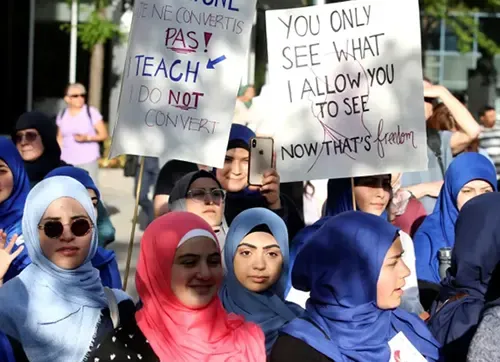
The Supreme Court of Canada has upheld a ban on the display of religious symbols in the public sector in the province of Quebec. In a ruling delivered on Friday, the country’s highest court validated the controversial law, which was enacted in 2019. Consequently, the prohibition remains in place, preventing individuals in public-sector jobs from wearing various religious symbols—including the hijab worn by Muslim women, the turbans of Sikhs, and the kippahs worn by Jewish individuals.
According to a report by Middle East Monitor, the law has faced criticism for allegedly targeting Muslim women who wear the hijab. However, its impact extends to other religious minority communities, including Catholics and Sikhs.
Based on the most recent census in 2021, Muslims make up approximately 5 percent of Quebec’s total population. Among Canada’s provinces, Quebec has the second-largest Muslim population, trailing only Ontario.
Amira Elghawaby—Canada’s first and only Special Representative on Combating Islamophobia—described the court’s ruling as “devastating.” Her office was closed earlier this year.
In a statement issued through the Muslim Communities Research Observatory—an organization she founded—Elghawaby remarked, “The promises made by the Canadian Charter of Rights and Freedoms have been broken. These rights may continue to be violated repeatedly in the future. This means that religious freedom, equality, and the rights of all Canadian citizens are no longer guaranteed.” She added, “This ruling will have an immediate impact on the lives and livelihoods of people in Quebec—Muslim women who wear the hijab, in particular, will be adversely affected.”
Law Upheld Due to Constitutional Provision
Central to the Supreme Court of Canada’s ruling is Section 33 of the Constitution, known as the “notwithstanding clause.” This provision allows a law to be shielded from legal challenges based on certain rights enshrined in the Canadian Charter of Rights and Freedoms. Quebec’s controversial Bill 21 has been addressed within the scope of this provision.
In a ruling on Friday, Chief Justice of the Supreme Court Richard Wagner stated, “In short, Bill 21 is rooted in Quebec’s legitimate and historical commitment to ensuring the secularism of the state within a free and democratic society.”
Controversial Bill 21 passed in 2019
In 2019, the Quebec government enacted Bill 21, which prohibits public-sector employees from wearing religious symbols while performing their duties. This includes various religious symbols, such as the hijab worn by Muslim women, the turbans worn by Sikhs, and the kippahs worn by Jews.
The bill was passed in the provincial legislature with a vote of 73 to 35. At the time, the right-leaning Coalition Avenir Québec government held a majority in the legislature. To limit debate on the legislation, the government invoked the Constitution’s “notwithstanding clause.”
Following the passage of the bill, then-Premier François Legault remarked, “This is the moment the people of Quebec have been waiting for for a long time.”