




Centrist political parties in major European nations are steadily losing public support. Slow economic growth, high inflation, the burden of public debt, and uncertainty regarding employment and the future for young people are driving ordinary citizens toward far-right and far-left political parties.
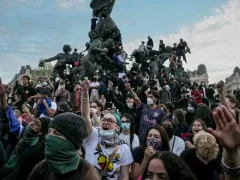
The recent crisis in France—where protests over funding shortages in the education sector escalated into nationwide violent unrest—serves as a stark example of this trend. However, this phenomenon has been developing for some time. Among the youth and the wage-earning working class, in particular, a perception has taken root that liberal democracy has failed to deliver on its promises of a better life and prosperity.
According to analysts, many now view both center-left and center-right parties as proponents of the same brand of politics. There is a growing belief that the educated elite leading these parties are disconnected from the struggles and aspirations of ordinary working people. Meanwhile, budget deficits, the rising cost of debt, and higher interest rates have made it increasingly difficult for governments to take significant action to address the crises affecting public life.
Consequently, in France, both the far-right National Rally—led by Marine Le Pen—and the far-left France Unbowed—led by Jean-Luc Mélenchon—are gaining popularity. In Germany, support is growing for the far-right Alternative for Germany (AfD) and the left-wing party Die Linke (The Left).
With major elections approaching in Spain, France, Italy, and Poland over the next year, political instability in Europe is likely to intensify. Even Italian Prime Minister Giorgia Meloni is facing challenges from hardline political rivals.
Declining Faith in Democracy
According to a survey by the Pew Research Center, dissatisfaction with the functioning of democracy is on the rise across major European nations. In France, 69 percent of people are dissatisfied with the functioning of democracy; the figures are 68 percent in Spain, 62 percent in Italy, and 47 percent in Poland. In the United States, this figure also stands at 69 percent.
According to Daron Acemoglu, a Nobel laureate in economics and a professor at MIT, there are two major failures underlying the crisis of democracy. First, the failure to distribute prosperity equitably among the general population. Second, the growing dominance of an educated elite within the political sphere.
Globalization, the spread of automated technologies, and income inequality have diminished the security of the working class. The advancement of artificial intelligence is also creating new concerns regarding jobs and livelihoods. Simultaneously, there is growing discontent over the failure of governments to maintain the quality of essential services, such as education, healthcare, and infrastructure.
Acemoglu argues that to revitalize liberal democracy, the interests of the working class must be brought back to the center of politics.
The Crisis of the Center in Germany
In Germany—Europe’s largest economy—the foundations of centrist politics are weakening. The center-right Christian Democratic Union (CDU) and the center-left Social Democratic Party (SPD)—which have dominated German politics since the Second World War—are now struggling to retain public support.
There is mounting criticism of the government’s handling of issues such as immigration, declining exports to the Chinese market, tensions with Russia, and sluggish economic growth. Former Chancellor Angela Merkel’s centrist policies and her decision to allow large-scale immigration alienated a segment of the CDU’s conservative base—a space that has since been occupied by the AfD (Alternative for Germany).
According to an average of current public opinion polls, the AfD commands approximately 28 percent support in Germany. The CDU and its coalition partner, the CSU, hold 19.8 percent, the Green Party 15 percent, and the SPD 13.1 percent. Support for the left-wing party Die Linke has also reached 11.3 percent.
Under these circumstances, securing the majority needed to form an effective government is becoming increasingly difficult. At the same time, there is growing disagreement among mainstream parties regarding the policies that should be adopted to counter the far-right.
Signs of a Major Shift in European Politics
Analysts fear that upcoming elections could bring significant changes to Europe’s political landscape. In a fragmented parliament or a coalition government, smaller far-right parties could wield greater influence. This might force mainstream parties to adopt more hardline stances and could also complicate the functioning of the European Union.
The French presidential election, set for next spring, is particularly significant in this regard. A victory for Marine Le Pen could have a major impact on European Union policies, the future of the euro, NATO, and Europe’s support for Ukraine.
According to analysts, political rhetoric alone is not enough to address this crisis. What is required are effective plans for job creation, wage increases, opportunities for advancement for those without university degrees, and the equitable distribution of the benefits of technology.
—An analysis by The New York Times