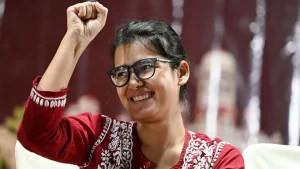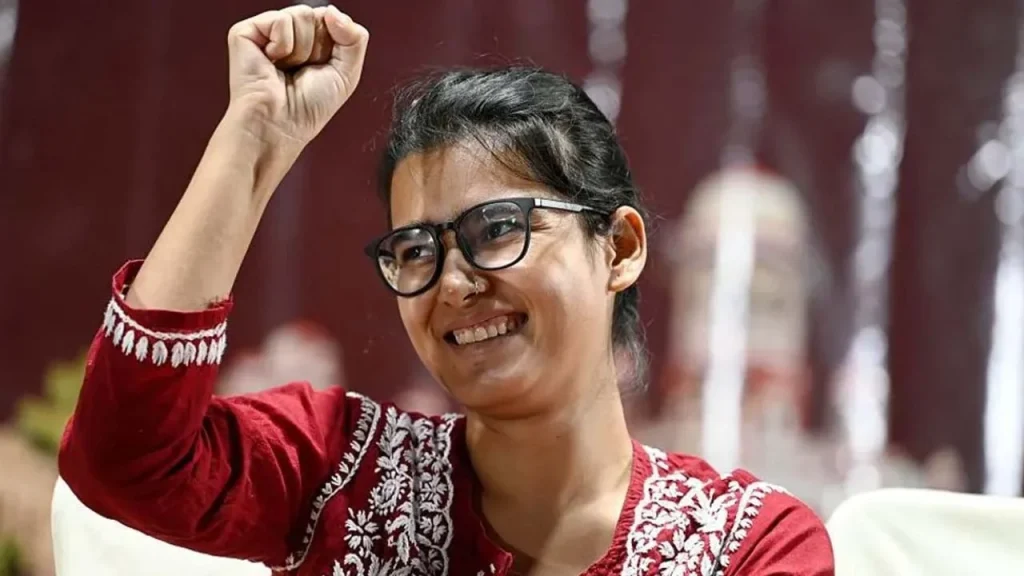
Neha Bora -a 29-year-old PhD researcher, theatre artist, and rights activist—has come into the spotlight amidst ongoing protests against Prime Minister Narendra Modi’s government over various issues. Public interest in her surged after videos circulated on social media showing her climbing police barricades to chant slogans, getting detained during street protests, and being carried away by police personnel.
Neha’s presence has particularly drawn attention within the movements led by India’s younger generation. The All India Students Association (AISA) has announced plans to participate in a protest at Delhi’s Jantar Mantar on October 10, demanding the resignation of Chief Election Commissioner Gyanesh Kumar; Neha, a leader of the organization, has confirmed her participation in the event.
However, in an interview with BBC Bangla, Neha downplayed the heightened attention surrounding her. She stated that the work she is doing within the Left-wing student movement is similar to what other activists have been doing for a long time; the only difference is that her actions were captured on camera, leading people to view the matter differently.
From student politics to national recognition
Born in the North Indian state of Uttarakhand, Neha grew up in various cities due to her father’s job as an army officer. After completing her undergraduate studies at Delhi University, she obtained a master’s degree from Ambedkar University in the capital. Currently, she is pursuing a PhD at Jawaharlal Nehru University (JNU) in India.
Neha has been associated with the Left-wing student organization AISA for the past decade and has served as its president for the last two years. This young activist has long campaigned on various student issues, including exam paper leaks and the need for educational reform.
However, her recognition beyond campus-based politics grew during the protests against educational reforms this past summer. A Gen-Z-led online satirical movement known as the ‘Cockroach Janata Party’ (CJP) staged protests in Delhi for several weeks. The movement concluded in July, following widespread protests regarding education reform and calls for the resignation of Education Minister Dharmendra Pradhan.
Although Neha and activists from AISA had participated in the movement since its inception, they were not widely known at the time. On June 28, when educationist and scientist Sonam Wangchuk began a hunger strike in support of the movement, Neha and several AISA activists joined him. It was then that Neha’s statements and her style of leading the protest caught the media’s attention.
In a subsequent interview, Neha stated that they had long been campaigning against question paper leaks and for education reform; thus, joining that specific protest was a natural decision for them.
**Hunger Strike, Detention, and Viral Videos**
While Sonam Wangchuk and others were hospitalized during the protest, Neha continued her hunger strike. Reports indicate that she lost approximately eight kilograms of weight as a result. Even after being hospitalized, she expressed her resolve to continue the movement in a video message, stating that once recovered, they would return to the streets to fight for their rights.
Neha has frequently appeared in the spotlight during recent clashes between protesters and the police, as well as during detentions. Videos circulating on social media show her climbing police barricades to chant slogans and being detained by female police officers. Images of her smiling while being carried away by police personnel also went viral.
Through these events, Neha has become a familiar face among young activists. She is participating in events supporting student demands across various cities and has also been seen at a press conference alongside Congress leader Rahul Gandhi.
**Criticism of Modi and the BJP; Family Disagreements**
Neha’s involvement in leftist politics and her critical stance toward BJP leaders—including Prime Minister Narendra Modi and Home Minister Amit Shah—have impacted her personal life. According to Neha, disagreements often arise within her family regarding her political stance, as her parents are staunch supporters of the BJP. Last month, the BJP filed at least three police complaints against Neha in Uttar Pradesh. These complaints cited her “objectionable remarks” regarding the state’s Chief Minister. Two days prior to that, AISA had lodged a police complaint on Neha’s behalf, claiming she had received death threats.
Additionally, it was alleged that a man threw ink at her during a protest march in Jharkhand. Neha later shared a photo of her ink-stained face on Instagram. Police stated that the accused individual was detained in connection with the incident.
**New Protests Over the Election Commission**
Amidst political debates in India regarding the electoral system and voter lists, a fresh call for protests has been issued. A demonstration demanding the resignation of Chief Election Commissioner Gyanesh Kumar is scheduled for October 10 at Jantar Mantar in Delhi. The event has been organized by the CJP.
Protesters allege that attempts were made to benefit Modi’s party, the BJP, by manipulating voter lists. However, both the Election Commission of India and the BJP have denied these allegations. Although Neha is not a member of the CJP, she has announced her intention to participate in the event on behalf of AISA. They assert that they will take to the streets once again to safeguard democracy.
**”The Streets Shape the Course of Politics”**
According to Neha, street-level movements have always played a pivotal role in Indian politics, and this trend is set to continue in the coming years.
She told the BBC that the social changes witnessed in the recent past did not stem merely from those sitting in parliament; rather, they originated from street-level movements.
Amidst debates over education reform, student rights, voter lists, and the electoral system, the activism of young protesters like Neha has sparked fresh discussion in Indian politics. The extent of her role in future protests will depend on the trajectory of the movement and the prevailing political situation.