






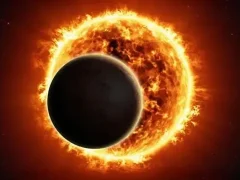


In a rare study, Chinese researchers have warned that future conflicts on Earth could extend to the lunar surface and the surrounding space. The study indicates that the vast region between Earth and the Moon – known as ‘cislunar space’—could emerge as a new theater of potential conflict in the future space race.
Researchers from Northwestern Polytechnical University in Xi’an, China, have identified a high-risk zone within cislunar space. This expansive region, influenced by the combined gravitational pull of Earth and the Moon, extends well beyond Earth’s orbit.
According to the researchers, spacecraft could exploit the Moon’s complex gravitational environment to mask their positions, follow unpredictable trajectories, and station themselves near critical ‘choke points.’ Such maneuvers could create opportunities to intercept adversary spacecraft or seize control of vital space corridors.
The Chinese study suggests that future space conflicts may not always involve direct military strikes. Instead, strategies of ‘non-kinetic deterrence’—pressuring an adversary without direct physical impact—could become crucial. Through these methods, a nation could compel an opponent to alter a spacecraft’s trajectory, delay a mission, miss a launch window, or incur additional costs.
Dang Zhaohui, the study’s lead author and an associate professor at Northwestern Polytechnical University’s School of Astronautics, noted that a country could force an adversary to change course, delay a mission, abandon a launch opportunity, or bear extra expenses without resorting to direct force. He emphasized that the competition for cislunar orbits is not merely about specific spacecraft, orbits, or flight paths; rather, the critical factors are the capabilities to access, control, and utilize space, as well as the ability to deter adversaries.
The study also outlines six potential types of conflict. These include pursuit and evasion, offense and defense, blockade and counter-blockade, as well as deception and detection. Researchers have also warned that monitoring spacecraft movements and activities across the vast cislunar space is extremely difficult; consequently, responding to potential threats might require making decisions based on incomplete information.
According to Chinese researchers, this situation could increase the risk of miscalculation or erroneous decisions. As a result, the Moon and its surrounding space could evolve into a critical arena for strategic competition among major powers, rather than remaining solely a domain for scientific research.