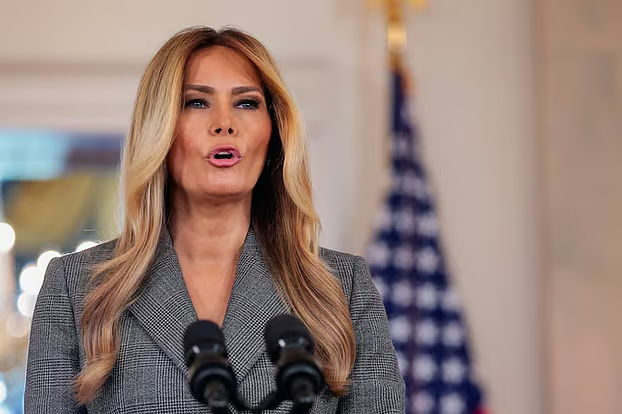
US First Lady Melania Trump made a statement regarding the Jeffrey Epstein scandal and the Trump family’s connection to the late sex offender. Delivered while standing at the White House’s main entrance on April 9, her remarks took Washington by surprise.
Until then, the Trump administration had been blocking the release of full records related to Epstein for months. Yet, in her statement, Melania publicly sided with the victims. At the same time, she indirectly supported the bipartisan effort in Congress demanding the release of classified documents concerning Epstein.
Now, a senior advisor to the First Lady has explained why Melania spoke out publicly on the matter, despite President Trump’s reticence.
Give these victims the opportunity to testify under oath before Congress. Every woman should have the chance to tell her story publicly.
Senior advisor Mark Beckman told the US-based media outlet Politico, “This was an opportunity to officially state for the record that she [Melania] had—and still has—no relationship with Jeffrey Epstein.” He added, “That is why Melania wanted to position herself as a supporter and voice for the victims. She also urged Congress to allow victims to appear before the body and formally place their accounts on the record if they wished.”
In that April statement, Melania said she had never been friends with Epstein, nor had she been harmed by him. She stated that she had neither witnessed any of Epstein’s crimes nor been involved in them in any way. She also denied claims that Epstein had introduced her to Donald Trump.
Additionally, Melania called on Congress to hold public hearings to hear directly from the victims. She said, “Give these victims the opportunity to testify under oath before Congress.” “Every woman should have the opportunity to tell her story publicly.”
That same month, an organization representing Epstein’s surviving victims alleged in a statement that Melania was effectively placing the burden of securing rights—and the burden of proof—squarely on the victims’ shoulders.
While Melania’s statement drew praise, it also faced criticism. That same month, an organization representing Epstein’s surviving victims alleged in a statement that Melania was effectively placing the burden of proving their case—and securing their rights—on the victims themselves. Yet, in 2025, despite objections from President Trump, Congress had compelled the Department of Justice to initiate the process of releasing Epstein-related documents.
The organization stated, “The First Lady is placing this burden on victims within a political climate where powerful institutions—such as the Department of Justice, law enforcement agencies, prosecutors, and the Trump administration—have yet to fully implement the ‘Epstein Files Transparency Act’.”
“This was an opportunity to officially place on the record that she [Melania] had—and still has—no connection to Jeffrey Epstein.”
Mark Beckman, Senior Advisor to Melania Trump
However, many praised Melania’s stance.
Representative Nancy Mace, who has herself spoken about being a victim of sexual assault, wrote on the social media platform X: “As a survivor, I say this is not a political issue; it is personal. It is truly a historic moment when the First Lady of the United States calls for justice for Epstein’s victims. These women deserve the chance to have their voices heard. Today, they got that chance.”
Meanwhile, the Department of Justice remains adamant about not releasing certain Epstein-related documents. They argue that withholding this information is necessary to protect the victims’ privacy.
Following the First Lady’s remarks, Trump told The New York Times, “I have no problem with it. I didn’t know what she was going to say. I just knew she was going to issue a statement.”
Despite a federal judge’s order, the U.S. Department of Justice continues its legal battle, refusing to release classified documents related to Epstein. A U.S. federal judge has issued a clear directive to the Department of Justice requiring the disclosure of the unredacted versions of Epstein’s investigation files—specifically the parts previously released with blacked-out sections. If they fail to do so, they must provide specific legal and logical grounds for maintaining the secrecy.