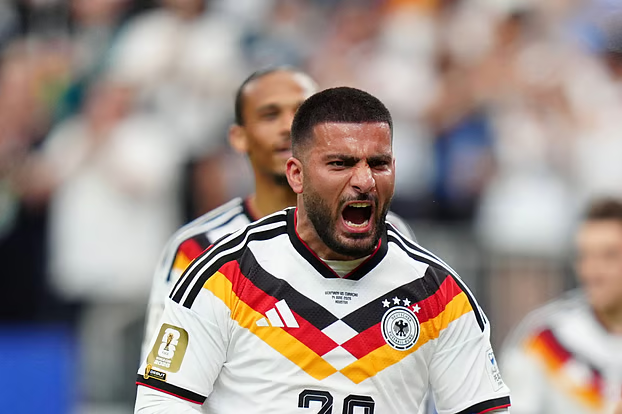
Deniz Undav has scored after coming on as a substitute in both of the first two World Cup matches. (Instagram/Undav)
He had to wake up at 4 AM. He had to go to the factory. After operating a laser machine for eight straight hours, he would rush to training. He wouldn’t return home until 8 PM. Such was the daily routine of 17-year-old Deniz Undav.
That very boy is now, 12 years later, the hero who has propelled Germany into the World Cup knockout stage.
Germany is a four-time world champion and a perennial contender for the title. Yet, Germany’s qualification for the knockout stage this time is no small feat. Since winning the trophy in the 2014 World Cup, the European side had failed to reach the knockout stage, exiting in the group phase in the last two tournaments. This time, the Germans overcame that hurdle thanks to Undav. And how did it happen?
On Saturday night at Toronto’s BMO Field, Germany was trailing 1-0 against Ivory Coast when Undav stepped onto the pitch. What followed was the stuff of dreams. In the 68th minute, he equalized with a left-footed volley off a cross from Nadiem Amiri; then, in stoppage time, he received the ball at the edge of the box and fired a powerful shot into the net to make it 2-1. With Undav’s brace, Germany advanced to the World Cup knockout stage.
Undav had also scored in Germany’s opening match against Curaçao—again, after coming on as a substitute. In total, he has recorded three goals and two assists in two matches after coming off the bench. This ties the record for the highest number of goals by substitutes in a single tournament since 1966. The list includes only two names: Roger Milla (1990) and Undav (2026).
Yet, just a few years ago, Undav was known for something entirely different. He used to work in a factory for a weekly wage of 120 pounds.
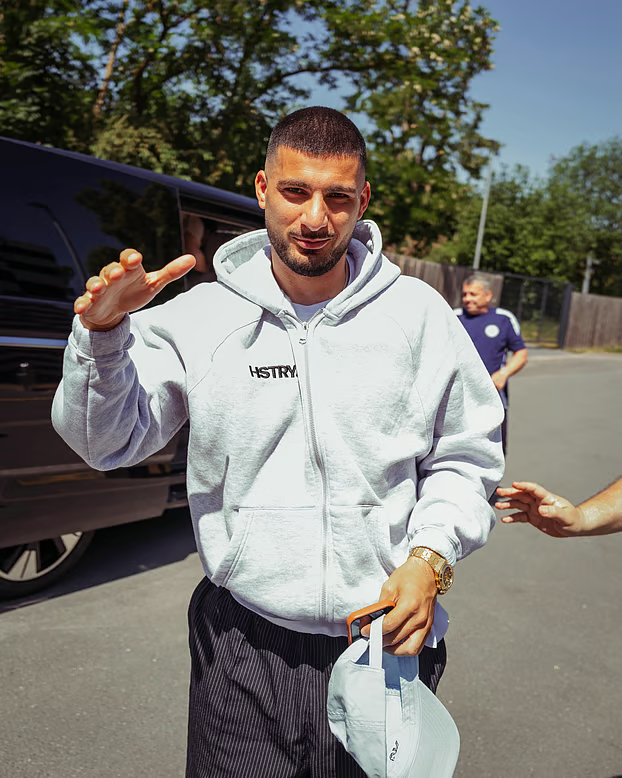
Undav grew up in the small German town of Achim. Born into a Kurdish-Yazidi family, Undav’s parents had immigrated to Germany from the Turkey-Syria border region. The youngest of five siblings, Undav had a passion for football from childhood.
While playing for the local club TSV Achim, he earned a spot in Werder Bremen’s academy in 2007. However, Bremen released him in 2012 because he was considered too short.
It was difficult for him to come to terms with that at the time. In a later interview with the Belgian media outlet 7sur7, Undav said, “When Werder [Bremen] told me I had no future there, I was deeply hurt. But I didn’t give up hope.”
Undav certainly didn’t give up hope, though the road ahead was rocky.
At the age of 17, Undav left his family to join the German fourth-division club TSV Havelse. As it was a lower-tier club, the meager earnings from football weren’t enough to make ends meet. So, Undav took a factory job: “I used to operate a laser machine for eight hours a day. I’d wake up around 4 AM, go to the factory, and then head to training. I’d return home around 8 PM… and the whole routine would start over the next day.”
He spent the next few years playing in Germany’s lower-tier leagues—Havelse, Braunschweig’s second team, and then Meppen. Top-flight football still seemed like a distant dream.
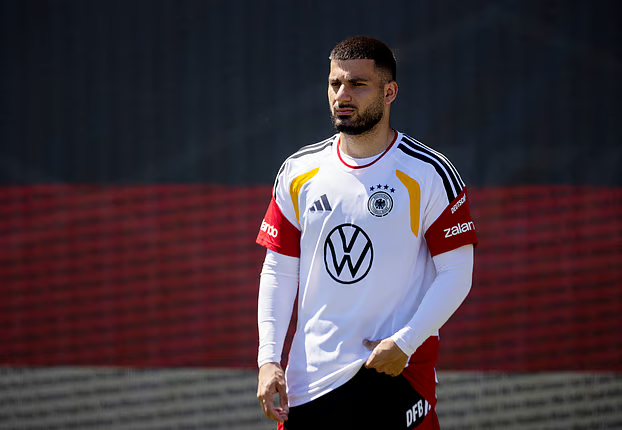
A turning point arrived in 2020 when Undav joined the Belgian second-division club Union Saint-Gilloise. It was a new country and a new environment, and Undav seemed to discover a new version of himself. He scored 18 goals in 29 matches during his debut season, helping Union SG earn promotion to the Belgian top flight. The following year, he netted 26 goals in 39 matches in the Belgian Pro League, winning awards for both the league’s top scorer and best player. From there, there was no looking back. After arriving at Stuttgart via Brighton, Undav established himself as one of the Bundesliga’s finest forwards.
He scored 19 goals in the 2025-26 season—ranking second in the Bundesliga only to Harry Kane and topping the list among German players.
However, Undav’s journey with the national team was not exactly smooth—particularly leading up to the World Cup.
Last March, Undav came off the bench to score the winning goal against Ghana but landed in hot water after expressing a desire to be in the starting lineup. Coach Julian Nagelsmann even remarked that had he started the match, that goal might never have happened.
Nagelsmann later expressed regret over the comment, yet questions remained about whether Undav would secure a spot in the World Cup squad due to the friction.
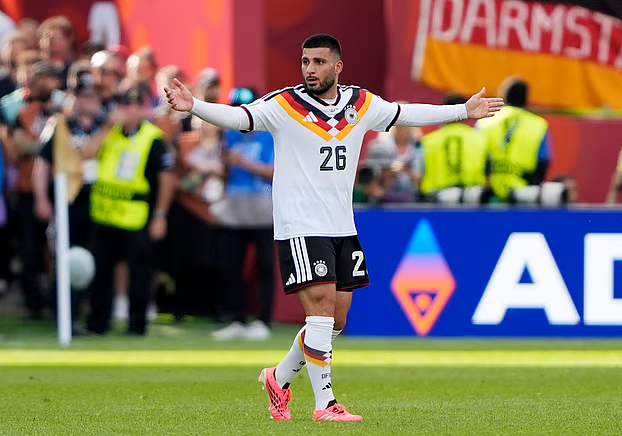
Undav did make the squad; coming off the bench against Curaçao, he contributed a goal and two assists, while a brace against Ivory Coast helped secure the team’s place in the Round of 32. After the match, a journalist asked the German coach if Undav might start in the final group game against Ecuador.
Nagelsmann’s reply: “Yes, absolutely.”
The coach, who had been hesitant just months ago, now says, “Why would I stifle his momentum? He could well be in the starting lineup.”
Undav, 29, celebrates his birthday on July 19—coincidentally, the day of the World Cup final.
Could the boy who was told at 14 he wasn’t tall enough, and who at 17 used to wake up at 4 a.m. to head to the factory, dream of winning the World Cup on his birthday?
Undav’s story suggests he can.