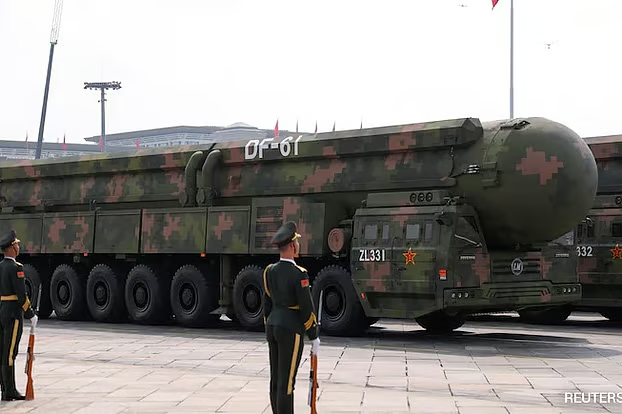
The number of nuclear weapons in a usable state has risen to 9,745. File photo: Reuters
Global spending on the production, maintenance, and development of nuclear weapons surged to a record high last year. Concurrently, nuclear-armed nations shifted more warheads from their stockpiles to active delivery systems. Experts revealed this information on Tuesday.
A research report by the International Campaign to Abolish Nuclear Weapons (ICAN)—a global coalition working to eliminate nuclear arms—stated that the nine nuclear-armed nations collectively spent approximately $119 billion on their arsenals last year, a 19 percent increase compared to the previous year.
ICAN’s report warns, “We are now on the brink of a new nuclear arms race.”
Yesterday (Monday), the Stockholm International Peace Research Institute (SIPRI) released a separate research report warning that nuclear risks are escalating amidst heightened geopolitical tensions. ICAN echoed similar concerns.
Both studies indicate that various nations are modernizing their nuclear arsenals and preparing to deploy more weapons, driving the rapid rise in spending.
Susi Snyder, ICAN’s programme director and co-author of the latest report, described this expansion of nuclear arsenals as alarming. She noted that the integration of artificial intelligence (AI) could further heighten the risk of nuclear weapon use. “To be honest, I am terrified,” she told AFP.
Risks and Trends
SIPRI’s report notes that the total number of nuclear warheads worldwide has been declining for decades; by the beginning of this year, the figure had dropped to 12,187. However, the organization warned that the number of nuclear weapons in a state of operational readiness has risen to 9,745. SIPRI Director Karim Haggag told AFP, “Even though the number of nuclear weapons is decreasing, the level of nuclear danger and risk is rising.” He noted that the weakening of strategic arms control regimes and growing competition among nuclear-armed nations are major causes for concern.
SIPRI forecasts that the global nuclear arsenal could expand again in the coming years. This is because the pace of dismantling old weapons is slowing down, while the deployment of new nuclear weapons is accelerating.
Currently, the United States and Russia hold approximately 83 percent of the world’s total nuclear arsenal. Together, the two nations possess more than 5,000 nuclear warheads.
According to SIPRI estimates, China is expanding its nuclear arsenal more rapidly than any other country. The nation currently possesses around 620 warheads.
Karim Haggag stated, “Growing geopolitical competition is encouraging China to rely more heavily on nuclear weapons.”
An ICAN report indicates that alongside the United States, Russia, and China, other nuclear-armed nations—Britain, France, India, Israel, North Korea, and Pakistan—have all increased investment in their arsenals.
Susi Snyder, Programme Director at ICAN
Last year, these nine nations collectively spent approximately $17 billion more than in the previous year. The United States incurred the highest expenditure.
According to ICAN data, the United States spent $69.2 billion on its nuclear weapons program, an increase of $12.4 billion over the previous year.
China follows the United States in terms of spending, having spent approximately $13.5 billion last year. Britain ranks next with an expenditure of $12.6 billion, while Russia spent around $9.5 billion.
Over the past five years, these nine nations have collectively spent more than $470 billion on their nuclear arsenals. Researchers predict that this spending will continue to rise in the future.
Looking at long-term plans, ICAN notes that Britain, France, and the United States plan to spend vast sums on developing and maintaining nuclear weapon systems well into the coming century. Other nations are also introducing new, long-lasting weapons systems.
The report notes that the US’s planned new ‘Sentinel’ intercontinental ballistic missile could remain operational beyond the year 2100. Meanwhile, plans to increase plutonium production suggest that current warheads could be kept viable until 2120. This will require vast sums of money.
Researchers estimate that US spending on its nuclear weapons sector alone could approach $1 trillion between 2025 and 2034.
Researchers point out that this massive expenditure is occurring at a time when humanitarian aid efforts worldwide are facing a funding crisis. By their calculations, the amount spent on nuclear weapons in a single day last year could have ensured food security for over two million people.
Susi Snyder states that instead of spending funds on aid or healthcare for their own citizens, nuclear-armed nations are investing in arsenals—knowing full well that using them would constitute war crimes.