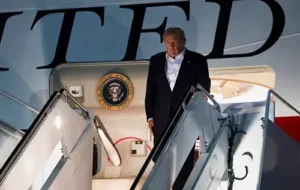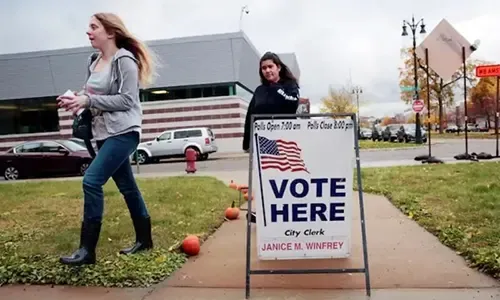
National opinion polls ahead of the US midterm elections in November show Democrats holding a slight lead over Republicans. This election could significantly impact President Donald Trump’s ability to implement his policies during the second half of his term. A combined analysis of recent national “generic congressional ballot” polls published by The New York Times indicates that Democrats are leading by margins of 1 to 6 percentage points in most surveys, with an even wider lead in one specific poll. Dawn Online reported this news.
In such polls, voters are asked which party they would support for Congress, without specifying particular candidates. According to the US Vote Foundation, midterm elections take place halfway through the president’s four-year term. In 2026, voters will cast ballots for all 435 seats in the House of Representatives and 35 of the 100 Senate seats. The foundation noted that the composition of Congress—and which party holds the power to enact legislation, support presidential decisions, or alter/reject them—significantly influences the administration’s success.
Congress serves as the legislative branch of the US government and acts as a powerful check on presidential power. A Congress controlled by the opposition party can block the president’s legislation, launch investigations, and make policy implementation difficult. Historically, midterm elections have proven challenging for the president’s party. The US Vote Foundation states that voters generally desire change; consequently, the president’s party typically loses seats in midterm elections—a trend observed in 20 of the last 22 midterm contests.
Current opinion polls appear to be following this historical pattern. President Donald Trump’s approval rating remains weak by historical standards. According to The New York Times‘ polling average, his approval rating stands at 38 percent, with a disapproval rating of 58 percent. Meanwhile, an Economist/YouGov poll shows his approval at 35 percent and disapproval at 60 percent.
Political analysts have long maintained that there is a strong correlation between a president’s popularity and the outcome of midterm elections. The 2026 election is taking place at a time when debates regarding the health of American democracy are intensifying. According to analysts, reactions to domestic and international policies—including the conflict with Iran—could influence voter sentiment. The Washington Post recently reported that the Trump administration has taken several controversial steps, including the redrawing of electoral districts, changes to voting procedures, and legal actions against political opponents.
The Campaign Legal Center, a Washington-based human rights and voting rights organization, has warned that democracy is at risk and that effective measures are needed to ensure fair elections. In the United States, House of Representatives seats are allocated based on districts; consequently, the boundaries of these electoral districts significantly impact election outcomes. As a result, a lead for Democrats at the national level does not always guarantee a majority in Congress.
Analysts believe that the balance of power in the 2026 election will be determined by a few highly competitive districts, where local issues, the candidates themselves, and voter turnout will play pivotal roles. With several months remaining before the election, factors such as the economy, international crises, the president’s popularity, and voter participation could still significantly alter the outcome. However, the current landscape points to a familiar political pattern: an unpopular president, a strong opposition party, and a midterm election with the potential to shift the balance of power.