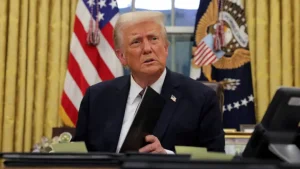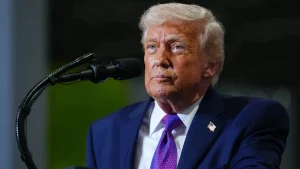
U.S. President Donald Trump may have won every skirmish against Iran. However, three months after launching attacks against the Islamic Republic, he now faces a major question: Is he, in reality, losing the war?
Needless to say, the Strait of Hormuz remains under Iranian control. Nor are they making any concessions regarding their nuclear activities. Furthermore, the country’s government remains intact. In light of this, doubts are mounting as to whether Trump can—or ever will be able to—frame the U.S. military successes as a significant geopolitical victory.
Trump repeatedly claims total victory; yet, analysts argue that these claims ring hollow. Both nations now stand at the precipice of uncertain diplomacy. Trump frequently issues threats of fresh attacks, while Iran warns that should an attack occur, it will retaliate across the entire region.
Trump now faces a significant risk: once the conflict concludes, the position of the United States and its Arab allies could end up being worse than before. Conversely, even if Iran suffers military and economic blows, its regional influence could actually expand—for it has demonstrated that, should it choose to do so, it possesses the capability to disrupt one-fifth of the world’s energy supply.
This crisis is far from over. Some experts believe Trump may yet find a way to save face—though this remains contingent upon negotiations tilting in his favor.
Others, however, foresee a dire post-conflict scenario for Trump.
Aaron David Miller—a former Middle East negotiator who served under both Republican and Democratic administrations—observes: “We are three months in, and it appears that what was planned as a short-term, easy victory for Trump is now morphing into a long-term strategic failure.”
This is particularly critical for Trump, given that he has always viewed the label of a “loser” as the ultimate indignity—a derogatory term he frequently employs to disparage his adversaries.
As Commander-in-Chief of the world’s most powerful military, Trump has discovered—amidst the unfolding crisis with Iran—that he stands confronted by a second-tier power; a power that, by all appearances, remains convinced that it is they who hold the upper hand. Trump still does not know where this war will end. However, he is in no way inclined to concede defeat. Nor does he wish to return to the nuclear deal forged during the Obama era. Analysts suggest that he views any form of retreat as a defeat.
Meanwhile, White House spokesperson Olivia Wells stated that, through “Operation Epic Fury,” the United States has achieved all its military objectives. She further added that President Trump holds all the cards; he has prudently kept every option open.
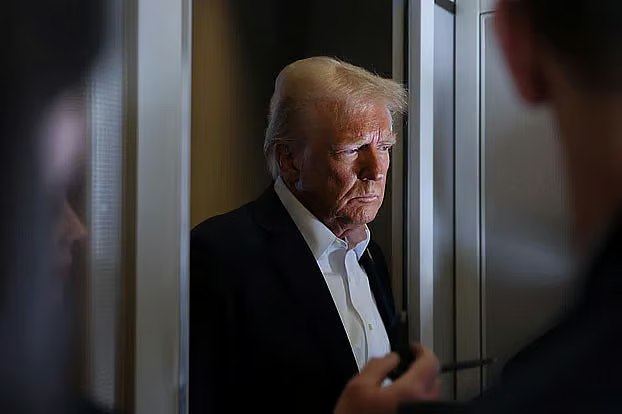
Pressure and Frustration
While campaigning for a second term, Trump pledged to put an end to unnecessary military interventions. Yet, he has entangled the United States in a complex conflict—one that could inflict lasting damage upon his foreign policy and his credibility on the global stage.
Amidst this standoff, Trump finds himself under mounting pressure, grappling with high domestic fuel prices and a precipitous decline in his popularity. His public approval ratings have plummeted following his entanglement in this unpopular war ahead of the midterm elections in November. His party—the Republicans—is also struggling to retain control of Congress.
Consequently, six weeks after the ceasefire went into effect, analysts believe Trump faces a difficult road ahead. His choices boil down to two options: accepting a compromise—however unpalatable—or pursuing a military course and risking a prolonged crisis.
Should diplomacy collapse, one of his potential alternatives would be to launch a limited yet intense strike, frame it as a decisive victory, and then withdraw from the scene. Another possibility is that he might pivot his focus to Cuba in an attempt to divert attention and secure a comparatively easier victory.
However, even there, he risks misjudging the challenges posed by Havana. As several of his aides have privately acknowledged, during the operation against Iran, he mistakenly assumed it would unfold much like the operation in Venezuela—the January 3rd operation in which the country’s President, Nicolás Maduro, was targeted for capture in Caracas.
Nevertheless, Trump is not without his supporters. One such figure is Alexander Gray. The CEO of American Global Strategies, Alexander served as an advisor to President Trump during his first term. Alexander is unwilling to concede that Trump is failing in his campaign against Iran. In his view, dealing a severe blow to Iran’s military capabilities constitutes a “strategic success.” Furthermore, this conflict has drawn the Gulf nations closer to the United States while distancing them from China. Moreover, the future of Iran’s nuclear program remains undetermined.
At the same time, signs of frustration are becoming apparent in Trump. He has lashed out at critics and labeled the media as “treasonous.”
Following the commencement of attacks on Iran, he had set a maximum timeframe of six weeks to bring the conflict to a close. However, the hostilities have dragged on for twice that duration. While MAGA supporters continue to stand by Trump, Republican lawmakers no longer offer him the same level of support they once did.
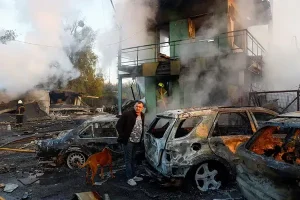
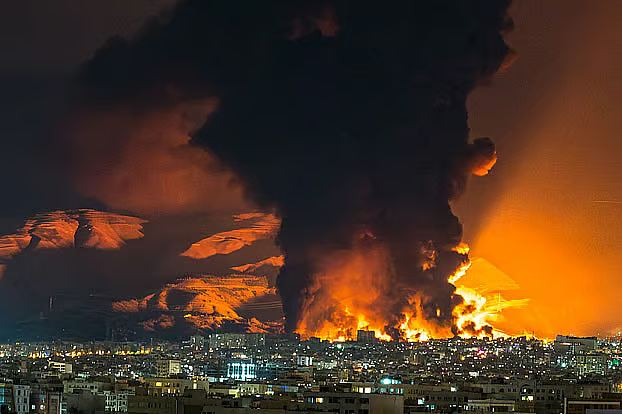
In the initial stages, airstrikes swiftly inflicted damage upon Iran’s ballistic missile arsenal, decimated a significant portion of its naval fleet, and resulted in the deaths of numerous top-ranking leaders. However, in a retaliatory move, Tehran blockaded the Strait of Hormuz, thereby driving up fuel prices. Subsequently, Trump ordered a blockade of Iran’s ports; yet, even this measure failed to bring Tehran to its knees.
Shifting Objectives, Uncertain Outcomes
Trump stated that the objectives of the conflict were to block Iran’s path to acquiring a nuclear bomb, to eliminate threats to regional and U.S. interests, and to oust the Iranian regime.
However, there are no signs that these objectives have been met. Nor do analysts see much likelihood of them being achieved.
Jonathan Panikoff, a former U.S. intelligence official specializing in the Middle East, observes that even though Iran has suffered significant losses, it views the situation as a success; this is because it has managed to survive and has learned the extent to which it can exert control over shipping traffic in the Gulf. In his view, Iran believes it can withstand economic pressure better than Trump can sustain it.
Trump’s primary objective—the nuclear disarmament of Iran—remains unfulfilled. Tehran has shown little inclination to curtail its nuclear program.
It is believed that stockpiles of highly enriched uranium remain buried underground, capable of being retrieved and further enriched to weapons-grade levels. Iran maintains that it seeks the right to enrich uranium solely for peaceful purposes.
Compounding the complexity of the situation, Iran’s Supreme Leader has issued a directive prohibiting the shipment of enriched uranium abroad.
According to some analysts, this conflict could, paradoxically, further incentivize Iran to pursue the development of nuclear weapons—much as North Korea did to ensure its own security.
Another of Trump’s objectives—to halt Iran’s support for armed proxy groups across the Middle East—also remains unachieved.
Furthermore, he now faces a new Iranian leadership that has adopted an even more hardline stance. Even in the aftermath of the conflict, they retain substantial arsenals of missiles and drones, which continue to pose a threat to their neighbors.
Concurrently, U.S. relations with its European allies are deteriorating. These allies refused to stand alongside the United States in this conflict, largely because they were not consulted prior to its commencement.
Robert Kagan, a senior fellow at the Brookings Institution, suggests that the current situation could deal a far greater blow to the United States’ global standing than did the wars in Vietnam or Afghanistan. In a recent article, he wrote: “There is no going back to the way things were before.” “No ultimate U.S. victory will emerge that can compensate for these losses.”
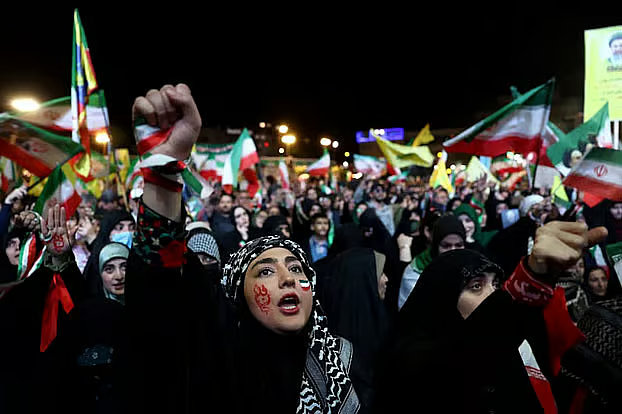
— Iran Claims: The Cause Lies in U.S. Obstinacy
A ceasefire was initiated in early April with the aim of ending the conflict that began on February 28, when the United States and Israel jointly launched attacks on Iran. Subsequently, although negotiations for a permanent agreement have been underway through the efforts of mediators, they have yet to come to fruition.
Iran’s delegation to the United Nations has held Washington responsible for the failure of these talks. They assert that the peace negotiations are on the verge of collapse due to the United States’ obstinacy.
Amidst this backdrop, various reports suggest that—should an agreement fail to materialize—President Trump’s administration is preparing to launch fresh attacks on Iran.
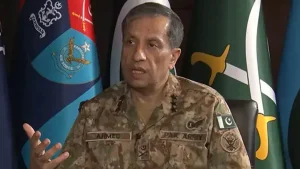
Pakistan’s Chief of Army Staff, Asim Munir, arrived in Tehran on Friday. He held a meeting with Iran’s Deputy Foreign Minister, Abbas Araqchi, that continued late into the night.
According to a post on Araqchi’s Telegram channel, the two officials discussed ongoing diplomatic efforts aimed at de-escalating tensions and averting a renewed outbreak of hostilities.
Meanwhile, President Trump confirmed on Friday that he would be unable to attend even his own son, Donald Trump Jr.’s, wedding. He is required to remain in Washington to attend to urgent government duties. This decision has fueled speculation that the current situation remains extremely delicate.
The U.S. President has characterized the discussions held this week as standing at a “crossroads.” In other words, the outcome will now be either the signing of a peace agreement or the resumption of attacks.
However, Ismail Baghai, the spokesperson for Iran’s Foreign Ministry, cautioned that Asim Munir’s visit does not signify that all issues have been resolved. According to ISNA, an Iranian news agency, significant differences of opinion still persist between the two sides.