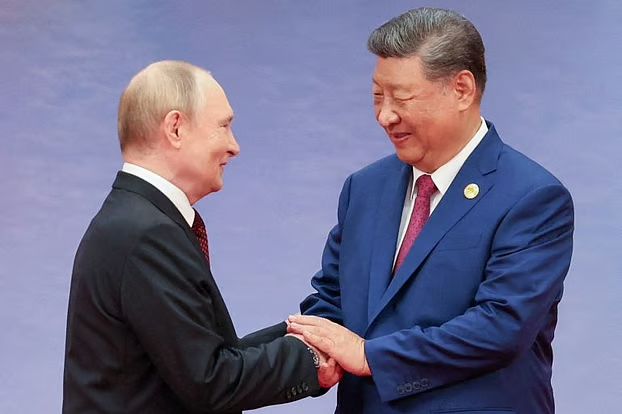
Russian President Vladimir Putin arrived in Beijing on Tuesday night. His primary official engagement will be to join Chinese President Xi Jinping in commemorating the 25th anniversary of a long-standing treaty. This agreement is formally known as the ‘Treaty of Good-Neighborliness and Friendly Cooperation,’ originally signed in 2001.
However, analysts suggest that the meeting between Xi and Putin on Wednesday morning holds far greater significance. Furthermore, the timing of this visit is particularly noteworthy.
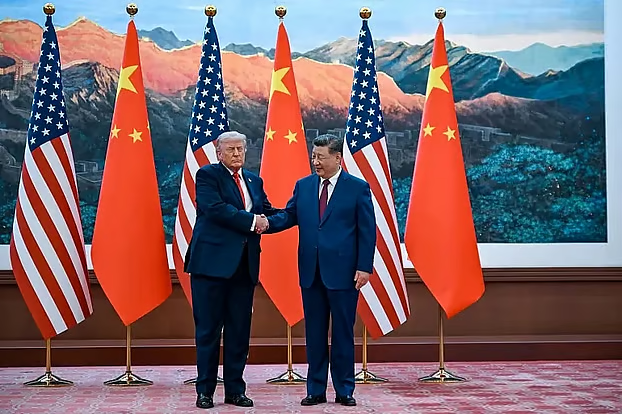
Just last week, U.S. President Donald Trump met with President Xi Jinping in China. The announcement of Putin’s visit came merely one day after Trump had departed Beijing.
Although Trump touted the prospect of a broader trade deal, there was virtually no indication of any significant progress regarding the most contentious issues between the United States and China. These contentious issues include Taiwan and the potential for a U.S.-Israeli strike against Iran.
According to analysts, this timing is highly advantageous for Putin. He is able to travel to Beijing with the confidence that China harbors no plans to sideline Russia.
For Beijing, on the other hand, this succession of visits serves as a major demonstration of its increasingly advantageous diplomatic standing. This diplomatic leverage is positioning China as a central power—one capable of engaging with rival powers entirely on its own terms.
Driven by a shared perspective regarding Western sanctions and a view of Trump’s foreign policy as ‘reckless,’ Putin and Xi have forged a robust partnership. The Russian President’s current visit is unlikely to bring about any major shifts in this dynamic.
Nevertheless, analysts argue that the very timing of this visit clearly illustrates how Beijing is consolidating its position at the epicenter of an increasingly fragmented global order.
‘Putin Needs This More Than Xi Does’
Despite China’s efforts to expand its influence, no major policy decisions are expected to emerge from Putin’s visit; rather, it is viewed as a continuation of their ongoing strategic relationship. Marina Miron, a post-doctoral researcher in Defence Studies at King’s College London, told Al Jazeera, “I don’t think any major changes are going to take place here.”
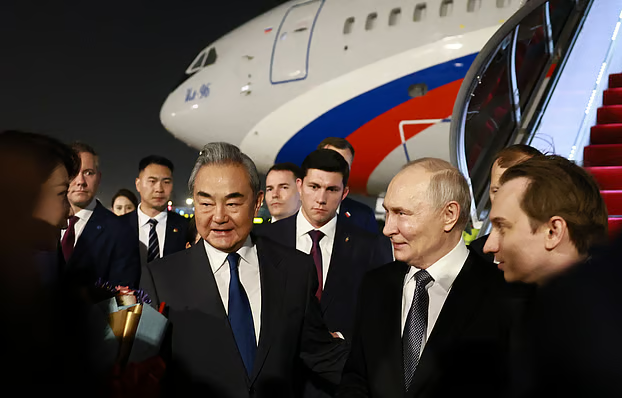
Miron further added that their bilateral relationship is set to deepen in areas such as economic cooperation, trade and commerce, the exchange of military technology, and similar matters.
Oleg Ignatov, a senior Russia analyst at the International Crisis Group, echoes this sentiment. He told Al Jazeera, “The relationship between these two countries is primarily strategic. They are partners—strategic partners—but not military allies. And I do not believe they will go any further than that.”
Ignatov further noted that the relationship between Russia and China is highly stable and holds immense importance for both nations. There are no negative aspects to this relationship.
Both countries are expected to push forward with joint projects, particularly those within the energy sector.
Researcher Marina Miron observed that China seeks to acquire Russia’s energy resources at a “discount.” Conversely, Russia relies on Chinese technology—specifically that which is applicable for both civilian and military purposes—for the production of drones.
Nevertheless, this meeting holds greater significance for Putin. Timothy Ash, a fellow in the Russia and Eurasia Programme at Chatham House, told Al Jazeera that Putin needs this far more than Xi does. Following Putin’s devastating war in Ukraine, Russia has now been reduced to a smaller, dependent partner. Putin may be hoping to secure increased military assistance from China.
Timothy Ash further noted that, much like Trump visited Beijing in the hope of gaining something, Putin is making this trip for precisely the same reason. All the cards, he observed, are now in China’s hands.
However, Ignatov of the Crisis Group cautioned against viewing this relationship solely through the lens of power dynamics, arguing that the fundamental driver behind the two nations’ conduct is their shared objective of establishing a multipolar global order.
“Both sides state that… they are working to build a multipolar world,” Ignatov said. “Consequently, they do not believe there should be a single dominant power in the world capable of dictating terms to other nations. They do not view international relations through that [unipolar] prism.”
A ‘Neutral Superpower’ Against the Backdrop of War
What lends particular significance to this series of high-level visits is the fact that they underscore Beijing’s expanding diplomatic influence. Analysts suggest that China is positioning itself as an indispensable mediator within an increasingly fractured international system.
Researcher Marina Miron observed that China is striving to establish itself as a mediator—a form of neutral power—without displaying any overt hostility. She added that, despite its close ties to Russia, China is attempting—at least publicly—to avoid taking sides with any major power.
“In the diplomatic arena,” Miron stated, “China is endeavoring to project an image of neutrality, positioning itself as a kind of ‘neutral superpower.'” She further noted that the ongoing conflict involving the United States, Israel, and Iran casts a shadow over this visit. This conflict has roiled global energy markets—nearly shutting down the Strait of Hormuz in the process—and its economic repercussions are far more profound for China than for Russia. This defense researcher notes that, as Gulf energy competitors find themselves cornered, Russia is benefiting—at least in the short term—from this disruption (the interruption of energy supplies).
However, analysts agree that long-term stability is crucial for Russia as well. Both nations desire to see an end to this conflict, even though they have shared intelligence and technology with Iran.
Timothy Ash of Chatham House points out that Moscow is privately quite pleased with what the Trump-Xi meeting failed to achieve. He observes that China did not grant Trump what he sought—namely, an end to the conflict involving Iran. In this regard, Moscow remains content simply knowing that Beijing is not abandoning either Tehran or itself.
The issue of the war in Ukraine is also almost certain to feature in the discussions during this visit. However, analysts do not believe that China will pressure Moscow to adopt any specific course of action regarding this matter.
Researcher Marina Miron states, “Ukraine will certainly be discussed. China will undoubtedly reiterate its support for mediation and peaceful negotiations.” She adds, “However, China has absolutely no desire to see Russia humiliated. I do not believe China will impose any kind of deadline on Russia regarding this issue.”
While this visit may not yield any significant diplomatic breakthroughs, one thing has become abundantly clear: by hosting the U.S. President one day—and the Russian President immediately thereafter—Beijing has demonstrated that it is a power that simply cannot be ignored.