
Last year, hundreds of companies in the United States raised a combined total of $70 billion by selling shares to the general public.
However, that record could be broken in 2026. This is because several major players—including the rocket and space technology firm SpaceX, ChatGPT creator OpenAI, and AI startup Anthropic—are all likely preparing to make their debut on the stock market.
The question now arises: exactly what process must a company in the United States undergo to become listed on the stock market?
This process is known as an Initial Public Offering (IPO). Typically, completing this process takes anywhere from several months to several years. It can also cost hundreds of thousands of dollars.
How the Process Works
Choosing a Stock Exchange: The first major step for a company embarking on the IPO path is deciding which stock exchange it will list on.
In the United States, two stock exchanges are predominantly the most influential: the New York Stock Exchange (NYSE) and Nasdaq.
The NYSE is the oldest and most renowned stock exchange. Its historic trading floor is located in Lower Manhattan, New York.
Nasdaq, on the other hand, is a fully electronic stock exchange. It is where shares of the world’s largest technology companies are traded.
Together, these two exchanges account for nearly half of the total value of shares traded globally.
When joining a stock exchange, companies must select a “ticker symbol.” This is a short code consisting of a few letters used to identify the company’s shares.
Some companies opt for simple ticker symbols; for instance, Microsoft’s ticker is “MSFT.” Others choose slightly more creative names—such as the donut company Krispy Kreme, whose ticker is “DNUT” (short for “Donut”), or the car rental company Avis, whose ticker is “CAR” (short for “Car”). ‘S-1’ Filing: Before a company can sell shares to the general public, it is required to submit a detailed document—known as an ‘S-1’—to the U.S. market regulator, the Securities and Exchange Commission (SEC).
The SEC is the government agency responsible for overseeing the U.S. financial markets. It effectively serves as the “referee” of Wall Street.
The S-1 document presents detailed information regarding the company’s financial health, business model, and potential risks. Its purpose is to assist retail investors in making informed decisions.
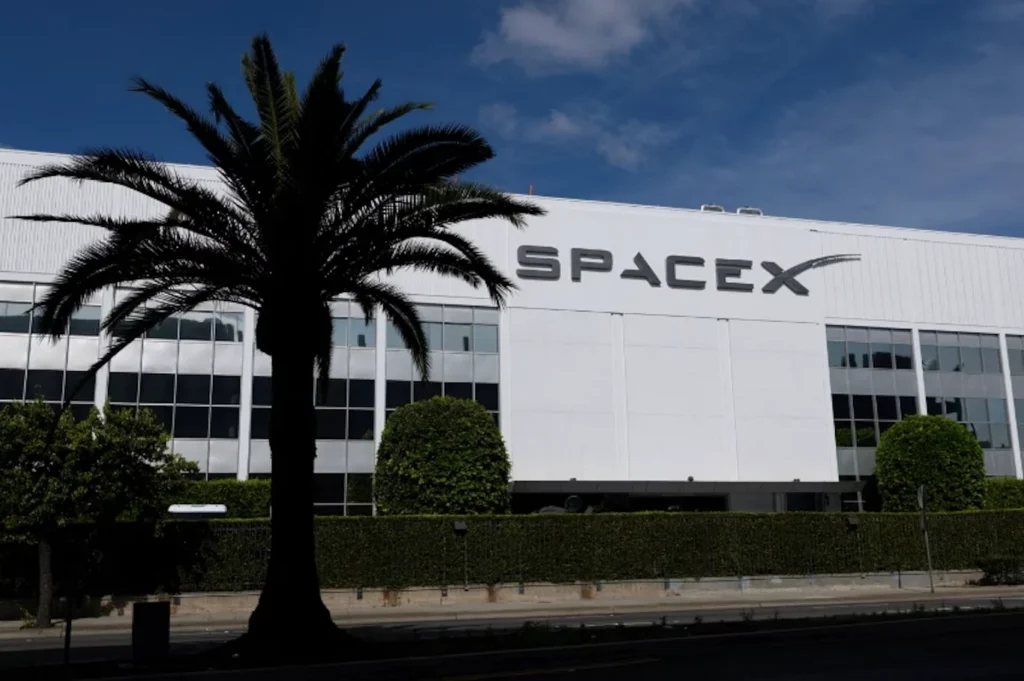
SpaceX building in California, USA
SpaceX building in California, USA | File Photo: Reuters
According to the U.S. multinational investment banking firm JPMorgan Chase, this document serves two primary objectives: to register securities with the SEC and to provide investors with detailed information regarding potential investment opportunities.
Subsequently, the SEC reviews the document. The agency may request the company to provide responses to various inquiries.
SEC Chairman Paul Atkins recently noted that the S-1 filing process often entails facing multiple rounds of comments and questions from regulatory officials. Consequently, the entire process can sometimes take several months to complete.
However, Paul Atkins stated that the agency is actively working to expedite this process.
According to a source familiar with the matter, SpaceX may submit its S-1 filing as early as this week.
Investment Outreach: Once the necessary paperwork is underway, the company’s top executives embark on a promotional campaign. They travel from city to city to present their company’s plans and potential to prospective investors. These presentations are also conducted via video calls. This entire process is referred to as a “roadshow.”
In addition to large institutional investors—such as pension funds and hedge funds—companies also showcase their potential to individual retail investors.
According to the U.S. media outlet CNBC, SpaceX is planning to host a special event for approximately 1,500 individual investors this coming June.
However, not every company succeeds in clearing this stage of the process. Fintech firm Clear Street cancelled its IPO plans last February. They cited their inability to generate sufficient investor interest—due to market volatility—as the reason for this decision.
Share Pricing: One of the most challenging aspects of the IPO process is determining the share price. Essentially, this involves establishing the value of a portion of the company’s ownership at the time of its initial listing on the stock market.
According to Matthew Kennedy, an IPO specialist at Renaissance Capital, IPO pricing is not solely a matter of mathematical calculation; industry-specific judgment also plays a crucial role.
The banks advising the company typically aim to raise as much capital as possible. However, they must simultaneously set a price that allows room for the share value to appreciate once trading commences; otherwise, investors may lose interest.
Matthew Kennedy of Renaissance Capital notes, “If you attempt to push the share price to its absolute maximum, demand in the post-listing market could drop significantly. This could potentially lead to a failed IPO. No one wants to see their share price plummet on the very day trading begins, just as the opening bell rings.”
Companies often fail to determine the correct price right from the outset, necessitating subsequent adjustments.
Chip startup Cerebras revised its target price range twice before making its debut on the stock market. Ultimately, they went public with a share price set at $185. Subsequently, on the very first day of trading, their share price surged by 68 percent.