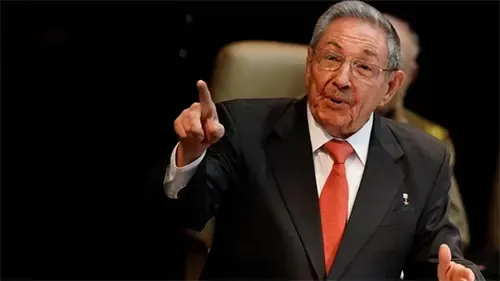
The U.S. Department of Justice is preparing to bring criminal charges against Cuba’s veteran leader, Raúl Castro, in connection with the downing of an aircraft 30 years ago. Filing these charges would require the approval of a U.S. grand jury. Meanwhile, at the same time, the Director of the CIA visited Havana, the Cuban capital, to hold meetings with officials. This news was reported by the BBC online.
The 94-year-old Raúl Castro stepped down from the leadership of the Communist Party of Cuba in 2021. This marked the end of his family’s rule, which had spanned more than 50 years. He led the country for 15 years, assuming power after his brother, the Cuban revolutionary leader Fidel Castro, stepped down. These potential charges against him are being viewed as another component of the United States’ escalating pressure campaign—pressure that includes oil embargoes and sweeping sanctions. The central focus of the charges is the 1996 downing of two aircraft belonging to “Brothers to the Rescue,” a U.S.-based humanitarian and political organization.
Citing officials from the U.S. Department of Justice, the report states that these charges could be filed as early as next Wednesday. When questioned by reporters about the matter on Friday while aboard Air Force One, President Donald Trump stated that the Department of Justice would comment on the issue. He further remarked, “The Cubans need help, as you know. It is a failing country. It really is a country—a deteriorating state.”
Trump has imposed an oil embargo against Cuba, which has further exacerbated the fuel crisis within the country. Earlier this week, Cuba’s Minister of Energy acknowledged that the island nation has effectively run out of fuel oil.
The specific details regarding the potential charges against Raúl Castro remain unclear. However, officials indicate that the investigation centers on the attack that took place on February 24, 1996—a time when Fidel Castro was President and Raúl Castro served as the Minister of the Armed Forces. Four people were killed in that incident. “Brothers to the Rescue,” an organization of Cuban exiles, conducted search-and-rescue missions at sea for migrants attempting to reach the United States from Cuba on rafts; the group had also previously dropped anti-government leaflets over the Cuban coast. The Cuban government stated that the organization had repeatedly violated Cuban airspace.
However, the International Civil Aviation Organization reported that the attack took place over international waters. In March, Florida’s Attorney General announced at a press conference that the state was reopening an investigation into Raúl Castro’s role in the matter.
Florida Governor Ron DeSantis praised this potential indictment as a correct step, albeit a long-overdue one. Cuba has not yet officially commented on the matter. However, the country’s Foreign Minister, Bruno Rodríguez, expressed a firm stance. He asserted that, despite blockades, sanctions, and threats of force, Cuba is sovereignly advancing along its path of socialist development. To bring charges, prosecutors must demonstrate to a grand jury that there are reasonable grounds to believe a crime has been committed. U.S. Acting Attorney General Todd Blanche did not confirm this matter. He told Fox News, “When the time comes to speak on this issue, we certainly will.”
Trump has stated that the United States seeks to change Cuba’s communist leadership. At a recent rally, he remarked that the United States could, if necessary, “take control” of the Caribbean island nation. This island nation is situated just 145 kilometers from Florida. Last Thursday, CIA Director John Ratcliffe met with officials from Cuban intelligence agencies at the Cuban Ministry of the Interior in Havana. Raúl Castro’s grandson, Raúl Rodríguez Castro, was present at the meeting. CIA officials told CBS News that the United States is interested in engaging in discussions regarding economic and security issues; however, such engagement would only be possible if Cuba implements fundamental changes. A statement from the Cuban government described the meeting as an effort to foster dialogue, emphasizing that Havana poses no security threat to the United States.