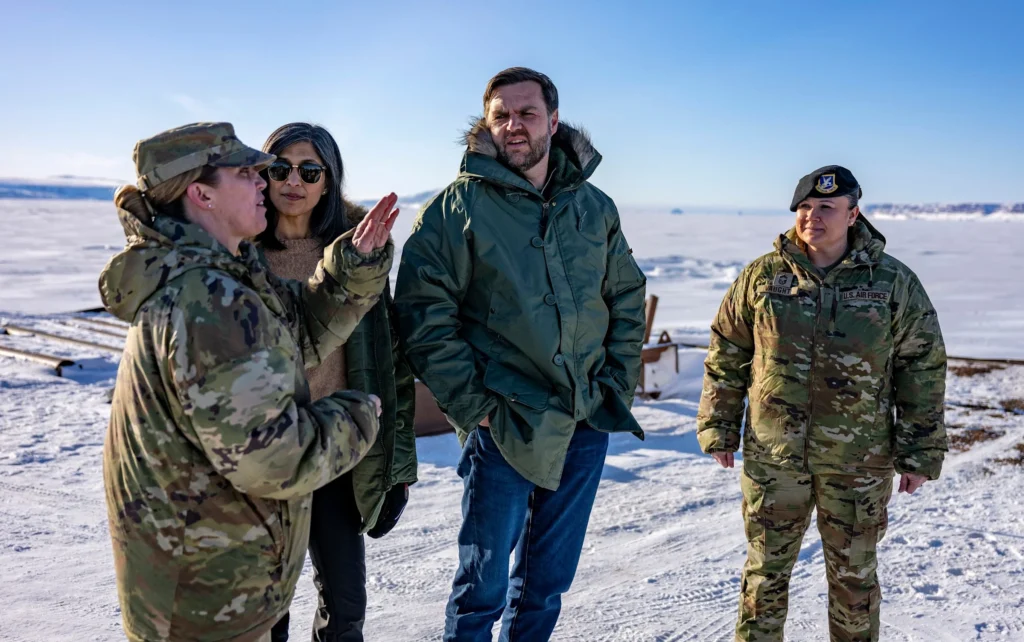
Officials have stated that the bases will be located in southern Greenland and will be used primarily to monitor potential maritime activities by Russia and China. The surveillance zone will encompass the region of the North Atlantic known as the GIUK Gap—the area situated between Greenland, Iceland, and the United Kingdom. Sources indicate that no final agreement has yet been reached, and the number of bases could still be subject to change. One potential site for a base is Narsarsuaq, which previously hosted a U.S. military base and a small airfield. According to analysts, the other new bases will likely be situated in locations that already possess existing infrastructure, such as airfields or ports. This approach would allow for development at a lower cost compared to constructing entirely new facilities.
During the discussions, U.S. officials did not raise the possibility of forcibly seizing control of Greenland. Both Denmark and NATO have publicly rejected such a notion. Despite threats made by President Trump, the two nations have been actively working toward a mutual agreement in recent months. A small team of Washington officials has been conducting these negotiations even while the administration remains preoccupied with the conflict involving Iran. Through these discussions, they have achieved progress away from the public eye. In March, while testifying before Congress, General Gregory Guillot—the head of U.S. Northern Command—provided a general overview of the negotiations, stating that the United States intends to establish new bases. However, sources close to the talks reveal that the negotiations have advanced significantly in recent months through a series of regular high-level meetings.
This sensitive diplomatic initiative is being led by Michael Needham, a senior official at the U.S. Department of State. He has been tasked with crafting an agreement that will satisfy President Trump while simultaneously adhering to Denmark’s stipulations regarding border security. A senior diplomat familiar with the negotiations noted that Needham is the key figure in charge of the Greenland issue. The diplomat further added that, behind the scenes, the administration is handling the matter with a high degree of professionalism.
Since mid-January, the two parties have met on at least five separate occasions. Several sources have indicated that Needham is typically accompanied by one or two officials from the State Department or the National Security Council. On the Danish side, the discussions involve Denmark’s Ambassador to the United States, Jesper Møller Sørensen, and Greenland’s top diplomat in Washington, Jakob Isbosethsen. Trump’s special envoy for Greenland—Louisiana’s Republican Governor Jeff Landry—did not participate in the talks. Three sources stated that his role in the diplomatic process has been virtually non-existent. An individual close to Landry remarked that his role was essentially limited to vociferously advocating that the U.S. should seize Greenland as a security asset by force. He further added that Landry was absent from every meeting involving substantive negotiations. Landry’s office did not respond to a request for comment on the matter.
Currently, the United States maintains a single military base in Greenland. During the Cold War era, however, there were approximately 17 U.S. military installations located there. Thule Space Base, situated in northwestern Greenland, conducts missile surveillance for NORAD, though it is not equipped for maritime surveillance. Several current and former officials, along with Arctic security experts, told the BBC that Washington could have advanced its interests in Greenland without resorting to such harsh rhetoric against a NATO ally.
A former senior U.S. defense official asked, “When an objective can easily be achieved through negotiation, why threaten an allied nation with military action or aggression?” Others, however, have praised the cooperation between the United States and Denmark. Retired General Glen VanHerck—who served as the commander of U.S. Northern Command and the North American Aerospace Defense Command (NORAD) from 2020 to 2024—noted that “wherever the United States and our allies leave a vacuum, China and Russia typically step in to fill it.”
Behind the scenes, negotiators are striving to reach an agreement within the framework of the long-standing security treaty between the United States and Denmark. That 1951 treaty grants the United States extensive latitude to expand its military operations within Greenland. Although any military expansion requires the approval of the Danish government, according to Arctic security experts, Denmark has historically supported U.S. military activities in the region and has never rejected a U.S. proposal for expansion.